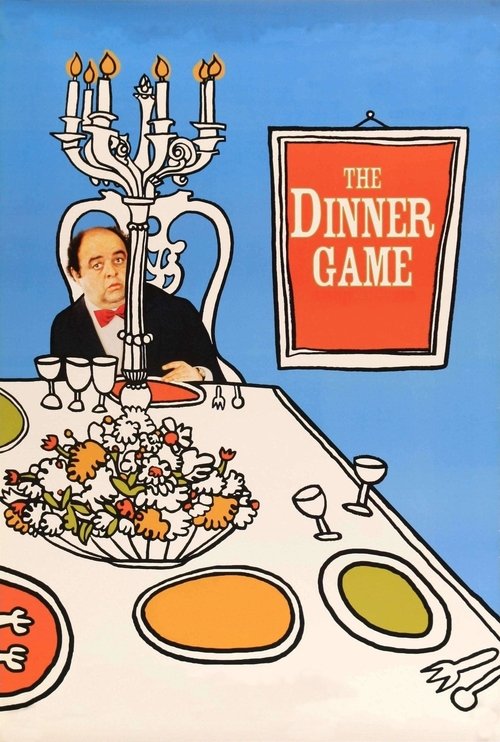
The Dinner Game (1998)
Directed by Francis Veber
No — The Dinner Game is not woke, scoring 7 out of 100 on our wokeness meter.
The Dinner Game arrives from 1998, a French farce adapted from Francis Veber's own stage play, and it carries itself with the tidy confidence of a comedy that ran for nine hundred performances before anyone thought to point a camera at it.
Consciousness Markers
The film gently satirizes the arrogance and cruelty of wealthy Parisian businessmen, and features a tax cheat undone by a tax inspector, but this is farcical class comedy rather than any coherent anti-capitalist thesis.
The cast is entirely white French performers with no diversity-conscious casting choices; the film predates such considerations and makes no effort toward representation.
No LGBTQ+ characters, themes, or subtext appear anywhere in this farce about businessmen and their hapless guests.
Female characters (Christine, Marlène) exist only as plot devices in service of the male protagonist's arc; the film offers no feminist critique or perspective.
No engagement with race or racial politics whatsoever; the film is a homogenous Parisian bourgeois comedy.
No environmental or climate themes are present.
Pignon's physical appearance is openly mocked as part of the joke; the film is the opposite of body-positive.
Pignon's obsessive matchstick-building and social obliviousness are played for ridicule as 'idiocy,' not framed as neurodivergence to be understood or celebrated.
No historical revisionism; the film is a contemporary-set comedy with no historical subject matter.
The film is a brisk farce that never pauses to deliver moral instruction; its mild lesson about humility emerges through slapstick consequence rather than sermonizing.
Why it received this score
The Dinner Game arrives from 1998, a French farce adapted from Francis Veber's own stage play, and it carries itself with the tidy confidence of a comedy that ran for nine hundred performances before anyone thought to point a camera at it. The premise is elegant and cruel: a group of Parisian businessmen gather weekly to bring the most spectacular fool they can find, and the winner is crowned champion. Pierre Brochant believes he has found a masterpiece in François Pignon, a Finance Ministry clerk who builds matchstick landmarks. The evening proceeds to dismantle Brochant's life with mechanical precision.
On the matter of social consciousness, the film is a desert. The cast is uniformly white and Parisian, assembled for comic contrast and nothing else. The women, Christine and Marlène, exist to be misdialed, mistaken, and discarded as the plot requires; the film has no interest in their interiority. Pignon's body is the joke. Reviewers of the day lingered on his balding, spherical head and pudgy mouth, and the film invites exactly that gaze, asking us to laugh at a man for the crime of being shaped wrong. His obsessive matchstick hobby and his social blindness are played as idiocy, never as a mind worth understanding. There is no environmental concern, no racial reckoning, no historical revision, no LGBTQ presence, and no moment where the film stops to instruct us on how to live.
What remains is a faint whiff of class resentment. The businessmen are vain, adulterous, and cheating on their taxes, and a tax inspector arrives to ruin the party. It is satisfying. It is also slapstick with a target, not a thesis. The film's mild lesson about humility arrives through catastrophe, not a pulpit. Ninety minutes of well-oiled cruelty, and then everyone is confused. That is the whole of it.
Analysis generated by our Consciousness Algorithm


Synopsis
For Pierre Brochant and his friends, Wednesday is “Idiots' Day”. The idea is simple: each person has to bring along an idiot. The one who brings the most spectacular idiot wins the prize. Tonight, Brochant is ecstatic. He has found a gem. The ultimate idiot, “A world champion idiot!”. What Brochant doesn’t know is that Pignon is a real jinx, a past master in the art of bringing on catastrophes...
Questions about The Dinner Game
Is The Dinner Game woke?
No — The Dinner Game is not woke, scoring 7 out of 100 on our wokeness meter. That earns it a verdict of Ultra Based.
Does The Dinner Game have any woke elements?
Very few. None of the 10 markers reaches 30, the level where a marker counts as present; the highest is Eat the Rich at 12.
How does The Dinner Game compare to other 1998 movies?
It ranks #67 of the 118 films from 1998 we've scored; their average is 12. The wokest is Show Me Love (60).
How is the Woke Score calculated?
An AI-assisted process researches the film and its reception, scores it 0–100 on ten markers, then combines those into one 0–100 Woke Score. It measures a specific set of 2020s cultural themes, not film quality.