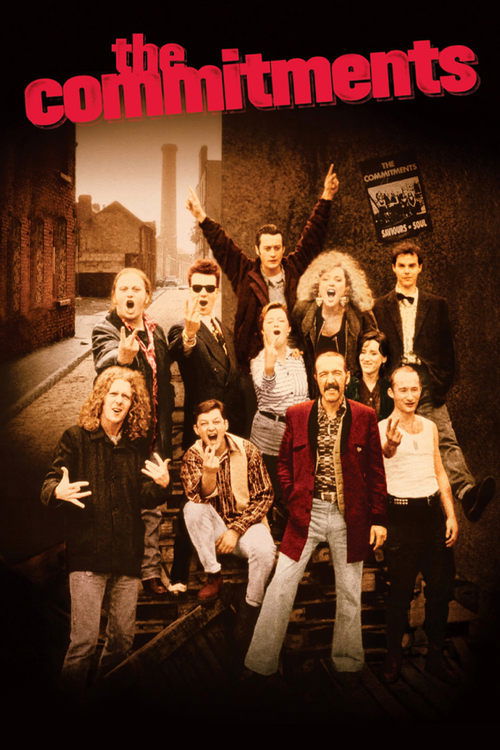
The Commitments (1991)
Directed by Alan Parker
No — The Commitments is not woke, scoring 2 out of 100 on our wokeness meter.
The Commitments arrives from 1991, directed by Alan Parker from Roddy Doyle's novel, and concerns a young Dublin man named Jimmy Rabbitte who assembles a soul band out of his Northside neighbors.
Consciousness Markers
The cast is almost entirely white Irish, with no deliberate inclusive or diverse casting agenda.
No LGBTQ+ characters, themes, or subtext appear in the film.
Female characters are present as backing singers but the film is male-centered and offers no feminist critique or agenda.
The band performs African-American soul music, but the film does not engage with racial justice, systemic racism, or modern racial identity politics.
No environmental or climate-related themes are present.
The film depicts working-class Dublin life but does not advance an anti-capitalist or eat-the-rich message.
No body positivity themes or messaging are present.
No neurodivergent characters or themes are present.
The film is a fictional story and does not revise or reinterpret historical events.
The film is a character-driven musical comedy-drama with no preachy or lecture-like social messaging.
Why it received this score
The Commitments arrives from 1991, directed by Alan Parker from Roddy Doyle's novel, and concerns a young Dublin man named Jimmy Rabbitte who assembles a soul band out of his Northside neighbors. The men are unemployed and the women are the backing vocalists, and the film regards both conditions without editorializing. Poverty here is texture, not thesis. The band rehearses above a snooker hall, acquires its equipment from a black marketeer, and disintegrates with the same casual inevitability with which it came together. Nobody at any point explains to the audience what any of it means.
The film's engagement with African-American soul music deserves a moment of scrutiny, since that is the sort of material that might invite commentary in a later era. It does not. The Commitments treat Wilson Pickett and Otis Redding as repertoire and vocation, a working-class Irish inheritance, and the film never converts that affection into a lesson about race or appropriation. The three female singers are given personalities, jokes, and romantic entanglements, then absorbed back into the story of the men. No critique of that arrangement is offered, and none is requested. The only sermonizing in the picture concerns heroin, and it is a lie Jimmy tells a priest to secure a gig.
What we have, then, is a musical comedy-drama with real craft and almost no contemporary social programming. The environment goes unmentioned. Nobody is diagnosed. The wealthy are not eaten. The film's political content extends to a passing contempt for record executives and a general sense that life is disappointing. It took four BAFTAs and an Academy Award nomination for editing, and it has aged into a document of a vanished mode of filmmaking: interested in people, music, and the comedy of disappointment, with no interest whatsoever in instructing its audience. The Commitments sits near the floor of our scale, and does so with a clear conscience.
Analysis generated by our Consciousness Algorithm


Synopsis
Jimmy Rabbitte, just a thick-ya out of school, gets a brilliant idea: to put a soul band together in Barrytown, his slum home in north Dublin. First he needs musicians and singers: things slowly start to click when he finds three fine-voiced females virtually in his back yard, a lead singer (Deco) at a wedding, and, responding to his ad, an aging trumpet player, Joey "The Lips" Fagan.
Questions about The Commitments
Is The Commitments woke?
No — The Commitments is not woke, scoring 2 out of 100 on our wokeness meter. That earns it a verdict of Ultra Based.
Does The Commitments have any woke elements?
No. All 10 markers score zero.
How does The Commitments compare to other 1991 movies?
It ranks #58 of the 68 films from 1991 we've scored; their average is 14. The wokest is Paris Is Burning (77).
How is the Woke Score calculated?
An AI-assisted process researches the film and its reception, scores it 0–100 on ten markers, then combines those into one 0–100 Woke Score. It measures a specific set of 2020s cultural themes, not film quality.