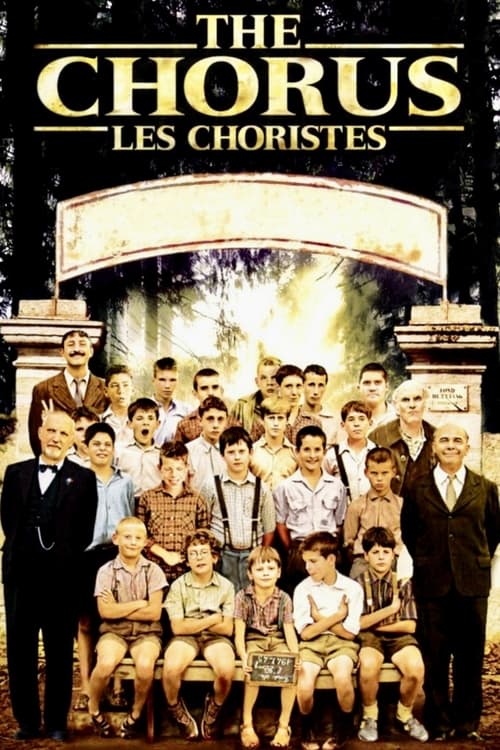
The Chorus (2004)
Directed by Christophe Barratier
No — The Chorus is not woke, scoring 6 out of 100 on our wokeness meter.
Christophe Barratier's The Chorus arrives in 1949 at Fond de l'Étang, a French boarding school for disruptive boys, and deposits there a failed musician named Clément Mathieu who teaches the children to sing.
Consciousness Markers
The story carries a gentle inspirational-teacher moral about kindness, but it preaches through sentiment rather than explicit modern sermonizing.
The strict headmaster is critiqued, but it is a critique of punitive pedagogy and institutional vanity rather than any anti-capitalist or class-based argument.
A single mother and a kindly teacher exist, but the story is overwhelmingly male-centered and offers no feminist framing or critique of gender dynamics.
The boys are labeled 'troubled,' but this is framed as behavioral and social difficulty rather than through any modern neurodivergence lens.
The cast is uniformly white French performers; the film's diversity is essentially nil and no casting choices signal modern representation priorities.
No LGBTQ+ characters, themes, or subtext whatsoever in this 1949-set boarding school drama.
The film engages no racial themes or consciousness; its characters are homogeneous and race is never a subject.
No environmental or climate content of any kind.
No body-positive messaging or body-diversity themes present.
The film is nostalgic and reverent toward its period setting rather than revising or reinterpreting history through a modern ideological frame.
Why it received this score
Christophe Barratier's The Chorus arrives in 1949 at Fond de l'Étang, a French boarding school for disruptive boys, and deposits there a failed musician named Clément Mathieu who teaches the children to sing. That is the whole machine, and it runs on the reliable fuel of uplift. The cast is white, French, and entirely untroubled by any casting logic that would announce itself to a modern audience. There are no LGBTQ students, no racial reckoning, no environmental lament, and no body-diverse ensemble. The boys are called troubled, a behavioral label from another era, and the film has no interest in reframing them through any contemporary diagnostic vocabulary. What it has instead is a choir, and the choir is lovely.
The film's villain is the headmaster Rachin, a man of rigid discipline and wounded vanity, and the film's argument against him is pedagogical, not economic. Mathieu defeats cruelty with patience and sheet music. This is a critique of punishment, not of capital, and no amount of institutional rot on display converts the story into a class parable. The lone mother, Violette, drifts through the narrative as an object of Mathieu's quiet longing, and the film never turns her into a thesis about gender. Its moral instruction is delivered through tearful finales and paper airplanes, not through speeches. The sermon here is warm and wordless.
Two Academy Award nominations and a French box office triumph followed, and the film has since been adapted into a stage musical. It is nostalgic for its period, reverent toward its setting, and innocent of the ideological preoccupations that would later define the decade's cultural arguments. We are left with a film that means well, sings beautifully, and asks nothing of us beyond a handkerchief.
Analysis generated by our Consciousness Algorithm
Synopsis
In 1940s France, a new teacher at a school for disruptive boys gives hope and inspiration.
Questions about The Chorus
Is The Chorus woke?
No — The Chorus is not woke, scoring 6 out of 100 on our wokeness meter. That earns it a verdict of Ultra Based.
Does The Chorus have any woke elements?
Very few. None of the 10 markers reaches 30, the level where a marker counts as present; the highest is Lecture Energy at 22.
How does The Chorus compare to other 2004 movies?
It ranks #104 of the 178 films from 2004 we've scored; their average is 12. The wokest is Tropical Malady (62).
How is the Woke Score calculated?
An AI-assisted process researches the film and its reception, scores it 0–100 on ten markers, then combines those into one 0–100 Woke Score. It measures a specific set of 2020s cultural themes, not film quality.