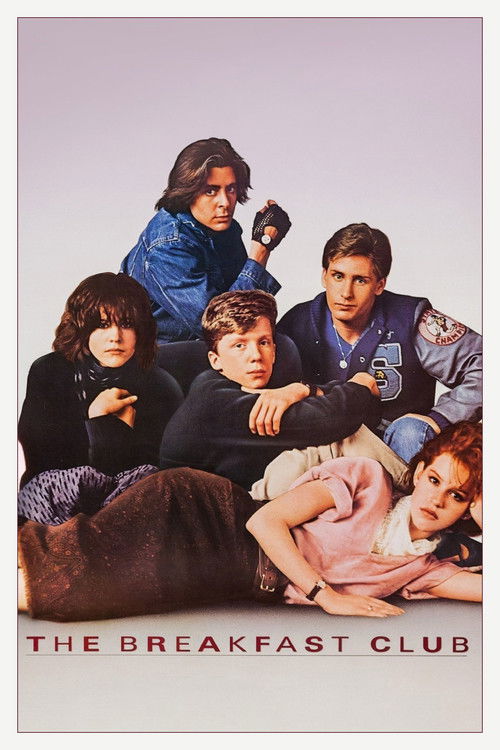
The Breakfast Club (1985)
Directed by John Hughes
No — The Breakfast Club is not woke, scoring 0 out of 100 on our wokeness meter.
The Breakfast Club arrives from 1985 with a clear conscience and no expectation of praise for it.
Consciousness Markers
The closing essay explicitly states the film's thesis about stereotypes, giving it a mild sermon-like wrap-up, but it is not modern social-justice lecturing.
The cast is uniformly white and the film's 'diversity' is clique-based, not identity-based; there is no modern representation-casting agenda.
No LGBTQ+ characters, themes, or subtext are present.
Female characters are central, but the film's gender politics are of their era—makeovers and romance—not a modern feminist agenda.
The film does not engage with race or racial justice; a production anecdote about Black casting is outside the film itself.
There is no climate or environmental messaging.
Teen rebellion targets adult authority and social cliques, not capitalism or class economics.
Allison's arc involves a conventional makeover rather than body-positive messaging.
Brian's nerdiness and Allison's quirks are not framed as neurodivergence.
The film is a contemporary teen story with no historical revisionism.
Why it received this score
The Breakfast Club arrives from 1985 with a clear conscience and no expectation of praise for it. John Hughes locks five students in a library and lets them talk, and the result is a study of cliques and parental pressure that owes nothing to the current vocabulary of identity. The cast is uniformly white. The gender politics are of their moment: Claire's arc resolves through a makeover and a kiss, and Allison's conversion from recluse to styled ingenue is offered as a happy ending, a choice that instructs modern viewers in ways the filmmakers never intended. On race the film is silent. The studio's reluctance to write for a Black actor is production lore, not text.
The economic and environmental registers are equally quiet. Bender's rebellion targets Vernon's authority, not the ownership of capital, and nobody in that library frets about the climate. Andrew's father pushes him toward wrestling glory, which is a portrait of parental coercion, not a critique of the systems that produce it. Brian's anxieties and Allison's thefts are never framed as neurodivergence. These people are simply teenagers in 1984, and the film treats them as such.
The one place the film raises its voice is the closing essay, dictated by Brian and signed by the group. It states the thesis outright: each of them is a brain, an athlete, a basket case, a princess, and a criminal, and the label is the problem. That is a sermon, though a modest one, and it lands because a nervous boy reads it aloud instead of an adult explaining it to us. For a picture so often credited with shaping the teen film, its cultural fingerprints are faint. It is a period piece that behaves like one.
Analysis generated by our Consciousness Algorithm
Part of


Synopsis
Five high school students from different walks of life endure a Saturday detention under a power-hungry principal. The disparate group includes rebel John, princess Claire, outcast Allison, brainy Brian and Andrew, the jock. Each has a chance to tell his or her story, making the others see them a little differently -- and when the day ends, they question whether school will ever be the same.
Questions about The Breakfast Club
Is The Breakfast Club woke?
No — The Breakfast Club is not woke, scoring 0 out of 100 on our wokeness meter. That earns it a verdict of Ultra Based.
Does The Breakfast Club have any woke elements?
Very few. None of the 10 markers reaches 30, the level where a marker counts as present; the highest is Lecture Energy at 20.
How does The Breakfast Club compare to other 1985 movies?
It ranks #51 of the 68 films from 1985 we've scored; their average is 8. The wokest is The Color Purple (62).
How is the Woke Score calculated?
An AI-assisted process researches the film and its reception, scores it 0–100 on ten markers, then combines those into one 0–100 Woke Score. It measures a specific set of 2020s cultural themes, not film quality.