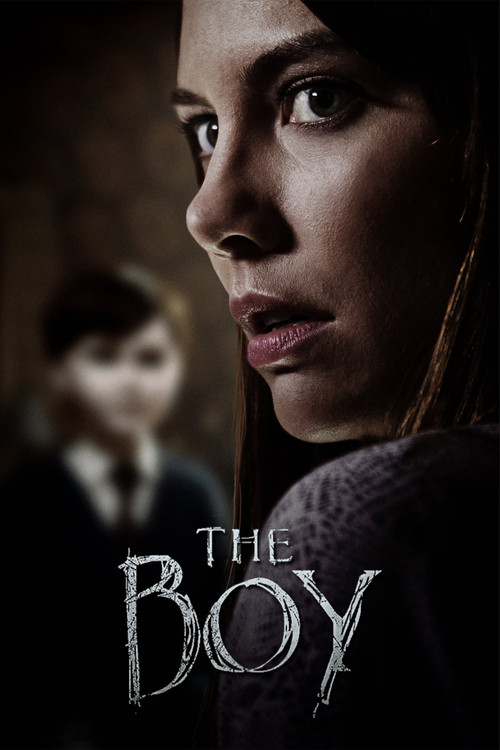
The Boy (2016)
Directed by William Brent Bell
No — The Boy is not woke, scoring 5 out of 100 on our wokeness meter.
The Boy arrives in the grand tradition of films about inanimate objects that refuse to stay inanimate, and it conducts itself with grim efficiency.
Consciousness Markers
The protagonist is a woman fleeing an abusive ex-boyfriend, which gives her a measure of agency, but the film treats this as horror-movie backstory rather than a feminist statement.
The cast is overwhelmingly white, with no meaningful effort at diverse or representative casting. The leads and supporting players are all Caucasian.
No LGBTQ+ characters, themes, or subtext appear anywhere in the film.
No engagement with race or racial themes whatsoever.
No environmental or climate themes present.
No critique of wealth, capitalism, or class structures; the wealthy Heelshires are simply a gothic horror backdrop.
No body positivity themes; the film trades in standard horror imagery.
The real Brahms is described as 'odd' and behaves in a childlike manner, but this is framed as sinister horror rather than any exploration of neurodivergence.
No historical revisionism; the film is a contemporary fictional horror story.
The film makes no attempt to lecture or moralize; it is a straightforward jump-scare horror vehicle.
Why it received this score
The Boy arrives in the grand tradition of films about inanimate objects that refuse to stay inanimate, and it conducts itself with grim efficiency. A young American, Greta, takes a post in a remote English village caring for a life-sized porcelain doll that the elderly Heelshires treat as their living son. There are rules. There is a mansion with a walled-off past. There is a fire, a drowned couple, and eventually a man in a doll mask lurking in the crawlspaces. The film declines, at every turn, to attach any larger social argument to its scares. The cast is uniformly white. Nobody remarks upon this, and the film does not ask them to. Race is not a subject the movie has any interest in raising.
The sole flicker of contemporary sensibility comes from Greta herself, a woman on the run from an abusive ex-boyfriend who has tracked her across an ocean. That detail supplies her with motive and momentum, and the actress plays the exhaustion of it well. But the film files it under backstory, a reason for her to stay in a house she should flee, and never pauses to make a statement about it. The wealthy Heelshires exist as gothic furniture, not as a target for class resentment. The real Brahms, described as odd and behaving like a child, is a monster behind a wall, not a case study. There is no lecture here, no lesson appended to the closing credits, nothing to take home but a mild case of the creeps.
Which leaves a lean genre exercise that knows its business and does it without commentary. The jump scares are dutiful. The twist lands with a thud that is not unpleasant. By the standards of the current cultural moment, the film is a relic, and the sequel that followed kept the faith. We classify it as a straightforward horror vehicle, one that asks nothing of its audience beyond a willingness to be startled in a dark room. There are worse things to be. There are also, for the purposes of our ledger, far more interesting ones.
Analysis generated by our Consciousness Algorithm


Synopsis
A young American woman takes a job as a nanny in a remote English village, soon discovering that the family's eight-year-old son is a life-sized doll that comes with a list of strict rules.
Questions about The Boy
Is The Boy woke?
No — The Boy is not woke, scoring 5 out of 100 on our wokeness meter. That earns it a verdict of Ultra Based.
Does The Boy have any woke elements?
Very few. None of the 10 markers reaches 30, the level where a marker counts as present; the highest is Feminist Agenda at 8.
How does The Boy compare to other 2016 movies?
It ranks #221 of the 285 films from 2016 we've scored; their average is 16. The wokest is 13th (92).
How is the Woke Score calculated?
An AI-assisted process researches the film and its reception, scores it 0–100 on ten markers, then combines those into one 0–100 Woke Score. It measures a specific set of 2020s cultural themes, not film quality.