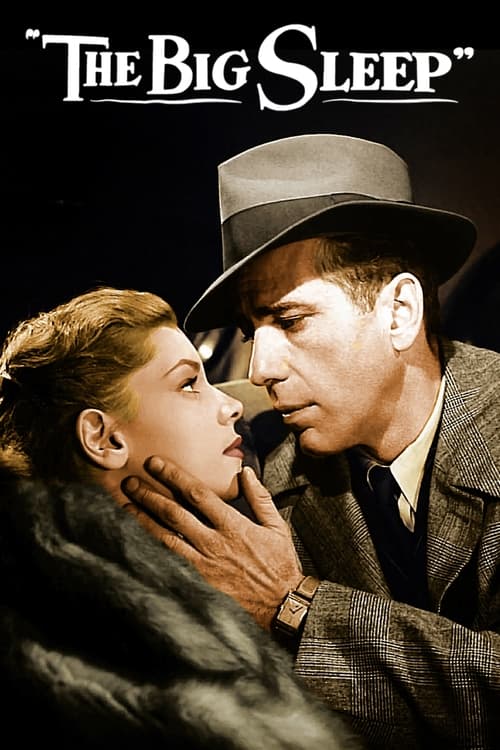
The Big Sleep (1946)
Directed by Howard Hawks
No — The Big Sleep is not woke, scoring 0 out of 100 on our wokeness meter.
The Big Sleep arrives from 1946 bearing a reputation as one of the densest narratives ever committed to celluloid, a private-eye puzzle in which even Raymond Chandler could not say who killed the chauffeur.
Consciousness Markers
The cast is entirely white and the film predates modern diversity casting concerns; no evidence of representation casting as a deliberate marker.
The novel's homosexual subtext involving Geiger and Lundgren was removed for the Hays Code, leaving no LGBTQ+ themes in the film.
Female characters exist in the noir plot, but the film does not advance a feminist agenda or critique patriarchal structures.
No racial consciousness or commentary on race appears in the film.
No environmental or climate-related themes are present.
The film depicts wealth and corruption but does not mount a modern anti-capitalist or eat-the-rich critique.
No body positivity themes or messaging are present.
Carmen's instability is treated as a plot device rather than a modern neurodivergence awareness theme.
The film adapts a contemporary novel and does not revise historical narratives for ideological purposes.
The film is a genre entertainment, not a preachy social lecture.
Why it received this score
The Big Sleep arrives from 1946 bearing a reputation as one of the densest narratives ever committed to celluloid, a private-eye puzzle in which even Raymond Chandler could not say who killed the chauffeur. Howard Hawks directs Humphrey Bogart through a Los Angeles of blackmail, gambling, and poisoned drinks, and the whole enterprise is content to be a mystery. There is no thesis tucked beneath the trench coat. The picture wants to entertain, and it does, with a plot that resists summary and a romance grafted on late to satisfy a studio eager to sell its married stars.
What the film does contain is the opposite of social messaging: it contains the removal of it. The Hays Office stripped the source novel of its homosexual undertones, dressed Carmen in a Chinese dress instead of nothing at all, and reduced explicit vice to a whisper. The result is a work shaped by censorship, not by advocacy. Women appear as femme fatales and objects of desire, never as a critique of patriarchy. Wealth appears as a source of rot, not as an invitation to redistribute it. Race, climate, body image, and neurological difference go entirely unremarked, which is to say they are simply not the film's business.
The modern viewer scanning for contemporary sensibilities will find the cupboard bare. This is not a failure of the film. It is a matter of chronology. The Big Sleep predates the cultural vocabulary it would need to say anything of the kind. What remains is craft: shadow, innuendo, and two people falling in love while the bodies pile up. The classification is straightforward. A genre picture, made well, meaning nothing beyond itself, and asking nothing of us but our attention for two hours.
That attention is repaid. The dialogue crackles, the mood holds, and the confusion is part of the design. We leave with noir's usual residue: a bad town, a tired man, and a woman who says nothing he cannot fix. No lessons are distributed. Nothing is corrected. It is, by the standards under review, a clean slate, and there is a quiet dignity in that, if not much to catalog. The ledger closes at zero, and the picture sleeps just fine.
{"thematic_tags": ["book_adaptation"]}
Analysis generated by our Consciousness Algorithm
Part of


Synopsis
Private Investigator Philip Marlowe is hired by wealthy General Sternwood regarding a matter involving his youngest daughter Carmen. Before the complex case is over, Marlowe sees murder, blackmail, deception, and what might be love.
Questions about The Big Sleep
Is The Big Sleep woke?
No — The Big Sleep is not woke, scoring 0 out of 100 on our wokeness meter. That earns it a verdict of Ultra Based.
Does The Big Sleep have any woke elements?
No. All 10 markers score zero.
How does The Big Sleep compare to other 1946 movies?
It ranks #9 of the 10 films from 1946 we've scored; their average is 5. The wokest is No Regrets for Our Youth (22).
How is the Woke Score calculated?
An AI-assisted process researches the film and its reception, scores it 0–100 on ten markers, then combines those into one 0–100 Woke Score. It measures a specific set of 2020s cultural themes, not film quality.