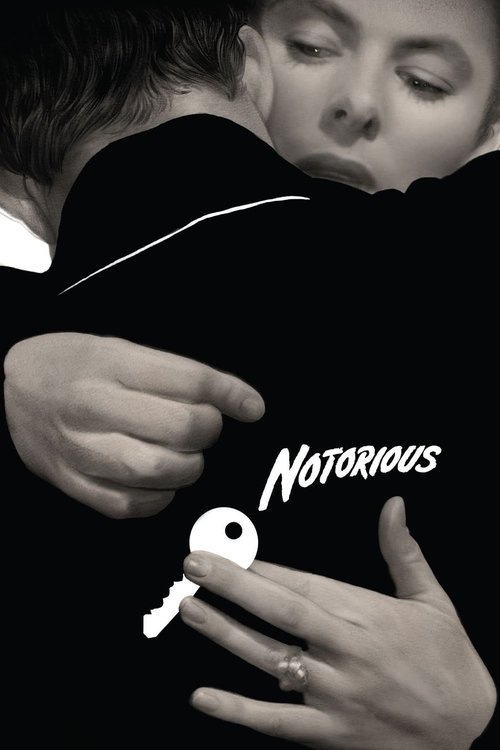
Notorious (1946)
Directed by Alfred Hitchcock
No · Ultra Based
How we score movies →Consciousness Markers
Bergman plays an active protagonist, but the narrative undermines her agency. She is manipulated and used as a sexual tool by male characters, with the film presenting this exploitation as thrilling rather than problematic.
The cast is entirely white with no racial or ethnic diversity. While Bergman provides female representation as the lead, there is no meaningful representation across other dimensions.
No LGBTQ+ themes, characters, or subtext are present in the film.
The film engages with post-war Nazi politics but does not address race as a thematic concern.
No climate-related themes or messaging are present.
The film focuses on geopolitical espionage and contains no anti-capitalist messaging or critique of economic systems.
No body positivity themes are evident. Bergman is presented through the male gaze as a conventionally attractive object of seduction.
No representation of neurodivergent characters or experiences.
While set against post-war Nazi politics, the film does not engage in historical revisionism but rather presents straightforward spy fiction.
The film is a thriller that trusts its audience to understand the stakes and contains no preachy moralizing about Nazism or war crimes.


Synopsis
In order to help bring Nazis to justice, U.S. government agent T.R. Devlin recruits Alicia Huberman, the American daughter of a convicted German war criminal, as a spy. As they begin to fall for one another, Alicia is instructed to win the affections of Alexander Sebastian, a Nazi hiding out in Brazil. When Sebastian becomes serious about his relationship with Alicia, the stakes get higher, and Devlin must watch her slip further undercover.
Why it received this score
Notorious stands as a masterwork of mid-century thriller construction, and it is also utterly devoid of any recognizable marker of modern progressive cultural consciousness. Hitchcock's 1946 film presents Ingrid Bergman as an active protagonist who is nonetheless systematically instrumentalized by the men around her, used as a sexual asset to infiltrate a Nazi cell in Brazil. The narrative frames this exploitation not as a moral problem but as the thrilling architecture of espionage. One might have expected a contemporary viewer to find this troubling, but the film predates by decades the cultural vocabulary that would allow such a critique to register as central to the story.
The film's political engagement with post-war Nazism is entirely conventional. It does not interrogate history, lecture the audience about fascism, or complicate its moral categories. Cary Grant's federal agent and Claude Rains' Nazi sympathizer are presented as straightforward antagonists and protagonists of a romantic thriller. The supporting cast is uniformly white, the sexual politics are entirely of their era, and there is no hint of LGBTQ+ representation, body diversity, disability representation, or any of the other markers by which we now measure cultural progressivism. The film is, in short, a historical artifact that reflects the values and blind spots of its moment.
This is not to say Notorious is not a great film. It is, by most measures, a magnificent piece of cinema. But it is also a film that has nothing to teach us about contemporary social consciousness. It belongs to a different world, one in which female agency could be presented as a form of sexual instrumentalization and audiences would accept this as dramatic necessity rather than exploitation. The film's cultural innocence on these matters is absolute.
Analysis generated by our Consciousness Algorithm
Critic Reviews
“A good film in many ways, but its best achievement is the casting of Jamal Woolard, a rapper named Gravy, in the title role.”
“Notorious makes the death of Biggie Smalls look like a tragic mistake, instead of the outgrowth of a culture devoted to selling the fantasy of who's the biggest man.”
“Though there was little surprise by the end--how could there be?--Notorious,' a movie about the life and death of rapper Christopher Wallace (a.k.a. The Notorious B.I.G., a.k.a. Biggie Smalls, a.k.a. Biggie), still managed to stun, unsettle and move me.”
“Absent the actual music, Notorious would be a lot worse.”