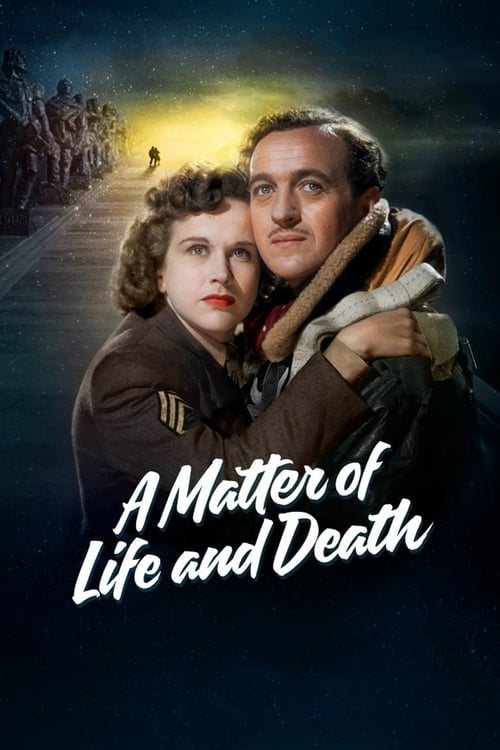
A Matter of Life and Death (1946)
Directed by Emeric Pressburger
No · Ultra Based
How we score movies →Consciousness Markers
The film includes an American female lead with agency, which was relatively progressive for 1946, but casting is not driven by contemporary diversity consciousness. The celestial court features international representatives, though presented as bureaucratic fantasy rather than deliberate multicultural casting.
The female protagonist has agency and romantic autonomy, which was somewhat progressive for the 1940s, but the narrative centers on the male protagonist's dilemma. No modern feminist consciousness or commentary is evident.
The film presents World War II and British-American relations through an idealized, patriotic lens that served contemporary propaganda purposes. This could be read as a form of historical framing rather than revisionism in the modern sense.
The celestial court includes representatives from various nations, reflecting post-war international cooperation themes, but this is presented as institutional spectacle rather than conscious engagement with racial or ethnic representation.
The celestial court trial provides some preachy moments about life, duty, and love, but the film prioritizes spectacle and romance over heavy-handed messaging or explicit instruction.
The film contains no explicit anti-capitalist messaging or critique of wealth and economic systems. It is fundamentally a romantic fantasy with wartime patriotic themes.
No LGBTQ themes, characters, or representation present in the film.
No climate-related themes, messaging, or advocacy present in the film.
No body positivity discourse, representation of diverse body types, or related themes are present in the film.
No representation of neurodivergent characters or exploration of neurodivergence is present in the film.
Synopsis
A British wartime aviator who cheats death must argue for his life before a celestial court, hoping to prolong his fledgling romance with an American girl.
Why it received this score
A Matter of Life and Death stands as a curious artifact, a film so thoroughly of its moment that it barely registers on the contemporary scale of cultural consciousness we employ. Produced during the war's final months as a piece of British propaganda designed to cement Anglo-American alliance, it concerns itself with matters of romantic love, national pride, and the supernatural rather than the specific social justice preoccupations that define modern progressive sensibility. The female lead, an American radio operator, possesses agency and intellectual parity with her British suitor, which represented a certain forward thinking for 1946, yet the film makes no show of this as ideological statement. She is simply present, capable, and allowed to want things, which was apparently enough.
The film's most ambitious sequence, a trial before a celestial bureaucracy, attempts something like international representation by assembling judges from various nations to decide the fate of our protagonist. Yet this multiculturalism functions as set dressing for a fundamentally British fantasy, a dream of global cooperation under the banner of wartime alliance. We are not meant to interrogate power structures or historical grievances; we are meant to marvel at the production design and accept that nations can put aside differences in service of romance and duty. The Technicolor splendor of the heavenly sequences contrasts deliberately with the austere earthly scenes, but this choice serves aesthetic and narrative purposes rather than any commentary on material conditions or systemic inequality.
What emerges most clearly is the temporal gulf between this film and our current moment. The absence of LGBTQ representation, climate consciousness, body diversity, neurodivergent characters, and anti-capitalist critique is not an oversight to be catalogued and scored; it is simply the unremarkable baseline of 1946 filmmaking. The film's modest score reflects not its quality as cinema but the mismatch between its concerns and ours, a mismatch so profound as to render most scoring categories almost meaningless. It is a genuinely accomplished work of fantasy and romance that operates in an entirely different cultural vocabulary than the one we have been asked to apply.
Analysis generated by our Consciousness Algorithm
Critic Reviews
“A compelling fantasy that sits thematically somewhere between Lost Horizon and The Devil and Daniel Webster, AMatterofLifeandDeathbrilliantly employs gorgeous production design, stellar cinematography, and superb performances from a talented cast.”
“Technological advances have not dated this classic love story. Special effects used are remarkable for a1946movie. The acting is superb. David Niven, Kim Hunter and especially Roger Livesey do an outstanding job. The use of Black and White / Color adds to the creative nature of the movie.”
“AMatterofLifeandDeathis no exception. I was amazed at just how richly colorful the cinematography was. There were multiple shots of such remarkable clarity that I could've been convinced they were contemporaneous rather than three-quarters of a century old.”