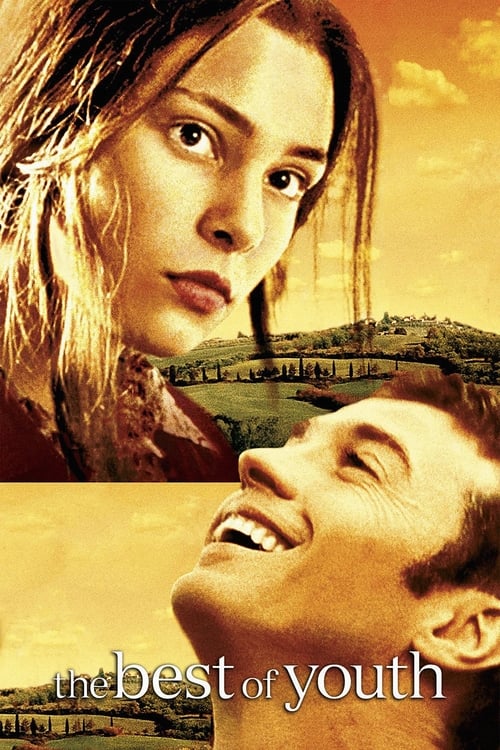
The Best of Youth (2003)
Directed by Marco Tullio Giordana
No — The Best of Youth is not woke, scoring 12 out of 100 on our wokeness meter.
A six-hour Italian family saga spanning 1966 to 2003, The Best of Youth follows the Carati brothers through the Arno flood, the Years of Lead, the Red Brigades, and the Tangentopoli scandals, and it manages all of it without a single moment of instruction.
Consciousness Markers
Nicola's career as a reform-minded psychiatrist and Giorgia's harrowing institutionalization make the humane treatment of the mentally ill a genuine, recurring concern, though framed as 1970s Basaglia-era reform rather than modern neurodivergence advocacy.
Political activism, the Red Brigades, anti-Mafia judges, and Tangentopoli corruption surface as historical texture, but the film diagnoses the era rather than preaching an anti-capitalist doctrine.
Women such as Giulia, Mirella, Sara, and Giorgia are given complex, consequential arcs, but the film offers no feminist thesis or gendered critique; their stories serve the family-saga structure.
The film shows rather than sermonizes; its six-hour sweep trusts the narrative to carry its themes without direct address to the audience.
The film reconstructs postwar Italian history through one family, but it is a humanist chronicle rather than a revisionist reframing of the historical record.
The cast is entirely Italian and white, reflecting the film's period-accurate Roman and Sicilian setting. No diversity-conscious casting choices are present.
No LGBTQ+ characters or themes appear anywhere in the sprawling family saga.
The film is set in a racially homogeneous Italy and engages no racial themes whatsoever.
The 1966 Arno flood is depicted as a historical event, not as an environmentalist parable or climate warning.
No body-positivity themes or messaging are present.
Why it received this score
A six-hour Italian family saga spanning 1966 to 2003, The Best of Youth follows the Carati brothers through the Arno flood, the Years of Lead, the Red Brigades, and the Tangentopoli scandals, and it manages all of it without a single moment of instruction. The film belongs to the old tradition of Rocco and His Brothers and The Leopard, where history is a weather system passing over a family. It predates the current cultural moment by two decades, and its instincts are those of a novelist, not a pamphleteer. We are shown corruption, terrorism, and grief. We are never told what to think about them.
The one thread that comes closest to a modern preoccupation is the psychiatry of Nicola, who spends his career fighting the institutional abuse of the mentally ill. Giorgia, tied to a bed in a hospital that has given up on her, is the film's conscience. This is Basaglia-era reform, though, a historical argument about humane treatment, not a contemporary vocabulary of neurodivergence. Women in the film, Giulia, Mirella, Sara, are given full and consequential lives, and the film never builds a thesis around them. The politics function as texture: the Red Brigades, the anti-Mafia judges, the bribery, all rendered as the air the characters breathe.
This leaves an old-fashioned humanist chronicle, and the modern scoring apparatus finds little to grip. There is no diversity-conscious casting in a period-accurate Rome. There is no environmental parable in the flood, no body-positivity messaging, no racial reckoning, no lecture. The film trusts its audience to keep up for six hours, which is its own kind of confidence. As a vintage, this is a dry, structured, old-world red, best decanted slowly. It will not satisfy anyone looking for the current fashion. It was never trying to.
Analysis generated by our Consciousness Algorithm


Synopsis
After a fateful encounter in the summer of 1966, the lifepaths of two brothers from a middle-class Roman family diverge, intersecting with some of the most significant events of postwar Italian history in the following decades.
Questions about The Best of Youth
Is The Best of Youth woke?
No — The Best of Youth is not woke, scoring 12 out of 100 on our wokeness meter. That earns it a verdict of Ultra Based.
Does The Best of Youth have any woke elements?
1 of the 10 markers register at 30 or above, led by Neurodivergence (30). On Neurodivergence: Nicola's career as a reform-minded psychiatrist and Giorgia's harrowing institutionalization make the humane treatment of the mentally ill a genuine, recurring concern, though framed as 1970s Basaglia-era reform rather than modern neurodivergence advocacy.
How does The Best of Youth compare to other 2003 movies?
It ranks #51 of the 150 films from 2003 we've scored; their average is 12. The wokest is Mona Lisa Smile (60).
How is the Woke Score calculated?
An AI-assisted process researches the film and its reception, scores it 0–100 on ten markers, then combines those into one 0–100 Woke Score. It measures a specific set of 2020s cultural themes, not film quality.