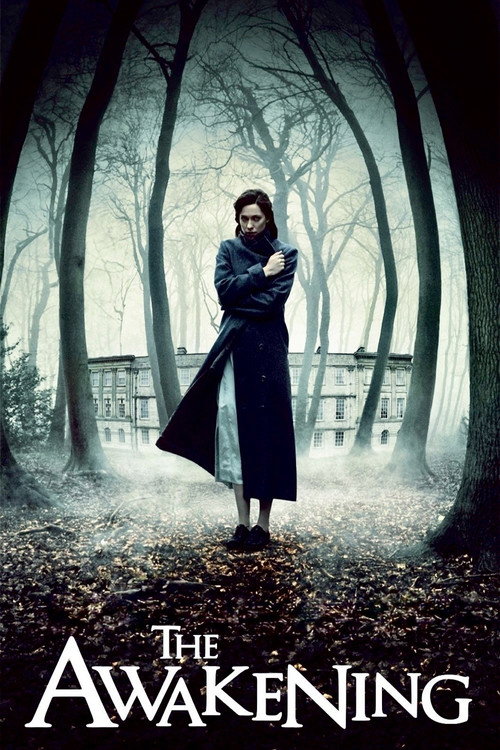
The Awakening (2011)
Directed by Nick Murphy
No — The Awakening is not woke, scoring 12 out of 100 on our wokeness meter.
The Awakening arrives in 1921, a year of mourning and rationed hope, and places Rebecca Hall at its center as Florence Cathcart, a professional sceptic who earns her living exposing fraudulent spiritualists and, in her spare time, hunting ghosts to determine whether her dead fiancé might be retrievable.
Consciousness Markers
Florence is an independent, professional woman working alongside police in 1921 and debunking male spiritualists, but the film treats this as period character detail rather than a feminist thesis.
Rebecca Hall anchors the film as a female paranormal investigator, but the cast is otherwise a uniformly white British ensemble with no meaningful diversity casting.
The film meditates on grief, scepticism, and belief, but delivers these as mood and mystery rather than preachy moral instruction.
No LGBTQ+ characters, relationships, or themes appear anywhere in the narrative.
India and Africa are mentioned only as plot devices (Tom's parents, Florence's false childhood memories); there is no engagement with race or racial politics.
No environmental or climate themes are present.
The film has no economic critique or class-warfare messaging; the boarding school setting is purely atmospheric.
No body-positivity themes or messaging appear in the film.
The film touches on grief, trauma, and repressed memory, but frames these as psychological horror rather than neurodivergence advocacy.
The 1921 post-war setting is a conventional period backdrop for a ghost story, not a revisionist reframing of historical events.
Why it received this score
The Awakening arrives in 1921, a year of mourning and rationed hope, and places Rebecca Hall at its center as Florence Cathcart, a professional sceptic who earns her living exposing fraudulent spiritualists and, in her spare time, hunting ghosts to determine whether her dead fiancé might be retrievable. It is a handsome film. Old stone corridors, damp English light, a boys' boarding school emptied for half-term. The camera lingers with the patience of a sommelier decanting something old and slightly corked.
Miss Hall carries the picture with a severity that suits a woman working alongside police in a decade that offered her few such positions. The screenplay treats this as texture, not argument. She is a professional because the plot requires one. No thesis is advanced about her place in the world, and the surrounding ensemble is uniformly white, uniformly British, and uniformly uninterested in commenting on itself. The film has other preoccupations: grief, loneliness, the ghosts that visit only the solitary, and a twist that arrives like a bill for a meal we did not order.
There is no racial consciousness here, despite India and Africa drifting through the dialogue as convenient furniture. There is no queerness, no climate anxiety, no economic grievance, no body politics, no neurodivergence advocacy. The dead are simply dead. The living are simply sad. What remains is atmosphere, competently assembled, and a moral about belief delivered as mood instead of sermon. We have tasted worse. We have also tasted better. This one is a decent vintage from a vineyard that has never once considered its carbon footprint.
Analysis generated by our Consciousness Algorithm


Synopsis
In post–War England, a writer and sometime-ghost hunter investigates a reported haunting at a boys boarding school.
Questions about The Awakening
Is The Awakening woke?
No — The Awakening is not woke, scoring 12 out of 100 on our wokeness meter. That earns it a verdict of Ultra Based.
Does The Awakening have any woke elements?
Very few. None of the 10 markers reaches 30, the level where a marker counts as present; the highest is Feminist Agenda at 28.
How does The Awakening compare to other 2011 movies?
It ranks #71 of the 245 films from 2011 we've scored; their average is 11. The wokest is Paul (68).
How is the Woke Score calculated?
An AI-assisted process researches the film and its reception, scores it 0–100 on ten markers, then combines those into one 0–100 Woke Score. It measures a specific set of 2020s cultural themes, not film quality.