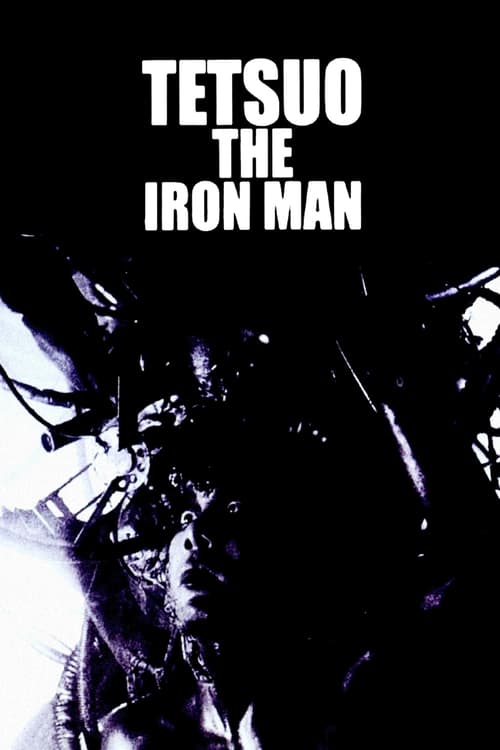
Tetsuo: The Iron Man (1989)
Directed by Shinya Tsukamoto
No — Tetsuo: The Iron Man is not woke, scoring 5 out of 100 on our wokeness meter.
Shinya Tsukamoto's Tetsuo: The Iron Man arrives from 1989 like a length of rebar dropped down a stairwell.
Consciousness Markers
Tsukamoto's own corporate drudgery influenced the film's vision of bodily erasure, giving the salaryman's transformation a faint metaphor of alienation under modern labor, but this is atmospheric unease rather than any 'eat the rich' polemic.
The cast is uniformly Japanese, which reflects the film's national origin rather than any conscious inclusion agenda; there is no diversity casting effort whatsoever.
The body-horror merging of the two male leads carries a faint homoerotic subtext, but it is 1989 psychosexual surrealism, not LGBTQ+ advocacy or thematic intent.
The girlfriend is largely a victim/temptress figure within a nightmarish, misogynistic-feeling body-horror framework; there is no feminist critique or empowerment messaging.
The film has no engagement with race or racial politics; all characters are undifferentiated Japanese urban dwellers.
No environmental or ecological themes are present.
Body positivity concerns affirming diverse, non-normative bodies; this film does the opposite, treating the body as a site of grotesque, violent metallic corruption.
No theme of neurodivergence, mental-health acceptance, or neurodiversity is present.
The film engages no historical subject matter or revisionist historical framing.
An aggressively experimental, non-verbal, surrealist exercise in noise and flesh; it preaches nothing and lectures no one.
Why it received this score
Shinya Tsukamoto's Tetsuo: The Iron Man arrives from 1989 like a length of rebar dropped down a stairwell. A salaryman sprouts metal from his cheek while shaving. A metal fetishist, wounded and then run down by a car, returns as a telekinetic force. The two men converge, twitch, scream, and fuse into a walking scrap pile that intends to convert the entire city. Shot in grainy black and white on 16mm and cut to Chu Ishikawa's clanging percussion, the film runs sixty-seven minutes and wastes none of them on explanation.
Anyone arriving with a checklist of contemporary social concerns will leave empty-handed. The cast is uniformly Japanese because the film is uniformly Japanese. The girlfriend exists to be menaced and then impaled. The homoerotic charge of the final merger belongs to psychosexual surrealism, a tradition with its own vocabulary and no interest in advocacy. The body here is not affirmed. It is drilled, rusted, and colonized by scrap. No character pauses to consider the climate, the patriarchy, or the historical record. The film is too busy screaming.
The one thread worth pulling is the salaryman himself. Tsukamoto worked eighteen months of punishing corporate hours before he was permitted to direct a single commercial, and that grind sits inside the film as an ambient dread. The transformation reads, faintly, as the body submitting its invoice for a life spent as office furniture. It is a mood, not a manifesto. No speeches follow. Nobody organizes. The metal simply wins. For a film this aggressive, its politics are nearly silent, which is a relief and, in its own way, a small mercy.
Analysis generated by our Consciousness Algorithm


Synopsis
A "metal fetishist", driven mad by the maggots wriggling in the wound he's made to embed metal into his flesh, runs out into the night and is accidentally run down by a Japanese businessman and his girlfriend. The pair dispose of the corpse in hopes of quietly moving on with their lives. However, the businessman soon finds that he is now plagued by a vicious curse that transforms his flesh into iron.
Questions about Tetsuo: The Iron Man
Is Tetsuo: The Iron Man woke?
No — Tetsuo: The Iron Man is not woke, scoring 5 out of 100 on our wokeness meter. That earns it a verdict of Ultra Based.
Does Tetsuo: The Iron Man have any woke elements?
Very few. None of the 10 markers reaches 30, the level where a marker counts as present; the highest is Eat the Rich at 8.
How does Tetsuo: The Iron Man compare to other 1989 movies?
It ranks #39 of the 68 films from 1989 we've scored; their average is 10. The wokest is Do the Right Thing (72).
How is the Woke Score calculated?
An AI-assisted process researches the film and its reception, scores it 0–100 on ten markers, then combines those into one 0–100 Woke Score. It measures a specific set of 2020s cultural themes, not film quality.