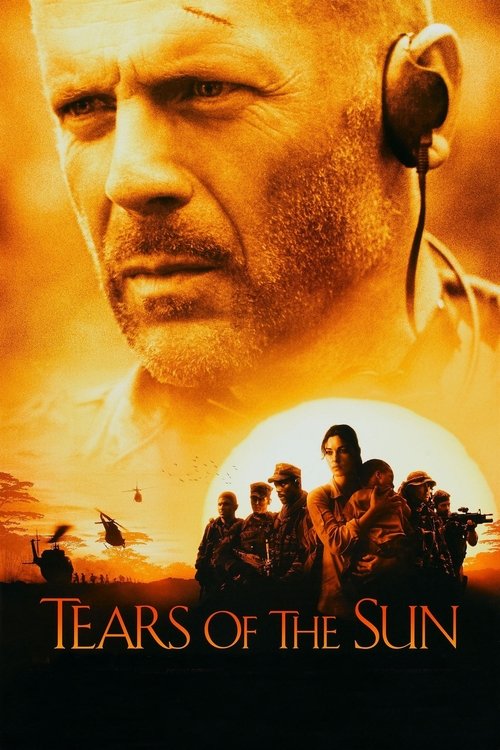
Tears of the Sun (2003)
Directed by Antoine Fuqua
No — Tears of the Sun is not especially woke, scoring 24 out of 100 on our wokeness meter.
Tears of the Sun arrives from 2003, a year when the American war film still believed it could carry a conscience in one hand and a rifle in the other.
Consciousness Markers
The film is set in Nigeria and fills its refugee cast with African actors, including real 'Lost Boys of Sudan' extras, but the core is a predominantly white star vehicle with Black characters as backdrop and ward.
The film gestures at ethnic cleansing and refugee suffering from a Western military vantage point, a textbook white-savior rescue with African atrocity as scenery rather than a sustained racial critique.
The film carries a humanitarian 'we should have protected them' message, though Fuqua's own account confirms the studio pushed the moralizing aside for action spectacle.
Monica Bellucci's Dr. Kendricks has agency and moral authority, refusing to abandon her patients, but her role is largely to be protected and to serve as the conscience of the male lead.
No LGBTQ+ characters or themes of any kind appear in the film.
No environmental or climate themes are present.
The film offers no economic critique or anti-capitalist argument; the antagonists are a military dictator's rebels, not a system of wealth.
No body-positive themes or messaging appear anywhere in the film.
No depictions or discussions of neurodivergence occur.
The story is entirely fictitious, using the Nigerian Civil War as a backdrop without making historical revisionist claims.
Why it received this score
Tears of the Sun arrives from 2003, a year when the American war film still believed it could carry a conscience in one hand and a rifle in the other. Antoine Fuqua directs Bruce Willis as Lieutenant A.K. Waters, a Navy SEAL sent into Nigeria to retrieve Dr. Lena Kendricks, played by Monica Bellucci, before the rebels reach her mission hospital. She refuses to leave her patients. He relents, then does not, then relents again. The film runs on that hesitation and on the sincere belief that a hardened operator discovering his humanity is worth two hours. Fuqua has since said he wanted to say something real about African suffering and was steered toward spectacle by a studio that wanted a Bruce Willis action picture. The finished object is both things, and neither fully.
The refugee cast is drawn largely from African actors, including men from the group known as the Lost Boys of Sudan, and their presence gives the crowd scenes a weight the screenplay does not earn. It is still a rescue narrative in which Africa supplies the atrocity and America supplies the rescue. The Black characters serve as ward and moral scenery. Dr. Kendricks holds genuine authority, refusing to abandon the people in her care, and the film grants that refusal real force. Then it hands her the other job, which is to be protected, and to be the conscience Waters eventually obeys.
The ledger beyond that is thin. No queer presence. No environmental argument. No economic critique, since the villains are a dictator's rebels and not a system. No body-positive messaging, no neurodivergent characters, no revisionist claims about a history the film invents wholesale. The sermonizing exists but arrives diluted, a humanitarian sigh between firefights. A film that wanted to lecture and settled for shooting. Competent, rain-soaked, well-photographed, and wearing its good intentions like tactical gear.
Analysis generated by our Consciousness Algorithm


Synopsis
Navy SEAL Lieutenant A.K. Waters and his elite squadron of tactical specialists are forced to choose between their duty and their humanity, between following orders by ignoring the conflict that surrounds them, or finding the courage to follow their conscience and protect a group of innocent refugees. When the democratic government of Nigeria collapses and the country is taken over by a ruthless military dictator, Waters, a fiercely loyal and hardened veteran is dispatched on a routine mission to retrieve a Doctors Without Borders physician.
Questions about Tears of the Sun
Is Tears of the Sun woke?
No — Tears of the Sun is not especially woke, scoring 24 out of 100 on our wokeness meter. That earns it a verdict of Based.
Does Tears of the Sun have any woke elements?
2 of the 10 markers register at 30 or above, led by Racial Consciousness (35) and Representation Casting (35). On Racial Consciousness: The film gestures at ethnic cleansing and refugee suffering from a Western military vantage point, a textbook white-savior rescue with African atrocity as scenery rather than a sustained racial critique.
How does Tears of the Sun compare to other 2003 movies?
It ranks #19 of the 150 films from 2003 we've scored; their average is 12. The wokest is Mona Lisa Smile (60).
How is the Woke Score calculated?
An AI-assisted process researches the film and its reception, scores it 0–100 on ten markers, then combines those into one 0–100 Woke Score. It measures a specific set of 2020s cultural themes, not film quality.