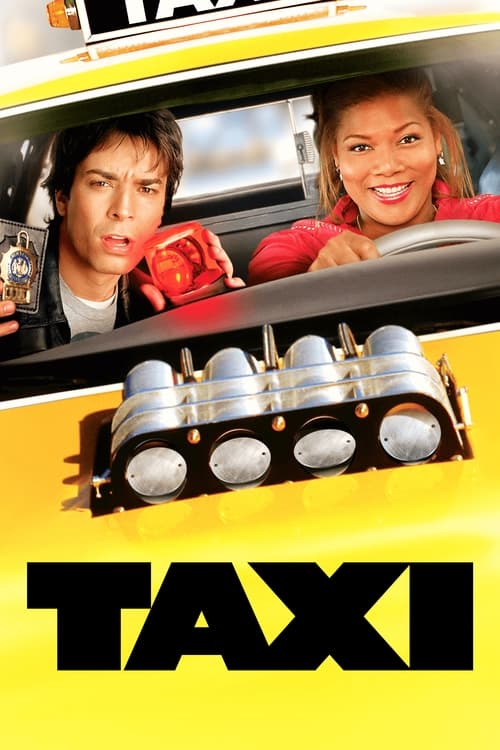
Taxi (2004)
Directed by Tim Story
No — Taxi is not woke, scoring 14 out of 100 on our wokeness meter.
We approach this 2004 action comedy, Taxi, with the appropriate level of fatigued solemnity.
Consciousness Markers
Queen Latifah headlines as a Black female lead with a supporting cast including Jennifer Esposito and a quartet of Brazilian actresses, giving the film an unusually diverse ensemble for a 2004 studio action comedy, though the casting is presented as unremarkable rather than as a statement.
The film is notably female-driven, with a competent woman as the protagonist, a female police lieutenant, and an all-female robbery crew, and Belle ultimately achieves her NASCAR dream; however, this plays as genre convention rather than an articulated feminist thesis.
The diverse cast exists naturally within the story with no commentary on race, and the Brazilian robbers are treated as a national stereotype rather than a subject of racial reflection.
The film is a lightweight action comedy that makes no attempt to instruct or moralize; it is widely panned for being witless rather than preachy.
No LGBTQ+ characters, themes, or subtext appear anywhere in the film.
No environmental or climate themes are present.
Bank robbery is the plot engine, but the film offers no critique of wealth, capitalism, or class; the ending even has banks sponsoring Belle's racing career.
No body-positivity themes or messaging are present.
No neurodivergence themes or characters are present; Washburn's incompetence is played for slapstick, not as a condition.
The film is a contemporary fictional caper with no historical subject matter to revise.
Why it received this score
We approach this 2004 action comedy, Taxi, with the appropriate level of fatigued solemnity. It is an exercise in the superficial application of progressive sensibilities within the confines of a genre that prefers cheap adrenaline over social commentary. The film presents a diverse ensemble, led by Queen Latifah, which gives the casting a certain immediate merit. We note the inclusion of a quartet of Brazilian actresses and a supporting cast that avoids the usual monolithic white protagonist. However, this is not a statement of cultural awareness, merely a concession to contemporary expectations. The casting is functional, but ultimately unremarkable, a standard feature of mid-budget studio fare.
The narrative leans heavily on a competent female protagonist who pursues her personal ambitions, which certainly satisfies the requirement for a female-driven plot. This competence, while present, functions as a simple genre trope rather than an articulated feminist thesis. The central conflicts, which involve a series of bank robberies, offer no critique of the economic systems driving these crimes. The pursuit of capital, even when temporarily thwarted by a quirky taxi driver, remains the film's primary engine. There is no engagement with environmental concerns, nor does the script attempt to deconstruct any systemic inequalities.
What emerges is a film that attempts to navigate modern cultural consciousness with a gentle, almost apologetic touch. It is an earnest, if witless, attempt to inject diverse voices and capable women into a car-chase framework. The film possesses a slight degree of cultural self-awareness, but it stops well short of challenging the status quo. It is a serviceable piece of genre entertainment that merely brushes the surface of progressive thought without ever committing to an ideological stance. It is a film that merely exists, functioning as a pleasant, if forgettable, cultural footnote.
Analysis generated by our Consciousness Algorithm


Synopsis
A mouthy and feisty taxicab driver has hot tips for a green and inept cop set on solving a string of New York City bank robberies committed by a quartet of female Brazilian bank robbers.
Questions about Taxi
Is Taxi woke?
No — Taxi is not woke, scoring 14 out of 100 on our wokeness meter. That earns it a verdict of Ultra Based.
Does Taxi have any woke elements?
2 of the 10 markers register at 30 or above, led by Representation Casting (42) and Feminist Agenda (32). On Representation Casting: Queen Latifah headlines as a Black female lead with a supporting cast including Jennifer Esposito and a quartet of Brazilian actresses, giving the film an unusually diverse ensemble for a 2004 studio action comedy, though the casting is presented as unremarkable rather than as a statement.
How does Taxi compare to other 2004 movies?
It ranks #53 of the 178 films from 2004 we've scored; their average is 12. The wokest is Tropical Malady (62).
How is the Woke Score calculated?
An AI-assisted process researches the film and its reception, scores it 0–100 on ten markers, then combines those into one 0–100 Woke Score. It measures a specific set of 2020s cultural themes, not film quality.