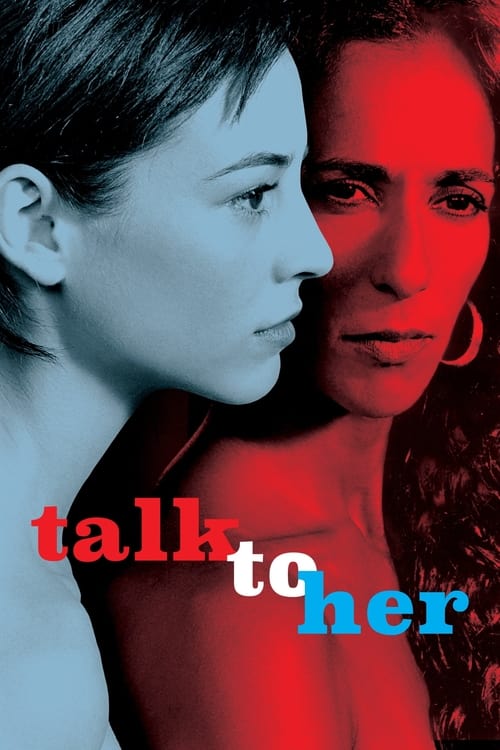
Talk to Her (2002)
Directed by Pedro Almodóvar
No — Talk to Her is not woke, scoring 9 out of 100 on our wokeness meter.
Pedro Almodóvar's Talk to Her arrived in 2002 carrying the weight of a magnum opus and the Academy Award for Best Original Screenplay, an honor rarely granted to a film not in English.
Consciousness Markers
Benigno falsely claims to be gay to deflect suspicion from his intimate care of Alicia, and Almodóvar's auteur sensibility carries a queer undercurrent, but the film's central relationships are heterosexual and the gay element is a narrative ruse.
A Spanish-language production with a naturally Spanish and Latin American cast (including Brazilian singer Caetano Veloso); the diversity is organic to the setting rather than a deliberate representational statement.
The film has been criticized for centering male perspectives and aestheticizing a sexual assault while barely addressing its consequences for the female characters, which runs counter to a feminist agenda.
The film is a restrained, emotionally complex melodrama that observes rather than preaches; it offers no explicit moralizing or didactic messaging.
No engagement with race or racial themes whatsoever.
No environmental or climate content.
No critique of wealth, class, or capitalism.
No body-positivity themes present.
Benigno's obsessive behavior is framed as psychological disturbance and transgression, not as neurodivergence in the modern celebratory sense.
A contemporary fictional melodrama with no historical revisionism.
Why it received this score
Pedro Almodóvar's Talk to Her arrived in 2002 carrying the weight of a magnum opus and the Academy Award for Best Original Screenplay, an honor rarely granted to a film not in English. Two men keep vigil over two comatose women. One is a journalist mourning a bullfighter. The other is a nurse whose devotion curdles into violation. The picture observes this arrangement with the patience of a sommelier decanting something expensive, and it declines, at every turn, to instruct us on how to feel about it. That refusal is its chief virtue and, for a certain kind of viewer, its chief offense.
The cast is Spanish and Latin American by birthright, including the Brazilian singer Caetano Veloso performing at a party, which lends the film an organic texture no casting directive could manufacture. A queer current runs beneath the surface, largely because Benigno announces he is gay to deflect a psychiatrist's suspicion, a ruse that says more about the closet than about any lived identity. On the matter of gender, the film has drawn fire for its male vantage point and for staging a rape through aesthetic distance while the women absorb the consequences offscreen. That is a fair complaint. This is not a work of advocacy. It is a work of unease.
There is no climate sermon here, no reckoning with race, no indictment of capital, no celebration of the body as a political site. Benigno's obsession reads as pathology, not as neurodivergence awaiting our understanding. The film is fiction, contemporary, and unburdened by history. What remains is a melodrama that trusts its audience to sit with discomfort, and the sermon never arrives. In an era of instruction, that restraint is nearly exotic.
Analysis generated by our Consciousness Algorithm


Synopsis
Two men share an odd friendship while they care for two women who are both in deep comas.
Questions about Talk to Her
Is Talk to Her woke?
No — Talk to Her is not woke, scoring 9 out of 100 on our wokeness meter. That earns it a verdict of Ultra Based.
Does Talk to Her have any woke elements?
Very few. None of the 10 markers reaches 30, the level where a marker counts as present; the highest is LGBTQ+ Themes at 22.
How does Talk to Her compare to other 2002 movies?
It ranks #66 of the 150 films from 2002 we've scored; their average is 12. The wokest is Far from Heaven (78).
How is the Woke Score calculated?
An AI-assisted process researches the film and its reception, scores it 0–100 on ten markers, then combines those into one 0–100 Woke Score. It measures a specific set of 2020s cultural themes, not film quality.