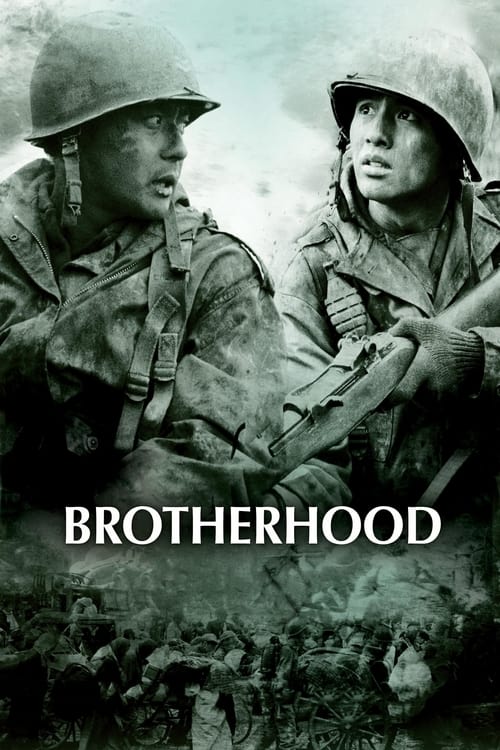
Tae Guk Gi: The Brotherhood of War (2004)
Directed by Kang Je-kyu
No — Tae Guk Gi: The Brotherhood of War is not woke, scoring 0 out of 100 on our wokeness meter.
Kang Je-kyu's Tae Guk Gi arrives from 2004, a year when a South Korean war epic could still simply be a South Korean war epic.
Consciousness Markers
The film carries an anti-war message, but it is delivered through melodrama and visceral combat rather than preachy sermonizing or direct address to the audience.
The cast is entirely Korean, which is the natural and only sensible choice for a Korean War story about Korean brothers; there is no deliberate diversity-casting agenda at work.
No LGBTQ+ characters, themes, or subtext appear anywhere in the film.
The lone significant female character, Young-shin, exists chiefly as a fiancée to be fridged as a plot catalyst for the brothers' tragedy; no feminist framework is present.
The film concerns inter-Korean conflict and the tragedy of national division, not modern racial-justice consciousness; no racial themes are engaged.
No environmental or climate themes whatsoever.
The film critiques war and ideology, not capitalism or class structures; no eat-the-rich sentiment.
No body-positivity themes; the film is a brutal war drama with no interest in body-image discourse.
No neurodivergent characters or themes are present.
The film does humanize North Korean soldiers and shows South Korean militia brutality, but this is a humanist anti-war stance rather than a modern ideological rewriting of history.
Why it received this score
Kang Je-kyu's Tae Guk Gi arrives from 2004, a year when a South Korean war epic could still simply be a South Korean war epic. The film cost 12.8 million dollars, drew nearly twelve million people to theaters, and briefly held the domestic record before the culture moved on to other preoccupations. What it does not contain is any detectable trace of the contemporary sensibility that now governs so much of the Anglophone film industry. This is not a failing. It is a curiosity, like finding a perfectly preserved specimen in amber.
The cast is entirely Korean, which is the only sensible arrangement for a story about Korean brothers conscripted into the Korean War. Lee Eun-ju's Young-shin exists to be arrested, shot, and mourned, a fiancee deployed as a plot catalyst, and the film offers no apology or framework for this. North Korean soldiers are granted moments of humanity, and South Korean militia men are shown burning prisoners alive, but the gesture is humanist and anti-war, not an ideological rewriting of the past. Nobody lectures. Nobody explains the themes to the audience.
The message, such as it is, arrives through melodrama and viscera: severed limbs, a silver pen, a pair of unworn shoes. The film wants us to weep, not to nod along at a thesis. It is a brutal, sincere, occasionally overwrought piece of popular entertainment, and it has no interest whatsoever in the moral instruction that a later era might demand of it. We are left with craft, grief, and the sound of a machine gun. Refreshing, in its way.
Analysis generated by our Consciousness Algorithm
Synopsis
When two brothers are forced to fight in the Korean War, the elder decides to take the riskiest missions if it will help shield the younger from battle.
Questions about Tae Guk Gi: The Brotherhood of War
Is Tae Guk Gi: The Brotherhood of War woke?
No — Tae Guk Gi: The Brotherhood of War is not woke, scoring 0 out of 100 on our wokeness meter. That earns it a verdict of Ultra Based.
Does Tae Guk Gi: The Brotherhood of War have any woke elements?
Very few. None of the 10 markers reaches 30, the level where a marker counts as present; the highest is Lecture Energy at 10.
How does Tae Guk Gi: The Brotherhood of War compare to other 2004 movies?
It ranks #151 of the 178 films from 2004 we've scored; their average is 12. The wokest is Tropical Malady (62).
How is the Woke Score calculated?
An AI-assisted process researches the film and its reception, scores it 0–100 on ten markers, then combines those into one 0–100 Woke Score. It measures a specific set of 2020s cultural themes, not film quality.