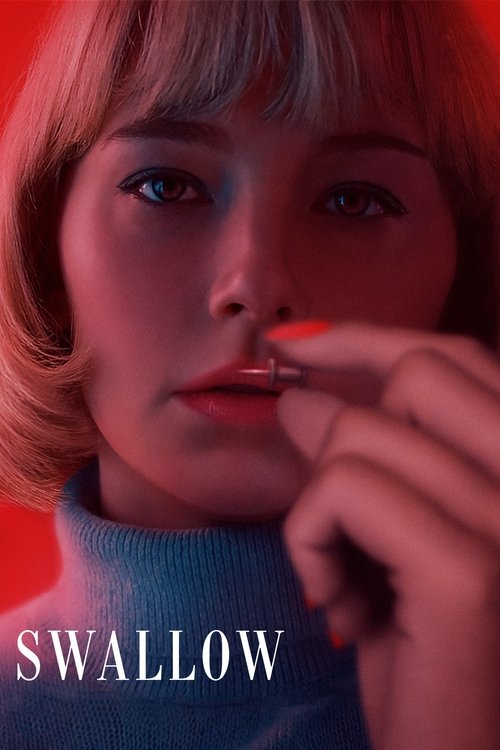
Swallow (2020)
Directed by Carlo Mirabella-Davis
Partly — Swallow is somewhat woke, scoring 52 out of 100 on our wokeness meter.
Swallow opens with a marble and closes with a decision, and between those two points Carlo Mirabella-Davis conducts a quiet, queasy study of a woman being managed into extinction.
Consciousness Markers
The film is squarely about a woman's fight for bodily autonomy against a controlling husband and in-laws, culminating in her decision to obtain an abortion. Critics explicitly framed it as a major statement on female bodily autonomy.
Pica is the film's central subject, treated as a genuine psychological disorder rooted in trauma and a need for control, and the director drew directly on his grandmother's OCD. Mental illness is depicted with seriousness rather than as a monster.
The wealthy Conrad family, the corporate CEO father-in-law, and the transactional control of Hunter's life provide a clear critique of moneyed power and class hierarchy, though it is framed more as domestic oppression than economic polemic.
The leads are white, but the supporting cast includes Lauren Vélez, Zabryna Guevara, Laith Nakli, Babak Tafti, and Nicole Kang, with Luay written as a Syrian immigrant. Diversity is present but not a thematic focus.
Themes of autonomy and abuse are present but delivered through atmosphere and body horror rather than speeches; critics noted it deliberately avoids 'rah-rah' empowerment messaging.
Luay, a Syrian immigrant, briefly remarks that Hunter's suffering stems from her privilege, and the film gestures at class and outsider status, but race is not a developed theme.
The film is intensely concerned with a woman's relationship to her own body and its autonomy, but it is body horror and disorder, not the body-acceptance ethos of body positivity.
No LGBTQ+ characters, relationships, or themes appear anywhere in the film.
No environmental or climate content of any kind.
No historical events or figures are reinterpreted; the story is contemporary and fictional.
Why it received this score
Swallow opens with a marble and closes with a decision, and between those two points Carlo Mirabella-Davis conducts a quiet, queasy study of a woman being managed into extinction. Hunter Conrad has married into a Manhattan fortune and been installed in a glass house upstate, where her function is decorative and her opinions register as interruptions. The objects she swallows (thumbtacks, a battery, eventually a screwdriver) are less a plot device than a private economy, the only transaction in her life she controls. The Conrads respond to her diagnosis the way a board responds to a quarterly miss: first with anger, then with a schedule of containment.
The film's argument about bodily autonomy is unmistakable and it arrives without a podium. Hunter's pregnancy is not a blessing but a claim staked on her body by a husband and his parents, and the ending, in which she takes pills in a food court and bleeds in a public restroom, is the least triumphant abortion scene imaginable. That restraint is the film's chief virtue. Mirabella-Davis lets the critique of moneyed power sit in the furniture, the glass, and the way Michael Conrad asks about business mid-toast. The single moment of explicit social commentary comes from Luay, the Syrian minder, who informs Hunter that her suffering is a product of privilege, and the film declines to pursue the thought any further.
Pica is treated as a genuine disorder with a documented lineage (the director's grandmother, her rituals, her lobotomy), not as a monster in the basement. That seriousness is commendable. Elsewhere the picture is narrower than its reputation: the supporting cast is more varied than the premise requires, though the camera never lingers on it, and there is no interest here in climate, history, or the wider world beyond the driveway. The remainder is a well-made, tightly wound chamber piece that earns its thesis through texture and refuses to hand out leaflets. A respectable vintage, slightly acidic on the finish.
{"thematic_tags": ["box_office_number_one"]}
Analysis generated by our Consciousness Algorithm


Synopsis
Hunter, a newly pregnant housewife, finds herself increasingly compelled to consume dangerous objects. As her husband and his family tighten their control over her life, she must confront the dark secret behind her new obsession.
Questions about Swallow
Is Swallow woke?
Partly — Swallow is somewhat woke, scoring 52 out of 100 on our wokeness meter. That earns it a verdict of Woke-Adjacent.
What makes Swallow woke?
4 of the 10 markers register at 30 or above, led by Feminist Agenda (75), Neurodivergence (55) and Eat the Rich (45). On Feminist Agenda: The film is squarely about a woman's fight for bodily autonomy against a controlling husband and in-laws, culminating in her decision to obtain an abortion.
How does Swallow compare to other 2020 movies?
It ranks #26 of the 227 films from 2020 we've scored; their average is 21. The wokest is One Night in Miami... (83).
How is the Woke Score calculated?
An AI-assisted process researches the film and its reception, scores it 0–100 on ten markers, then combines those into one 0–100 Woke Score. It measures a specific set of 2020s cultural themes, not film quality.