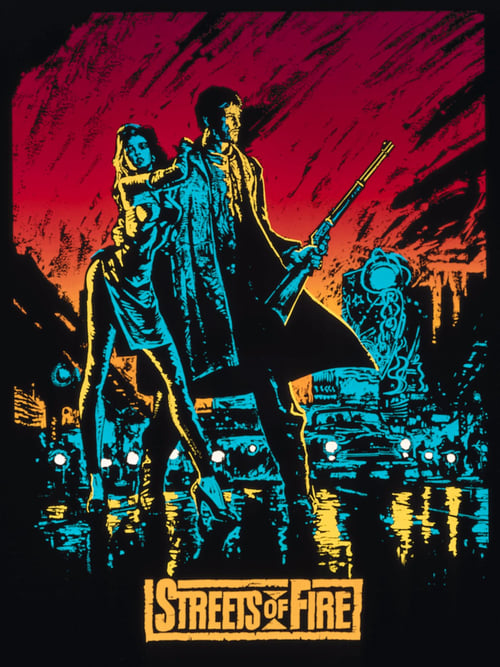
Streets of Fire (1984)
Directed by Walter Hill
No — Streets of Fire is not woke, scoring 8 out of 100 on our wokeness meter.
Walter Hill's 1984 rock and roll fable arrives dressed as an action picture but behaves like a musical that wandered into a biker bar.
Consciousness Markers
Amy Madigan's McCoy is a tough ex-soldier and mechanic who inserts herself into the mission, a role originally written for a man. This is a notable female action presence, but the plot still centers on rescuing a kidnapped woman and the film makes no feminist argument.
The cast includes Black actors Richard Lawson and Grand L. Bush in supporting roles, but they exist naturally within the story without any commentary on representation. No deliberate diversity agenda is present.
The plot revolves around a mercenary paid $10,000, and Tom Cody pointedly throws the reward money back at his employer. This gestures faintly at money being worthless compared to honor, but it is not an anti-capitalist statement.
Walter Hill's film is a self-consciously stylized rock-and-roll fable concerned with atmosphere, music, and myth rather than moral instruction. It preaches nothing.
There are no LGBTQ+ characters, themes, or subtext anywhere in the film.
The film engages with no racial themes or commentary whatsoever; its gang warfare and rescue plot are entirely race-neutral.
No environmental or climate themes appear in the film.
No body positivity themes or messaging are present.
No neurodivergent characters or themes are depicted.
The film is a stylized fantasy fable set in an abstract 'another time, another place' and makes no historical claims to revise.
Why it received this score
Walter Hill's 1984 rock and roll fable arrives dressed as an action picture but behaves like a musical that wandered into a biker bar. Tom Cody (Michael Paré) rides back into a nameless city of perpetual neon to retrieve his ex-girlfriend, the kidnapped singer Ellen Aim (Diane Lane), from the leather-clad Raven Shaddock (Willem Dafoe). The setting is described in the opening credits as another time, another place, which spares the film any obligation to comment on the actual one. Hill wanted custom cars, rain-slicked streets, and questions of honor, and he got them. The result is a mood in search of a movie, and the mood is impeccable.
On the matter of social consciousness, the film is nearly barren, and this appears to be a deliberate aesthetic choice. Amy Madigan's McCoy, a tomboy mechanic and ex-soldier, was written as an overweight man before Madigan asked to play the part unchanged, which grants the film a genuine female action presence that the plot never bothers to celebrate. Black actors Richard Lawson and Grand L. Bush appear in supporting roles and are simply present, without the screenplay pausing to congratulate itself. There is no romance outside the heterosexual default, no racial argument, no ecological lament, no body-positive messaging, no neurodivergent arc. The closest thing to a political gesture is Tom Cody tossing his reward money back at his employer, a flicker of contempt for the paycheck that amounts to roughly nothing.
What the film offers instead is atmosphere, and it preaches no sermons. Hill builds a fairy tale where nobody bleeds and nobody dies, a comic book without a comic book, and he trusts the audience to meet him in the artificial world. There is no lesson here, only sledgehammers at dawn and a convertible in the rain. We classify it, we note its faint traces of an argument it never makes, and we move on to the next reel.
Analysis generated by our Consciousness Algorithm
Part of


Synopsis
Raven Shaddock and his gang of merciless biker friends kidnap rock singer Ellen Aim. Ellen's former lover, soldier-for-hire Tom Cody, happens to be passing through town on a visit. In an attempt to save his star act, Ellen's manager hires Tom to rescue her. Along with a former soldier, they battle through dangerous cityscapes, determined to get Ellen back.
Questions about Streets of Fire
Is Streets of Fire woke?
No — Streets of Fire is not woke, scoring 8 out of 100 on our wokeness meter. That earns it a verdict of Ultra Based.
Does Streets of Fire have any woke elements?
Very few. None of the 10 markers reaches 30, the level where a marker counts as present; the highest is Feminist Agenda at 22.
How does Streets of Fire compare to other 1984 movies?
It ranks #15 of the 51 films from 1984 we've scored; their average is 7. The wokest is Revenge of the Nerds (30).
How is the Woke Score calculated?
An AI-assisted process researches the film and its reception, scores it 0–100 on ten markers, then combines those into one 0–100 Woke Score. It measures a specific set of 2020s cultural themes, not film quality.