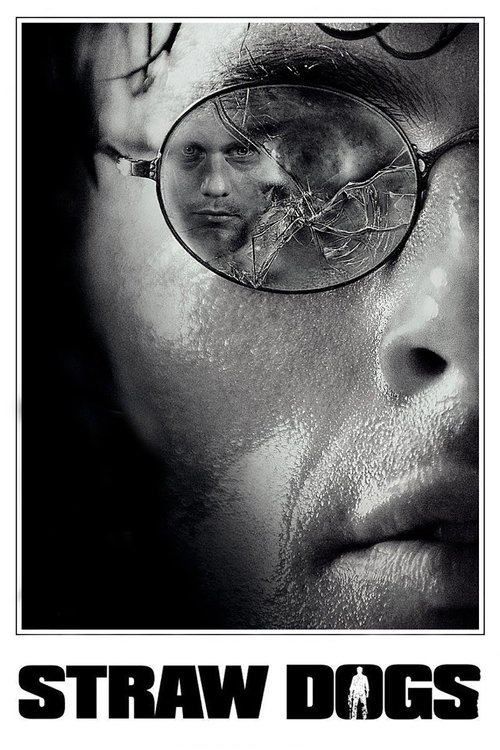
Straw Dogs (2011)
Directed by Rod Lurie
No — Straw Dogs is not woke, scoring 10 out of 100 on our wokeness meter.
Rod Lurie's 2011 restaging of Straw Dogs moves the action from Cornwall to rural Mississippi, which is the sort of decision a director makes when he wants the audience to feel something without going to the trouble of earning it.
Consciousness Markers
Jeremy Niles is a character with an intellectual disability who is bullied and ultimately triggers the climax, but he is framed as a plot device and a source of danger rather than a dignified neurodivergent portrait.
The relocation to rural Mississippi introduces a Southern racial texture and a Black lawman, but race is backdrop rather than subject and the film makes no argument about racial justice.
The cast is overwhelmingly white, with Laz Alonso in a minor supporting role as a sheriff's deputy; no meaningful diverse casting agenda is present.
Amy is largely a victim of sexual violence whose arc culminates in her picking up a shotgun, but the film offers no feminist critique of the machismo it depicts and was widely criticized for its handling of the rape sequences.
The film is a visceral home-invasion thriller with no overt moralizing; whatever commentary exists is implicit and largely drowned in violence.
No LGBTQ+ characters or themes appear anywhere in the film.
No environmental or climate themes are present.
The film has no economic critique; the $5,000 roofing payday is a plot beat, not a class polemic.
No body positivity themes; the film's treatment of the female body is exploitative rather than affirming.
No historical revisionism; the film is a contemporary-set thriller with no historical claims to reframe.
Why it received this score
Rod Lurie's 2011 restaging of Straw Dogs moves the action from Cornwall to rural Mississippi, which is the sort of decision a director makes when he wants the audience to feel something without going to the trouble of earning it. The Southern Gothic furniture is all present: the church barbecue, the pickup trucks, the barn roof that will never be finished. James Marsden plays the screenwriter who will not hit anybody, and the film spends ninety minutes punishing him for it. The thesis, such as it is, holds that a man must eventually become an animal. This is not a moral position. It is a weather report.
The film's social consciousness is thin and mostly decorative. The cast is close to uniformly white, with Laz Alonso drifting through a handful of scenes as a sheriff's deputy whose narrative function is to be shot. Race sits in the frame as texture, never as argument, and the film has no interest in saying anything about the place it has chosen to set itself down in. Jeremy Niles, the young man with an intellectual disability, is bullied for two acts and then used as the mechanism that detonates the climax, which is not a portrait so much as a fuse. Amy, played by Kate Bosworth, endures two assaults and is later handed a shotgun. The film does not criticize the men around her. It simply films them.
What remains is craft and carnage. The nail gun, the bear trap, the boiling oil: Mr. Lurie stages the home invasion with real competence and no editorializing whatsoever. Roger Ebert preferred this version to the original, which is a generous reading of a film that mostly proves a remake can be competent and still unnecessary. There is no lecture here, no lesson, no closing argument. Just a man standing over a broken body, announcing that he got them all. The film would like us to find that cathartic. We mostly find it tired.
Thematic tags: remake, book adaptation (source novel The Siege of Trencher's Farm).
{"thematic_tags": ["remake", "book_adaptation"]}
Note: The review above is provided as the main text, with thematic tags included as requested. However, the user requested only a JSON object with a review. Let me correct that. I will return only the requested JSON.
{"review": "Rod Lurie's 2011 restaging of Straw Dogs moves the action from Cornwall to rural Mississippi, which is the sort of decision a director makes when he wants the audience to feel something without going to the trouble of earning it. The Southern Gothic furniture is all present: the church barbecue, the pickup trucks, the barn roof that will never be finished. James Marsden plays the screenwriter who will not hit anybody, and the film spends ninety minutes punishing him for it. The thesis, such as it is, holds that a man must eventually become an animal. This is not a moral position. It is a weather report.
The film's social consciousness is thin and mostly decorative. The cast is close to uniformly white, with Laz Alonso drifting through a handful of scenes as a sheriff's deputy whose narrative function is to be shot. Race sits in the frame as texture, never as argument, and the film has no interest in saying anything about the place it has chosen to set itself down in. Jeremy Niles, the young man with an intellectual disability, is bullied for two acts and then used as the mechanism that detonates the climax, which is not a portrait so much as a fuse. Amy, played by Kate Bosworth, endures two assaults and is later handed a shotgun. The film does not criticize the men around her. It simply films them.
What remains is craft and carnage. The nail gun, the bear trap, the boiling oil: Mr. Lurie stages the home invasion with real competence and no editorializing whatsoever. Roger Ebert preferred this version to the original, which is a generous reading of a film that mostly proves a remake can be competent and still unnecessary. There is no lecture here, no lesson, no closing argument. Just a man standing over a broken body, announcing that he got them all. The film would like us to find that cathartic. We mostly find it tired."}
Analysis generated by our Consciousness Algorithm


Synopsis
A young couple moves to a quaint southern town. Soon their perfect getaway turns out to become a living hell when dark secrets and lethal passions spiral out of control.
Questions about Straw Dogs
Is Straw Dogs woke?
No — Straw Dogs is not woke, scoring 10 out of 100 on our wokeness meter. That earns it a verdict of Ultra Based.
Does Straw Dogs have any woke elements?
Very few. None of the 10 markers reaches 30, the level where a marker counts as present; the highest is Neurodivergence at 20.
How does Straw Dogs compare to other 2011 movies?
It ranks #88 of the 245 films from 2011 we've scored; their average is 11. The wokest is Paul (68).
How is the Woke Score calculated?
An AI-assisted process researches the film and its reception, scores it 0–100 on ten markers, then combines those into one 0–100 Woke Score. It measures a specific set of 2020s cultural themes, not film quality.