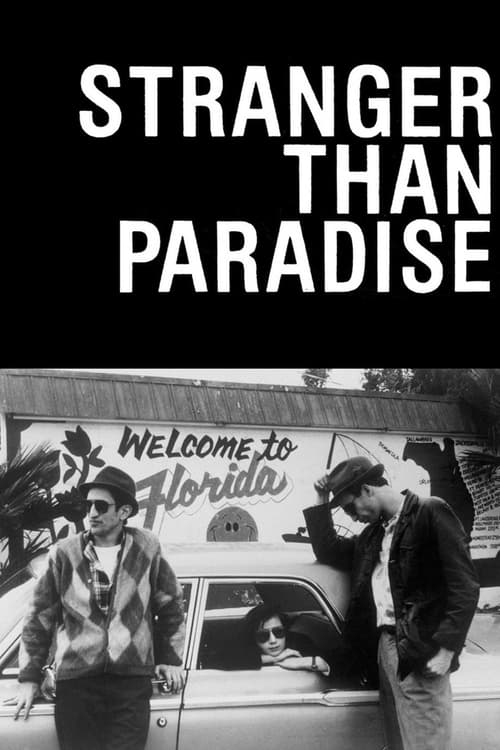
Stranger Than Paradise (1984)
Directed by Jim Jarmusch
No — Stranger Than Paradise is not woke, scoring 6 out of 100 on our wokeness meter.
Jim Jarmusch's Stranger Than Paradise arrives in 1984 with a black-and-white stillness that predates nearly every cultural argument later demanded of cinema.
Consciousness Markers
The cast is led by Hungarian-born actress Eszter Balint and features immigrant characters, but their ethnicity exists naturally within the story without any commentary or box-ticking intent.
The film's gamblers and hustlers drift through a dead-end America, and the 'American dream' keyword hints at quiet disillusionment, but it offers no explicit anti-capitalist critique or eat-the-rich sentiment.
Eva is a quietly self-possessed young woman with some agency, but the film advances no feminist argument and treats her independence as character texture rather than thesis.
Jarmusch's minimalist, deadpan style deliberately avoids moralizing or lecturing; the film observes rather than preaches.
No LGBTQ+ characters, themes, or subtext appear anywhere in the film.
The film has no engagement with racial themes or racial consciousness whatsoever.
No environmental or climate themes are present.
No body positivity themes or messaging are present.
No neurodivergent characters or themes are depicted.
The film is a contemporary deadpan comedy with no historical revisionism.
Why it received this score
Jim Jarmusch's Stranger Than Paradise arrives in 1984 with a black-and-white stillness that predates nearly every cultural argument later demanded of cinema. Willie, a Hungarian-born layabout in a bare Brooklyn apartment, receives his cousin Eva for ten days and offers her no sheets, no food, and no curiosity about her journey. The film watches this withholding and says nothing. An actual Hungarian actress, Eszter Balint, carries the lead, and several characters bring immigrant histories along with them. None of it is staged as a statement. The story simply contains these people and lets them be foreign without an accompanying seminar.
Eva is the closest the film comes to an argument. She cleans the apartment, plays Screamin' Jay Hawkins against Willie's wishes, acquires groceries and cigarettes with no money at all, and outmaneuvers both men largely by accident. Her self-possession reads as temperament, not thesis. Jarmusch grants her independence and then declines to editorialize about it. The men around her gamble on horses and dogs in a dead-end America that offers them little, and the quiet disillusionment with the national promise never hardens into a critique with a named target. The drift is the point. There is no villain to indict and no fortune to redistribute, just three people moving through Cleveland and Florida with the same flat disappointment.
This is a movie that observes. It does not lecture, does not instruct, does not turn to the audience to confirm that the lesson landed. Its long takes and black-outs ask us to look harder at grimy detail, and the ask is aesthetic, not moral. On the scale of contemporary social instruction, the film registers as an artifact from a less insistent era, one that trusted viewers to draw their own conclusions. Pauline Kael noted the Beckett-like pauses. She was right, and those pauses say more than any speech the film might have written for itself. The vacuum cleaner bit remains a small, perfect joke about nothing at all, which is the highest compliment available here.
{"thematic_tags": []} // (empty list appended separately below for the parser)
Let me restate cleanly:
{"review": "Jim Jarmusch's Stranger Than Paradise arrives in 1984 with a black-and-white stillness that predates nearly every cultural argument later demanded of cinema. Willie, a Hungarian-born layabout in a bare Brooklyn apartment, receives his cousin Eva for ten days and offers her no sheets, no food, and no curiosity about her journey. The film watches this withholding and says nothing. An actual Hungarian actress, Eszter Balint, carries the lead, and several characters bring immigrant histories along with them. None of it is staged as a statement. The story simply contains these people and lets them be foreign without an accompanying seminar.\n\nEva is the closest the film comes to an argument. She cleans the apartment, plays Screamin' Jay Hawkins against Willie's wishes, acquires groceries and cigarettes with no money at all, and outmaneuvers both men largely by accident. Her self-possession reads as temperament, not thesis. Jarmusch grants her independence and then declines to editorialize about it. The men around her gamble on horses and dogs in a dead-end America that offers them little, and the quiet disillusionment with the national promise never hardens into a critique with a named target. The drift is the point. There is no villain to indict and no fortune to redistribute, just three people moving through Cleveland and Florida with the same flat disappointment.\n\nThis is a movie that observes. It does not lecture, does not instruct, does not turn to the audience to confirm that the lesson landed. Its long takes and black-outs ask us to look harder at grimy detail, and the ask is aesthetic, not moral. On the scale of contemporary social instruction, the film registers as an artifact from a less insistent era, one that trusted viewers to draw their own conclusions. Pauline Kael noted the Beckett-like pauses. She was right, and those pauses say more than any speech the film might have written for itself. The vacuum cleaner bit remains a small, perfect joke about nothing at all, which is the highest compliment available here.", "thematic_tags": []} }
Analysis generated by our Consciousness Algorithm


Synopsis
New York layabout Willie forms an unexpected bond with his young Hungarian cousin Eva when she pays him a surprise visit. Later, Eva moves in with their aunt in Cleveland, and Willie takes his best friend Eddie to see her—a visit that culminates in a strange, eventful trip to Florida.
Questions about Stranger Than Paradise
Is Stranger Than Paradise woke?
No — Stranger Than Paradise is not woke, scoring 6 out of 100 on our wokeness meter. That earns it a verdict of Ultra Based.
Does Stranger Than Paradise have any woke elements?
Very few. None of the 10 markers reaches 30, the level where a marker counts as present; the highest is Eat the Rich at 12.
How does Stranger Than Paradise compare to other 1984 movies?
It ranks #21 of the 51 films from 1984 we've scored; their average is 7. The wokest is Revenge of the Nerds (30).
How is the Woke Score calculated?
An AI-assisted process researches the film and its reception, scores it 0–100 on ten markers, then combines those into one 0–100 Woke Score. It measures a specific set of 2020s cultural themes, not film quality.