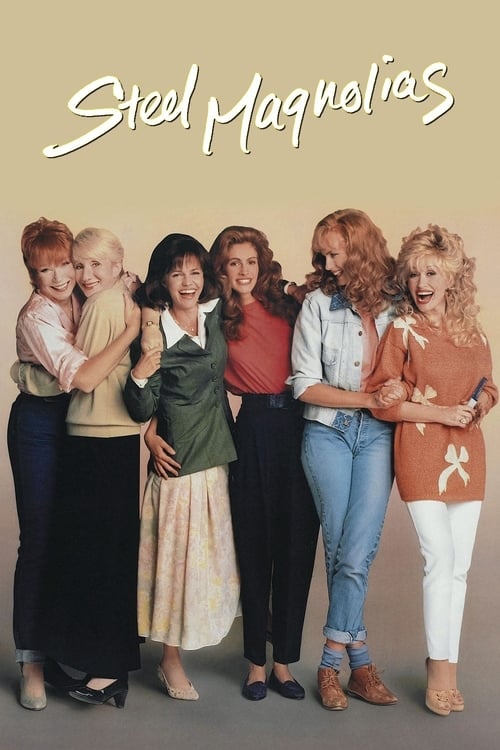
Steel Magnolias (1989)
Directed by Herbert Ross
No — Steel Magnolias is not woke, scoring 16 out of 100 on our wokeness meter.
Steel Magnolias arrives from 1989 with a bouquet of Southern charm, a loaded shotgun, and a kidney transplant.
Consciousness Markers
The film centers on a bond among women and a mother-daughter relationship, and Shelby asserts her choice to bear a child against medical advice, but this is a humanist portrait of Southern women's lives rather than a modern feminist statement.
A brief subplot mentions Clairee's nephew who came out as gay and was subsequently estranged from his father, but this is a passing reference rather than a developed theme.
The film carries sentimental moralizing about motherhood and sacrifice, but it delivers these through melodrama and humor rather than modern social-justice sermonizing.
The principal cast is entirely white, with no deliberate or commented-upon diverse casting; the ensemble reflects the demographics of the source material without any representational agenda.
No racial themes or commentary appear; the story is set in an all-white small-town Southern community with no engagement with race.
No environmental or climate themes are present.
No critique of wealth, class, or capitalism appears in the film.
No body-positivity themes are present; the film does not engage with body image or size acceptance.
No neurodivergence themes are present; Shelby's type 1 diabetes is a physical illness, not a neurodivergent identity.
No historical revisionism is present; the film is a contemporary domestic drama.
Why it received this score
Steel Magnolias arrives from 1989 with a bouquet of Southern charm, a loaded shotgun, and a kidney transplant. The film gathers its women in Truvy's salon and lets them talk, grieve, and tease one another through weddings and funerals. As a piece of social consciousness, it operates on a different frequency from the modern sermon. The cast is entirely white, and the small Louisiana town is presented as a closed world. No racial commentary intrudes, no climate anxiety, no critique of wealth. The movie is about friendship and loss, not about the systems that produce either.
Representation here is not a project. The characters exist as written, and the film does not pause to congratulate itself for their existence. A passing reference to Clairee's estranged nephew, who came out as gay, registers as a minor detail in a crowded Southern tapestry. It is not a developed theme. The feminist reading is available, since the story centers on women and a mother-daughter bond, and Shelby chooses pregnancy against medical advice. But the film treats that choice as a personal and familial tragedy, not as a manifesto. The moralizing that does occur concerns motherhood, sacrifice, and the cost of love. It is sentimental and heavy-handed in the final act, though it arrives through melodrama and humor, not through a lecture on contemporary social justice.
Body positivity, neurodivergence, and historical revisionism are absent. Shelby's diabetes is a physical illness, not an identity category. The film has no interest in reimagining the past or in interrogating capitalism. What remains is a well-acted domestic drama with a sharp ensemble and a famous cemetery scene. It wants us to cry, and it succeeds. As a cultural artifact, it is a product of its time, warm, limited, and resistant to the progressive checklists we now bring to the table. We can admire the performances without pretending the film is doing work it never intended.
Analysis generated by our Consciousness Algorithm


Synopsis
A young beautician, newly arrived in a small Louisiana town, finds work at the local salon, where a small group of women share a close bond of friendship and welcome her into the fold.
Questions about Steel Magnolias
Is Steel Magnolias woke?
No — Steel Magnolias is not woke, scoring 16 out of 100 on our wokeness meter. That earns it a verdict of Ultra Based.
Does Steel Magnolias have any woke elements?
1 of the 10 markers register at 30 or above, led by Feminist Agenda (30). On Feminist Agenda: The film centers on a bond among women and a mother-daughter relationship, and Shelby asserts her choice to bear a child against medical advice, but this is a humanist portrait of Southern women's lives rather than a modern feminist statement.
How does Steel Magnolias compare to other 1989 movies?
It ranks #11 of the 68 films from 1989 we've scored; their average is 10. The wokest is Do the Right Thing (72).
How is the Woke Score calculated?
An AI-assisted process researches the film and its reception, scores it 0–100 on ten markers, then combines those into one 0–100 Woke Score. It measures a specific set of 2020s cultural themes, not film quality.