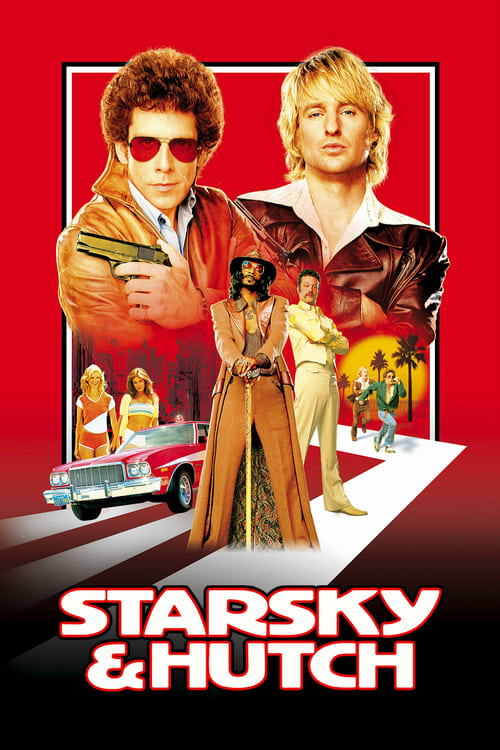
Starsky & Hutch (2004)
Directed by Todd Phillips
No — Starsky & Hutch is not woke, scoring 6 out of 100 on our wokeness meter.
Todd Phillips's 2004 adaptation of the 1970s television series is a prequel that reverses the personalities of its leads and hands the whole enterprise to the Frat Pack.
Consciousness Markers
The cast includes Black performers such as Snoop Dogg and Fred Williamson in supporting roles, but this is conventional 2004 buddy-cop casting rather than a deliberate diversity push.
No LGBTQ+ characters, themes, or subtext.
Female characters are largely sexualized cheerleaders and love interests; no feminist agenda.
Huggy Bear and other minority characters exist without racial commentary or consciousness.
No environmental or climate themes.
The drug trade is a crime plot, not a critique of capitalism.
No body positivity themes.
No neurodivergence themes.
No historical revisionism; it's a fictional prequel to a TV series.
No preachy or lecture-like messaging.
Why it received this score
Todd Phillips's 2004 adaptation of the 1970s television series is a prequel that reverses the personalities of its leads and hands the whole enterprise to the Frat Pack. Ben Stiller plays the uptight one, Owen Wilson the laid-back one, and the plot concerns a drug kingpin, a batch of untraceable cocaine, and a 1974 Ford Gran Torino that ends up at the bottom of Bay City harbor. The film knows exactly what it is. That self-awareness is its entire personality.
On the question of social consciousness, this is a period piece in more ways than one. Snoop Dogg and Fred Williamson appear in supporting roles, which is standard buddy-comedy casting practice from the era and nothing more ambitious than that. Huggy Bear exists as a comic informant, not a vehicle for racial commentary, and the film never asks him to be. The female characters are cheerleaders who disrobe for laughs and a threesome, a treatment that would send a modern studio's compliance department into a long weekend. There is no environmental messaging, no economic critique, no neurodivergent arc, no historical revision, and no sermon delivered to the audience. The drug trade is a plot mechanism. The cocaine is a sight gag involving artificial sweetener. Nobody learns anything about structural injustice, and nobody was meant to.
Strip away the marketing and you have a reasonably funny, thoroughly weightless comedy coasting on the chemistry of its two stars and a nostalgia for a television show most of its audience had never watched. The Gran Torino sinking into the bay carries more emotional weight than any thesis the film might have entertained. It belongs to a moment when a studio comedy could be about two men, a car, and a bad plan, and the culture wars had not yet requisitioned the buddy cop genre. We score it accordingly, and we do so without malice. There is simply nothing here to measure.
Analysis generated by our Consciousness Algorithm
Part of


Synopsis
Join uptight David Starsky and laid-back Ken "Hutch" Hutchinson as they're paired for the first time as undercover cops. The new partners must overcome their differences to solve an important case with help from street informant Huggy Bear and persuasive criminal Reese Feldman.
Questions about Starsky & Hutch
Is Starsky & Hutch woke?
No — Starsky & Hutch is not woke, scoring 6 out of 100 on our wokeness meter. That earns it a verdict of Ultra Based.
Does Starsky & Hutch have any woke elements?
Very few. None of the 10 markers reaches 30, the level where a marker counts as present; the highest is Representation Casting at 15.
How does Starsky & Hutch compare to other 2004 movies?
It ranks #104 of the 178 films from 2004 we've scored; their average is 12. The wokest is Tropical Malady (62).
How is the Woke Score calculated?
An AI-assisted process researches the film and its reception, scores it 0–100 on ten markers, then combines those into one 0–100 Woke Score. It measures a specific set of 2020s cultural themes, not film quality.