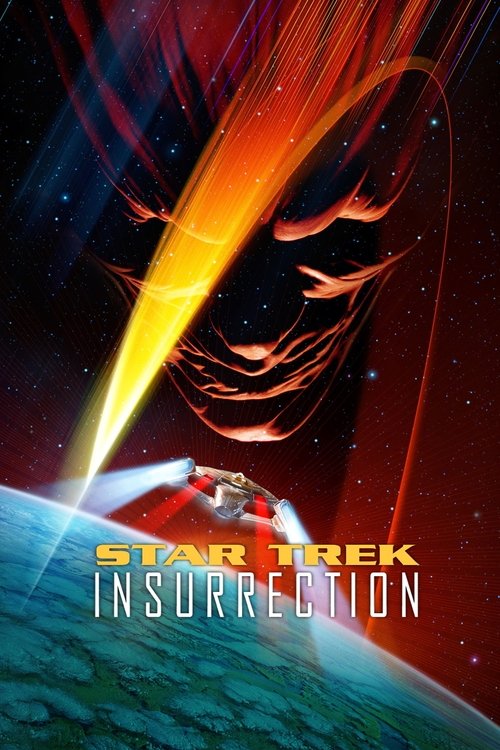
Star Trek: Insurrection (1998)
Directed by Jonathan Frakes
No — Star Trek: Insurrection is not especially woke, scoring 27 out of 100 on our wokeness meter.
Star Trek: Insurrection arrives in 1998 as the ninth film in the franchise and the third to employ the Next Generation cast.
Consciousness Markers
The Ba'ku are a peaceful, pre-technological people whose planet is to be seized and their population deceptively relocated for its resources, a clear allegory for colonial and indigenous displacement that the film treats as a moral outrage.
Picard delivers multiple earnest speeches about the Prime Directive, Starfleet ideals, and the immorality of forced relocation, giving the film a distinctly sermonizing, moralizing tone.
The villains are resource extractors and Starfleet officers who collude to strip a planet for its commercial and medical value, and Picard's rebellion is framed against that pragmatic exploitation, but the critique is aimed at corruption rather than capitalism itself.
The cast is the established Next Generation ensemble, which happens to include Black actors LeVar Burton and Michael Dorn and Greek-born Marina Sirtis, but this is inherited franchise diversity rather than a casting decision made for representational purposes.
The harvesting of the metaphasic particles is noted to massively poison the planet, giving the plot a mild environmental-destruction angle, though it is a means to an end rather than an ecological crusade.
Crusher and Troi are competent officers and Anij is a dignified Ba'ku elder, but the film's women largely orbit Picard's romance or serve the ensemble; there is no feminist thesis at work.
The Son'a's grotesque reliance on excessive cosmetic surgery is portrayed as a symptom of a culture obsessed with youth, a faint critique of appearance-fixation, but it is not framed as body positivity.
There are no LGBTQ+ characters, relationships, or themes anywhere in the film.
Data is an android whose malfunction drives the plot, but his nature is treated as artificial intelligence, not as a neurodivergent condition.
The film presents a straightforward Star Trek adventure with no revisionist reframing of historical events.
Why it received this score
Star Trek: Insurrection arrives in 1998 as the ninth film in the franchise and the third to employ the Next Generation cast. It aims for a lighter tone after the grim efficiency of First Contact, though what it mostly achieves is a feature-length episode with a larger catering budget. The plot concerns the Ba'ku, a peaceful people who have rejected technology, and the joint Starfleet and Son'a operation to relocate them by deception so that the planet's metaphasic particles can be harvested. This is a colonial displacement narrative, plainly stated and morally outraged. Picard's rebellion against his own command carries real sermon weight, and the film returns again and again to the Prime Directive as a sacred text. The environmental angle exists, since the harvesting poisons the world, but it functions as a plot mechanism. The villainy is corporate and corrupt, though the critique lands on bad actors inside a good institution, not on the economic order itself.
The ensemble remains the established one. LeVar Burton, Michael Dorn, and Marina Sirtis are present, but their inclusion is inherited from television, not a representational casting initiative. The women are capable officers and Anij is a dignified elder, yet the emotional architecture places Picard's romance at the center, and the feminist argument never advances beyond competence. The Son'a's reliance on excessive cosmetic surgery allows for a faint jab at youth obsession, a gesture toward appearance culture that stops well short of body positivity. Data's malfunction is an android problem, not a neurodivergent one. There are no queer characters, relationships, or subtext. The film has no interest in revising history; it is a straightforward adventure with a moral headache.
The sermonizing is the most consistent feature. Picard lectures admirals, defends the Ba'ku, and invokes Starfleet ideals with the weary certainty of a man who has read the mission statement and believes every word. The film is earnest, middleweight, and convinced of its own virtue. It wants to be about something, and it is, just not with the rigor its speeches imply. A well-meaning vintage, lightly oaked in self-importance, best served at room temperature.
Analysis generated by our Consciousness Algorithm
Part of


Synopsis
When an alien race and factions within Starfleet attempt to take over a planet that has "regenerative" properties, it falls upon Captain Picard and the crew of the Enterprise to defend the planet's people as well as the very ideals upon which the Federation itself was founded.
Questions about Star Trek: Insurrection
Is Star Trek: Insurrection woke?
No — Star Trek: Insurrection is not especially woke, scoring 27 out of 100 on our wokeness meter. That earns it a verdict of Based.
Does Star Trek: Insurrection have any woke elements?
2 of the 10 markers register at 30 or above, led by Lecture Energy (45) and Racial Consciousness (45). On Lecture Energy: Picard delivers multiple earnest speeches about the Prime Directive, Starfleet ideals, and the immorality of forced relocation, giving the film a distinctly sermonizing, moralizing tone.
How does Star Trek: Insurrection compare to other 1998 movies?
It ranks #10 of the 118 films from 1998 we've scored; their average is 12. The wokest is Show Me Love (60).
Is Star Trek: Insurrection the most woke Star Trek: The Next Generation movie?
Yes. It scores highest of the 4 Star Trek: The Next Generation films we've scored.