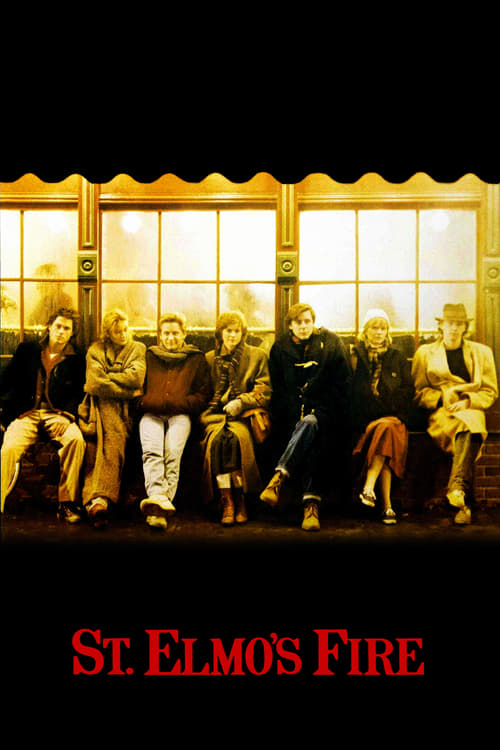
St. Elmo's Fire (1985)
Directed by Joel Schumacher
No — St. Elmo's Fire is not woke, scoring 4 out of 100 on our wokeness meter.
St. Elmo's Fire arrives as a pristine specimen of 1985 Brat Pack cinema, a film that follows seven Georgetown graduates as they negotiate the treacherous waters of post-collegiate life.
Consciousness Markers
Leslie resists Alec's pressure to marry and declares she doesn't want to date anyone for a while, and Wendy asserts independence from her parents, but these are mild 1985-era gestures rather than a feminist agenda.
The principal Brat Pack cast is entirely white; a wealthy Korean businessman (Kim Sung Ho) and an ungainly Jewish suitor (Howie Krantz) appear only as minor plot devices, with no meaningful representation agenda.
Jules accuses Kevin of being gay and in love with Alec, but this is a single throwaway line used as an insult rather than any genuine LGBTQ+ theme or character.
The film is a self-absorbed character drama that wallows in its protagonists' problems without delivering any preachy social message to the audience.
The film engages no racial themes whatsoever; its Korean and Jewish characters exist as background color without commentary on race or identity.
No environmental or climate content of any kind appears in this post-college character drama.
The film is thoroughly yuppie-aspirational, centered on young Republicans and career ambition; Jules's overspending is framed as personal failure, not a critique of capitalism.
Billy mocks Wendy's girdle during a drunken encounter, the opposite of any body-positive sensibility.
No neurodivergent characters or themes are present.
The film is a contemporary 1985 story with no historical subject matter to revise.
Why it received this score
St. Elmo's Fire arrives as a pristine specimen of 1985 Brat Pack cinema, a film that follows seven Georgetown graduates as they negotiate the treacherous waters of post-collegiate life. The enterprise is thoroughly yuppie-aspirational, its moral universe bounded by career ambition, romantic entanglements, and the search for a more sedate brunch spot. Any expectation of modern social consciousness should be set aside at the door. The principal cast is uniformly white, with a wealthy Korean businessman and an ungainly Jewish suitor appearing only as minor plot devices. A single line in which Jules accuses Kevin of being gay functions as a throwaway insult, not a genuine exploration of LGBTQ+ themes. Leslie's reluctance to marry and Wendy's assertion of independence from her parents register as mild 1985-era gestures, hardly a feminist agenda. The film's treatment of Wendy's girdle during a drunken encounter is the opposite of body-positive sensibility. There is no climate content, no anti-capitalist critique (Jules's overspending is framed as personal failure), no neurodivergent characters, and no historical subject matter to revise. The film's lecture energy is similarly muted. It wallows in its protagonists' problems without delivering any preachy social message to the audience. The characters are spoiled, affluent, and unbearably smug, as contemporary critics noted, and the film accepts their worldview without real criticism. This is not a sermon; it is gossip, as David Denby put it, designed to be picked apart on the telephone. The result is a time capsule of self-absorption, a document of young Republicans learning to brunch. For those of us who classify cultural artifacts with somber precision, St. Elmo's Fire offers a low-yield specimen: a film that gestures toward independence and romantic autonomy but never threatens to challenge the status quo. It is a relic of an era when social consciousness meant remembering to call your friends after a crisis. The score, appropriately, sits near the bottom of the scale.
Analysis generated by our Consciousness Algorithm


Synopsis
Reluctant to let go of college life, a close-knit team of seven friends--irresponsible saxophone player Billy, young Republican Alec, his girlfriend Leslie, struggling journalist Kevin, drama queen Jules, lovesick waiter Kirby, and Wendy, a social worker with a heart of gold--realise the party is over. And as the burdens of maturity close in on the young dreamers, the complexities of adulthood and the daily struggle of growing up put their sacred friendship to the test. But everyone knows life is not a bed of roses. It won't be easy, but when all is said and done, what will it take for St. Elmo's clique to find its place in the real world?
Questions about St. Elmo's Fire
Is St. Elmo's Fire woke?
No — St. Elmo's Fire is not woke, scoring 4 out of 100 on our wokeness meter. That earns it a verdict of Ultra Based.
Does St. Elmo's Fire have any woke elements?
Very few. None of the 10 markers reaches 30, the level where a marker counts as present; the highest is Feminist Agenda at 12.
How does St. Elmo's Fire compare to other 1985 movies?
It ranks #33 of the 68 films from 1985 we've scored; their average is 8. The wokest is The Color Purple (62).
How is the Woke Score calculated?
An AI-assisted process researches the film and its reception, scores it 0–100 on ten markers, then combines those into one 0–100 Woke Score. It measures a specific set of 2020s cultural themes, not film quality.