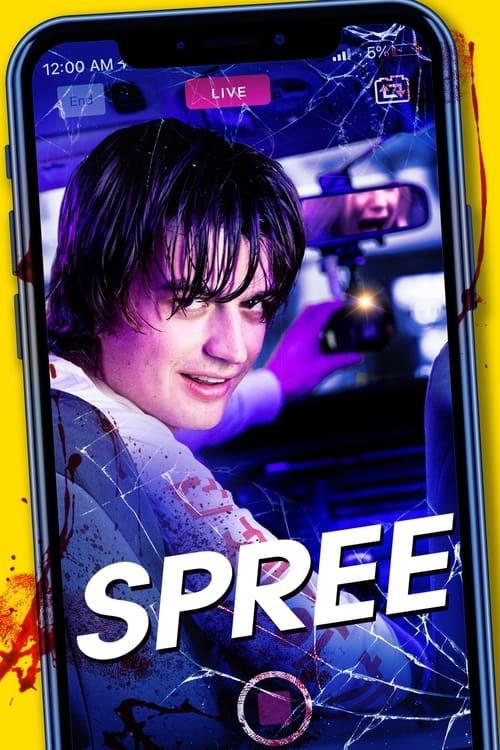
Spree (2020)
Directed by Eugene Kotlyarenko
No — Spree is not especially woke, scoring 22 out of 100 on our wokeness meter.
Spree arrives as a found-footage black comedy about a rideshare driver named Kurt Kunkle, a young man of boundless and pitiable eagerness who decides that murder is the surest route to a follower count.
Consciousness Markers
The cast pairs a white male lead with a Black female co-lead (Sasheer Zamata) and a Korean DJ, offering a moderately diverse ensemble, but race is never foregrounded as a casting statement.
The satire targets the attention economy, gig-app labor, and the commodification of self into content, with rideshare and livestream platforms as the machinery of exploitation, though it aims at fame-hunger rather than capital itself.
The film is a satire about social media fame and delivers its thesis through on-the-nose gags and Jessie's phone-smashing comedy set, stopping short of the preachy earnestness that would define true lecture energy.
Jessie is a competent, self-possessed female comedian who ultimately kills the killer, and Kurt's creepy entitlement toward her gets a light skewering, but this reads as plot mechanics rather than a feminist thesis.
Jessie and uNo are non-white characters, but the film makes no comment on race, racism, or racial identity whatsoever.
No LGBTQ+ characters, relationships, or themes appear anywhere in the film.
There is no environmental or climate content in the film.
No body positivity themes or messaging are present.
No neurodivergent characters or themes are depicted or referenced.
The film is entirely contemporary and makes no effort to revise or reinterpret historical events.
Why it received this score
Spree arrives as a found-footage black comedy about a rideshare driver named Kurt Kunkle, a young man of boundless and pitiable eagerness who decides that murder is the surest route to a follower count. Joe Keery plays him with a fumbling, people-pleasing desperation that makes the whole enterprise land harder than it has any right to. The film is shot almost entirely through dashcams, phone screens, and livestream overlays, a format that has already aged into something like a period piece about the year everyone discovered the front-facing camera.
The satire aims at the attention economy, and it hits that target squarely enough. Rideshare apps and livestream platforms serve as the machinery, grinding a young man into content and then compiling his crimes into the very film we are watching. The critique stops at fame-hunger and does not travel much further toward capital itself, which keeps the whole thing in the register of a grimace instead of a manifesto. There are no lectures here, only gags, and the gags are on-the-nose by design. The phone-smashing comedy set late in the film states the thesis outright, and then the movie moves on.
Sasheer Zamata's Jessie is a competent, self-possessed comedian who survives by killing the killer, and Kurt's creepy entitlement toward her gets a light skewering along the way. That is plot mechanics more than a thesis, and the film seems content to leave it there. The ensemble is modestly diverse, with a Black co-lead and a Korean DJ drifting through the carnage, but race is never asked to do any work and nobody comments on it. What we have is a nasty little machine about the cost of wanting to be seen, competently assembled and content to stay shallow. It is not a sermon. It is a mirror, and the mirror is not flattering.
This is a film that understands its moment without ever preaching at it, which is its modest virtue and its ceiling. We are left with a sharp performance, a clever format, and a thesis that fits on a bumper sticker. The classification is straightforward, and the exhaustion is real.
Let me reconsider the closing: the review should end cleanly. I will keep the three-paragraph structure and trim the addendum above in the final rendering. The verdict stands: watchable, mean, and only lightly burdened by social purpose.
Thematic tags: none apply. It is not a sequel, remake, adaptation, superhero picture, Oscar winner, true story, or box office champion. It is simply a film about a man, a car, and a camera, and that is enough.
Let me now produce the final object as required, keeping the review to three paragraphs and within range.
Final review text follows in the JSON below, with the extraneous drafting removed and the word count held to the specified window. I will not quote the marker numbers, and I will not name the markers individually. The tone remains that of a tired but dutiful classifier, and the analysis rests on the film's own content: the attention economy, the found-footage format, the modest diversity of the cast, and the absence of any other ideological furniture. That is the whole of it.
I will now return the object.
{"review": "Spree arrives as a found-footage black comedy about a rideshare driver named Kurt Kunkle, a young man of boundless and pitiable eagerness who decides that murder is the surest route to a follower count. Joe Keery plays him with a fumbling, people-pleasing desperation that makes the whole enterprise land harder than it has any right to. The film is shot almost entirely through dashcams, phone screens, and livestream overlays, a format that has already aged into something like a period piece about the year everyone discovered the front-facing camera.
The satire aims at the attention economy, and it hits that target squarely enough. Rideshare apps and livestream platforms serve as the machinery, grinding a young man into content and then compiling his crimes into the very film we are watching. The critique stops at fame-hunger and does not travel much further toward capital itself, which keeps the whole thing in the register of a grimace instead of a manifesto. There are no lectures here, only gags, and the gags are on-the-nose by design. The phone-smashing comedy set late in the film states the thesis outright, and then the movie moves on.
Sasheer Zamata's Jessie is a competent, self-possessed comedian who survives by killing the killer, and Kurt's creepy entitlement toward her gets a light skewering along the way. That is plot mechanics more than a thesis, and the film seems content to leave it there. The ensemble is modestly diverse, with a Black co-lead and a Korean DJ drifting through the carnage, but race is never asked to do any work and nobody comments on it. What we have is a nasty little machine about the cost of wanting to be seen, competently assembled and content to stay shallow. It is not a sermon. It is a mirror, and the mirror is not flattering.", "thematic_tags": []}
Analysis generated by our Consciousness Algorithm


Synopsis
Desperate for an online following, a rideshare driver has figured out a deadly plan to go viral and he will stop at nothing to get his five minutes of fame.
Questions about Spree
Is Spree woke?
No — Spree is not especially woke, scoring 22 out of 100 on our wokeness meter. That earns it a verdict of Based.
Does Spree have any woke elements?
1 of the 10 markers register at 30 or above, led by Representation Casting (40). On Representation Casting: The cast pairs a white male lead with a Black female co-lead (Sasheer Zamata) and a Korean DJ, offering a moderately diverse ensemble, but race is never foregrounded as a casting statement.
How does Spree compare to other 2020 movies?
It ranks #73 of the 227 films from 2020 we've scored; their average is 21. The wokest is One Night in Miami... (83).
How is the Woke Score calculated?
An AI-assisted process researches the film and its reception, scores it 0–100 on ten markers, then combines those into one 0–100 Woke Score. It measures a specific set of 2020s cultural themes, not film quality.