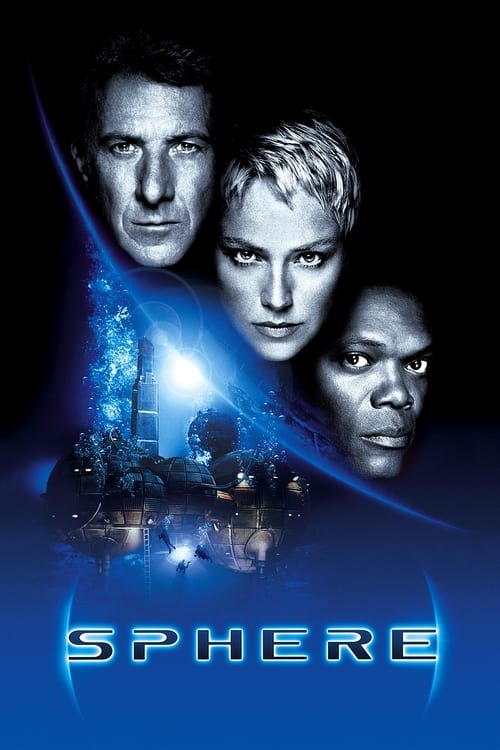
Sphere (1998)
Directed by Barry Levinson
No — Sphere is not woke, scoring 9 out of 100 on our wokeness meter.
The year is 1998, and Warner Bros.
Consciousness Markers
The ensemble includes Samuel L. Jackson, Queen Latifah, Marga Gómez, and James Pickens Jr. in roles that exist naturally without commentary, reflecting 1990s colorblind casting rather than a modern representation agenda.
Sharon Stone plays a competent marine biologist, but her gender is never framed as a statement or struggle; she is simply a scientist on the team.
The film is heavy on expositional dialogue about the sphere and the entity, but this is plot mechanics rather than social or political lecturing.
No LGBTQ+ characters, themes, or subtext appear anywhere in the film.
The film engages no racial themes whatsoever; the diverse cast is incidental to a story about alien psychology and fear.
The deep-sea setting is atmospheric, not ecological; no climate messaging is present.
No critique of capitalism, corporations, or wealth appears in the narrative.
No body-positive themes or messaging about body image are present.
The psychologist protagonist is a professional role, not a depiction of neurodivergence; no such themes are explored.
The film is a straightforward adaptation of Crichton's novel with no historical revisionism.
Why it received this score
The year is 1998, and Warner Bros. has spent somewhere between seventy-three and eighty million dollars on a Michael Crichton adaptation in which a team of scientists descends to the Pacific floor, finds a spacecraft that should not be there, and then finds a sphere inside it. Barry Levinson directs. Dustin Hoffman, Sharon Stone and Samuel L. Jackson star. The film opened third, earned tepid notices, and closed its theatrical run as a write-down. It is a genre exercise from a decade that had not yet been asked to explain itself.
The ensemble is more textured than the material deserves. Samuel L. Jackson, Queen Latifah, Marga Gómez and James Pickens Jr. appear as working professionals whose presence is never framed as a statement. This is colorblind casting in the 1990s manner, incidental and unremarked. Sharon Stone plays a marine biologist of evident competence, and the film never converts that competence into an argument about anything. No racial themes surface. No LGBTQ content, no ecological warning, no contempt for corporations, no discourse on bodies or brains. The psychologist is a job title, not a diagnosis.
The film does have talk, and plenty of it. The sphere is probed, described, theorized, and explained by men and women standing in a wet room. This is exposition as load-bearing architecture, and it holds up nothing. Roger Ebert observed that the screenplay uses lots of talk to conceal the fact that the story has never been grappled with, which remains a fair verdict. The result is an A-level cast delivering B-grade material, culturally inert and apparently content to stay that way. The sphere, for its part, floats off into space at the end, unbothered.
Analysis generated by our Consciousness Algorithm
Part of


Synopsis
A spacecraft is discovered at the bottom of the Pacific Ocean, presumed to be at least 300 years old and of alien origin. A crack team of scientists and experts is assembled and taken to the ocean floor to investigate. However, the ship is not as it seems and when a giant perfect sphere is discovered in the cargo bay, things begin to fall apart.
Questions about Sphere
Is Sphere woke?
No — Sphere is not woke, scoring 9 out of 100 on our wokeness meter. That earns it a verdict of Ultra Based.
Does Sphere have any woke elements?
1 of the 10 markers register at 30 or above, led by Representation Casting (30). On Representation Casting: The ensemble includes Samuel L.
How does Sphere compare to other 1998 movies?
It ranks #51 of the 118 films from 1998 we've scored; their average is 12. The wokest is Show Me Love (60).
How is the Woke Score calculated?
An AI-assisted process researches the film and its reception, scores it 0–100 on ten markers, then combines those into one 0–100 Woke Score. It measures a specific set of 2020s cultural themes, not film quality.