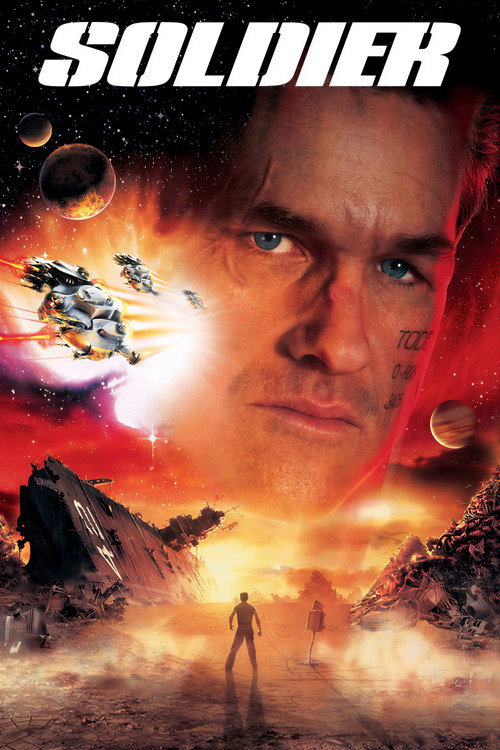
Soldier (1998)
Directed by Paul W. S. Anderson
No — Soldier is not woke, scoring 8 out of 100 on our wokeness meter.
Soldier arrives in 1998 as a slab of grim futurism, a Kurt Russell vehicle in which the star speaks 104 words and spends most of the runtime limping through a garbage planet.
Consciousness Markers
The cast is overwhelmingly white, with Jason Scott Lee as the antagonist Caine 607 providing the only notable non-white presence in a 1998 action ensemble. No deliberate diversity casting agenda is evident.
The military establishment discards obsolete soldiers like trash, offering a faint critique of institutional callousness, but this is a genre trope rather than an anti-capitalist thesis.
The film gestures at themes of humanity and emotion versus conditioning, but delivers them through action rather than preachy dialogue; Todd speaks only 104 words.
Connie Nielsen's Sandra is a supportive wife figure with no agency beyond the domestic sphere; the film is a male-centric military actioner with no feminist framing.
The waste-disposal planet Arcadia 234 is a setting for the story rather than an environmentalist statement; no climate messaging is present.
The mute son Nathan is defined by trauma-induced silence rather than any modern neurodivergence framing; the condition is a plot device, not a statement.
No LGBTQ+ characters, themes, or subtext appear anywhere in the film.
The film contains no engagement with racial themes, history, or consciousness whatsoever.
No body-positive themes or messaging are present.
The film invents a fictional future military history with no revisionist claims about real events.
Why it received this score
Soldier arrives in 1998 as a slab of grim futurism, a Kurt Russell vehicle in which the star speaks 104 words and spends most of the runtime limping through a garbage planet. Paul W. S. Anderson directs with the solemnity of a man filing a government report. The premise concerns obsolete military men replaced by genetically engineered ones, discarded like defective appliances, then forced to defend a peaceful colony of crash survivors. This is sturdy genre machinery, and the film has aged into a minor cult item for people who enjoy seeing a taciturn man solve problems with his hands. The social consciousness on display is mostly accidental. The cast is white by default, with Jason Scott Lee as the antagonist providing the only visible variation. No larger argument about representation is made. No queer subtext disturbs the proceedings.
The domestic sphere gets a brief nod through Connie Nielsen's Sandra, a wife and mother whose narrative function is to worry and to be protected. Any feminist reading would be a generous act of archaeology. Racial themes are absent. The waste planet Arcadia 234 is a backdrop, not a climate parable, though its mountains of refuse could support an environmentalist essay if anyone involved had shown interest. The military hierarchy treats old soldiers as trash, which offers a faint anti-institutional chill, but it is a familiar action trope, not an economic thesis. Body positivity does not enter the frame. The mute child Nathan is a plot device born of trauma, not a study in neurodivergence, and his silence exists to teach the hero about feeling.
Where the film gestures toward meaning, it does so through action. Todd's conditioning versus his growing humanity is conveyed with long stares and tactical violence. The sermonizing is minimal, which is a relief. The result is a lean, humorless, occasionally effective B picture with delusions of grandeur and a surprisingly sturdy cult afterlife. It asks little of the audience beyond patience and a tolerance for smoke. That restraint keeps its cultural agenda nearly invisible, which in 1998 was not a strategy but a default.
Analysis generated by our Consciousness Algorithm
Part of


Synopsis
Sergeant Todd is a veteran soldier for an elite group of the armed forces. After being defeated by a new breed of genetically engineered soldiers, he is dumped on a waste planet and left for dead. He soon interacts with a group of crash survivors who lead out a peaceful existence. The peace is broken as the new soldiers land on the planet to eliminate the colony, which Sergeant Todd must defend.
Questions about Soldier
Is Soldier woke?
No — Soldier is not woke, scoring 8 out of 100 on our wokeness meter. That earns it a verdict of Ultra Based.
Does Soldier have any woke elements?
Very few. None of the 10 markers reaches 30, the level where a marker counts as present; the highest is Representation Casting at 18.
How does Soldier compare to other 1998 movies?
It ranks #56 of the 118 films from 1998 we've scored; their average is 12. The wokest is Show Me Love (60).
How is the Woke Score calculated?
An AI-assisted process researches the film and its reception, scores it 0–100 on ten markers, then combines those into one 0–100 Woke Score. It measures a specific set of 2020s cultural themes, not film quality.