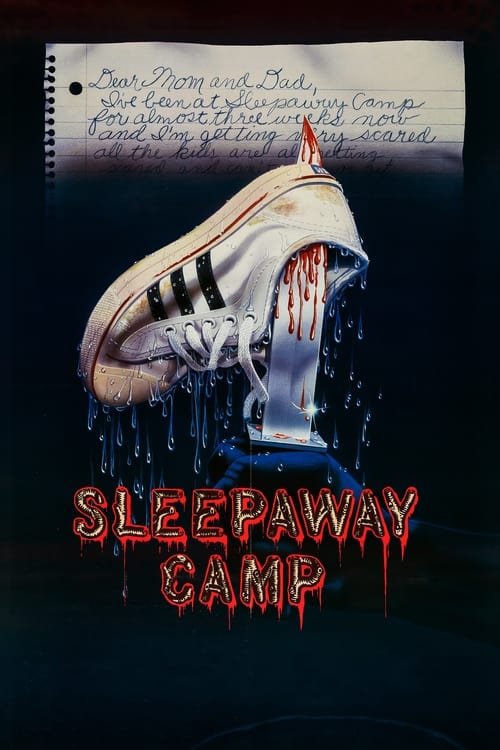
Sleepaway Camp (1983)
Directed by Robert Hiltzik
No — Sleepaway Camp is not woke, scoring 9 out of 100 on our wokeness meter.
Sleepaway Camp arrives from 1983 with the confidence of a film that knows precisely what it is: a cheap, mean slasher assembled in the shadow of Friday the 13th.
Consciousness Markers
The film includes a gay couple and a notorious gender-identity twist, but it is framed as exploitative horror rather than progressive LGBTQ+ representation.
The cast is overwhelmingly white, with only a minor Black supporting actor; there is no modern inclusive casting intent.
Female characters are largely victims, bullies, or objects of violence; no feminist agenda is present.
The film does not engage with racial themes or consciousness.
No environmental or climate-related themes appear.
There is no critique of capitalism or wealth inequality.
The film does not promote body positivity or challenge body norms.
Mental illness and trauma are used as horror tropes, not as neurodivergent advocacy.
The film is not based on historical events and offers no revisionist historical narrative.
The film is a straightforward slasher with no preachy or lecture-like messaging.
Why it received this score
Sleepaway Camp arrives from 1983 with the confidence of a film that knows precisely what it is: a cheap, mean slasher assembled in the shadow of Friday the 13th. The campers of Camp Arawak form a uniformly pale procession of adolescents, and the lone Black performer in the cast, Robert Earl Jones, occupies a supporting corner while the screenplay never once acknowledges his presence as a matter of design. There is no casting architecture at work here, no curatorial hand arranging faces for an audience's approval. The production needed bodies to fill bunks, and it found them.
The picture does carry a faint residue of transgressive material. The opening boating trip establishes John Baker and his boyfriend Lenny, and the closing revelation reframes the traumatized heroine as her presumed-dead brother Peter, raised as a girl by an aunt who wanted a daughter. Both gestures land as exploitation, not affirmation. The final image is a naked, knife-clutching figure hissing at two horrified counselors, staged for revulsion and nothing else. Whatever conversation about identity the film brushes against, it conducts that conversation with a hot curling iron and a severed head.
The remaining ledger is bare. Female characters exist to be bullied, seduced, or bisected, and the film mounts no counter-argument on their behalf. Mental illness serves as a plot mechanism. Wealth, climate, body image, and the historical record go entirely unmentioned. Nobody lectures. Nobody explains the moral. A group of children are murdered in their sleeping bags, and the camera regards the aftermath with the calm of a counselor filing a routine report. For a certain kind of viewer this registers as a defect. For the sacred work of classification, it is a clean slate, and we record it as such.
Analysis generated by our Consciousness Algorithm


Synopsis
Years after a terrible boating accident, Angela is sent to Camp Arawak where a series of bizarre and violent "accidents" begin to claim the lives of various campers.
Questions about Sleepaway Camp
Is Sleepaway Camp woke?
No — Sleepaway Camp is not woke, scoring 9 out of 100 on our wokeness meter. That earns it a verdict of Ultra Based.
Does Sleepaway Camp have any woke elements?
Very few. None of the 10 markers reaches 30, the level where a marker counts as present; the highest is LGBTQ+ Themes at 15.
How does Sleepaway Camp compare to other 1983 movies?
It ranks #14 of the 38 films from 1983 we've scored; their average is 10. The wokest is Sans Soleil (68).
How is the Woke Score calculated?
An AI-assisted process researches the film and its reception, scores it 0–100 on ten markers, then combines those into one 0–100 Woke Score. It measures a specific set of 2020s cultural themes, not film quality.