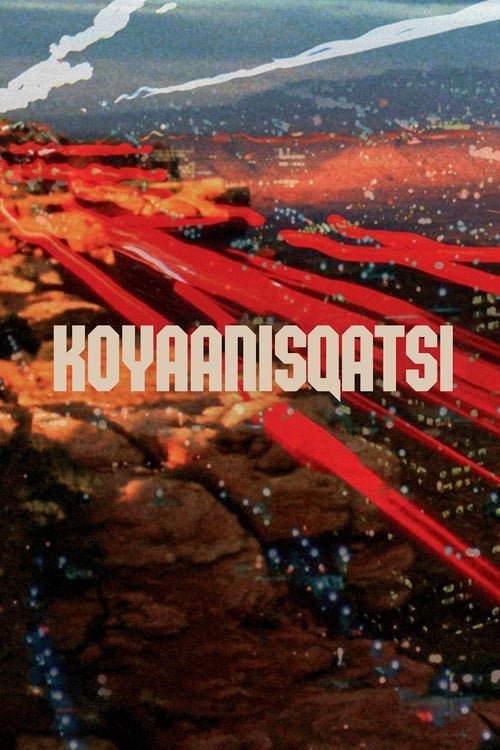
Koyaanisqatsi (1983)
Directed by Godfrey Reggio
No — Koyaanisqatsi is not especially woke, scoring 21 out of 100 on our wokeness meter.
Godfrey Reggio's Koyaanisqatsi arrives from 1982 with the patience of a geological epoch and the temperament of a sermon delivered entirely in pictures.
Consciousness Markers
Environmental destruction is the film's central preoccupation — mining, oil drilling, power plants, and the toll of industry on the earth — though framed as a 1982 meditation on technology rather than modern climate activism.
The film critiques industrial modernity, consumerism, and the technological system through images of factories, shopping centers, and channel surfing, but its target is technology itself rather than capital or class.
The film is a wordless visual tone poem with no narration or dialogue, so it cannot lecture verbally; its social commentary is delivered entirely through image and music juxtaposition.
The film's Times Square portrait sequence captures a cross-section of passersby of varying races and classes, but this is observational street footage rather than a deliberate diversity-casting agenda.
The film invokes Hopi prophecies and an indigenous cosmology as a counterpoint to modern civilization, but this is poetic framing rather than a revisionist reinterpretation of historical events.
Urban-decay and Pruitt-Igoe imagery carries implicit racial subtext given the demographics of those sites, but the film never addresses race explicitly or thematically.
No LGBTQ+ content, characters, or themes of any kind appear in this non-narrative visual essay.
The film offers no feminist framework or gendered critique; its subject is technology and civilization in the abstract.
No body-positivity themes or messaging are present.
No neurodivergence themes or representation appear in the film.
Why it received this score
Godfrey Reggio's Koyaanisqatsi arrives from 1982 with the patience of a geological epoch and the temperament of a sermon delivered entirely in pictures. There is no dialogue, no narrator, no intertitles. Philip Glass supplies a score of relentless repetition, and Ron Fricke supplies time-lapse clouds, strip mines, cooling towers, and the slow-motion drift of shoppers through a food court. The film's animating concern is the toll that industrial civilization takes on the earth and on the people who live inside it. Mining, oil drilling, evaporation ponds, a nuclear test blooming over the desert: the environmental case is made with unusual thoroughness for its era, though the argument is framed as a meditation on technology, not as a call to policy.
The social critique is real but slippery. Factories, shopping centers, channel surfing, and the demolition of the Pruitt-Igoe housing project all pass before the lens, indicting consumer appetite and the machinery that feeds it. The target, however, is the technological system itself, not capital or class. Reggio has said as much. Hopi prophecy provides the moral counterweight, sung near the end over the faces of ordinary people pulled from Times Square, a cross-section of strangers who stare back at the camera. That gesture carries a quiet racial and economic subtext, given the sites chosen for the urban-decay passages, but the film never names it.
The film does not lecture. It cannot. It has no words to lecture with, and its commentary is assembled entirely through juxtaposition, which keeps the preaching implicit and the imagery in charge. The result is a landmark of observational cinema, preserved in the National Film Registry, and a reminder that a film may be deeply concerned with the planet while remaining innocent of the vocabulary that later decades would insist upon.
Analysis generated by our Consciousness Algorithm


Synopsis
Takes us to locations all around the US and shows us the heavy toll that modern technology is having on humans and the earth. The visual tone poem contains neither dialogue nor a vocalized narration: its tone is set by the juxtaposition of images and the exceptional music by Philip Glass.
Questions about Koyaanisqatsi
Is Koyaanisqatsi woke?
No — Koyaanisqatsi is not especially woke, scoring 21 out of 100 on our wokeness meter. That earns it a verdict of Based.
Does Koyaanisqatsi have any woke elements?
3 of the 10 markers register at 30 or above, led by Climate Crusade (65), Eat the Rich (40) and Lecture Energy (30). On Climate Crusade: Environmental destruction is the film's central preoccupation — mining, oil drilling, power plants, and the toll of industry on the earth — though framed as a 1982 meditation on technology rather than modern climate activism.
How does Koyaanisqatsi compare to other 1983 movies?
It ranks #6 of the 38 films from 1983 we've scored; their average is 10. The wokest is Sans Soleil (68).
How is the Woke Score calculated?
An AI-assisted process researches the film and its reception, scores it 0–100 on ten markers, then combines those into one 0–100 Woke Score. It measures a specific set of 2020s cultural themes, not film quality.