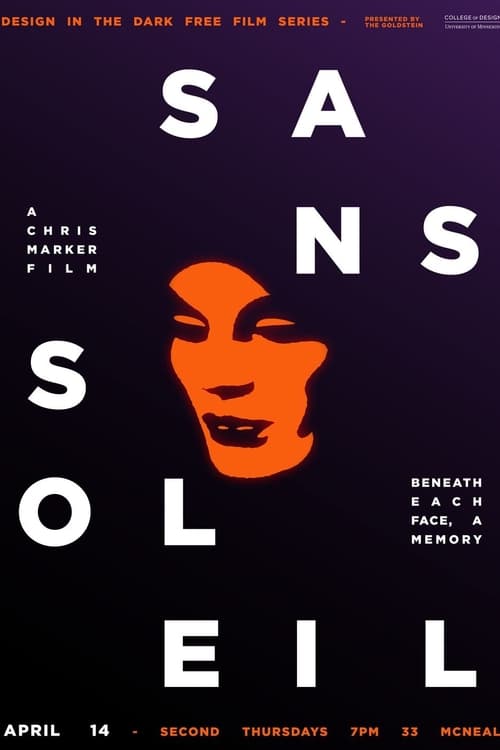
Sans Soleil (1983)
Directed by Chris Marker
Yes · Woke
How we score movies →Consciousness Markers
The film is essentially a sustained lecture delivered through narration and juxtaposed imagery. Marker's intellectual apparatus and the narrator's contemplative voice create an unmistakably preachy, essayistic tone throughout.
Marker's extended, respectful documentation of Guinea-Bissau's post-independence reconstruction and revolutionary struggle demonstrates genuine racial consciousness and anti-colonial awareness. The film centers African liberation movements as worthy of sustained attention.
Strong anti-capitalist current throughout. Marker critiques consumer culture in Japan, commodification of experience in urban spaces, and the alienating effects of late capitalism on human connection and memory.
Marker's treatment of Guinea-Bissau's independence struggle could be read as revisionist in its elevation of African agency and resistance, though it operates more as historical documentation than as revisionism per se.
The female narrator is a significant presence, but serves primarily as a narrative device rather than a fully developed character with agency. The film centers the perspective of a male traveler, with the woman providing commentary.
While a woman narrates, the film does not engage with feminist themes or gender politics. The narrator's voice operates as an intellectual apparatus rather than as an expression of feminine or feminist perspective.
No LGBTQ+ themes or representation present in the film. This is not a criticism given the era, but it registers as absent on contemporary metrics.
No engagement with climate or environmental themes. The film's interest in Iceland and Japan touches landscape, but not from an ecological consciousness perspective.
No engagement with body positivity, body diversity, or related themes. The film's visual approach to the body is observational rather than ideological.
No representation of or engagement with neurodivergence. This marker does not apply to the film's concerns.


Synopsis
A woman narrates the thoughts of a world traveler, meditations on time and memory expressed in words and images from places as far-flung as Japan, Guinea-Bissau, Iceland, and San Francisco.
Why it received this score
Sans Soleil is a film that operates in layers, each demanding separate consideration from the vantage point of contemporary cultural consciousness. Marker's 1983 meditation on time, memory, and global capitalism presents a narrator (a woman) reflecting on a mysterious traveler's journey through Japan, Guinea-Bissau, Iceland, and San Francisco. The film's treatment of the colonized world, particularly its extended footage from Guinea-Bissau during the aftermath of independence struggles, carries a genuine anti-imperialist consciousness that predates contemporary discourse on these matters. Yet the work remains a product of its era, filtered through Marker's European intellectual perspective, and the female narrator functions more as a narrative device than as a fully realized presence.
The film's relationship to race and colonial history deserves serious attention. Marker documents Guinea-Bissau with visible respect for its revolutionary struggle against Portuguese colonialism, centering footage of children, public works, and social reconstruction. This positioning of African liberation movements as worthy of sustained cinematic attention was genuinely progressive for 1983, though the gaze remains that of the Western observer. The broader anti-capitalist current runs throughout: Marker's meditations on consumer culture in Japan and the commodification of experience in San Francisco articulate a clear skepticism toward late capitalism. However, the film exhibits no engagement with LGBTQ+ themes, neurodiversity, or body diversity in any meaningful way.
The moderate score reflects a work that achieves some contemporary cultural resonance through its anti-colonial and anti-capitalist sensibilities, combined with its treatment of race and global power structures. These elements were ahead of their time, yet the work lacks the specific markers of 2020s progressive consciousness that define modern cultural analysis. Sans Soleil remains important cinema as historical artifact, a record of how an earlier era engaged with questions of power, representation, and memory.
Analysis generated by our Consciousness Algorithm
Critic Reviews
“Filters its ruminations through the prism of memory, both hazily distant and fiercely modern.”
“"Sans Soleil" is part history lesson, part home movie travelogue, and a wholly thrilling, anxiety-inducing chronicle of human disconnection.”
“Marker the intellectual, the theorist of montage, and the leftist are all evident in Sans Soleil, whose intellectual breadth seems ostentatious at first but eventually coheres.”