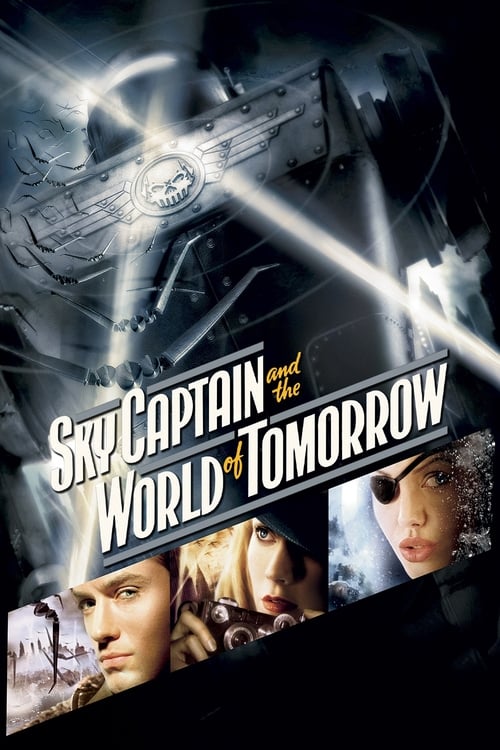
Sky Captain and the World of Tomorrow (2004)
Directed by Kerry Conran
No — Sky Captain and the World of Tomorrow is not woke, scoring 10 out of 100 on our wokeness meter.
Kerry Conran spent four years in his living room with a Macintosh IIci, assembling a black and white teaser that eventually convinced someone to hand him seventy million dollars.
Consciousness Markers
Polly Perkins is a proactive reporter and co-protagonist, and Commander Franky Cook is a female military leader, but the film treats these as pulp-adventure conventions rather than advancing a feminist agenda.
The film features non-white actors in supporting roles, such as Omid Djalili as Kaji and Bai Ling as the Mysterious Woman, but these are conventional exoticized adventure-film roles rather than deliberate modern inclusive casting.
There are no LGBTQ+ characters, themes, or subtext in the film.
The film contains no exploration of racial identity, systemic racism, or racial justice themes.
Although the villain's rocket threatens to ignite the atmosphere, this is a sci-fi apocalypse plot device, not a climate-change allegory or environmental crusade.
The antagonist is a mad scientist seeking to remake humanity, not a capitalist or economic system, and the film offers no eat-the-rich critique.
There is no body-positivity theme or celebration of diverse body types.
The film does not depict or discuss neurodivergence or neurodiverse characters.
The alternate 1939 setting is a retro-futuristic pulp aesthetic, not a revisionist historical narrative with modern ideological reframing.
The film is a lighthearted adventure serial homage and does not pause for moralizing or didactic speeches.
Why it received this score
Kerry Conran spent four years in his living room with a Macintosh IIci, assembling a black and white teaser that eventually convinced someone to hand him seventy million dollars. The result is a 1939 that never happened: art deco spires, zeppelins moored atop the Empire State Building, giant robots stomping through Manhattan while a reporter named Polly Perkins burns through her final two rolls of film. Laurence Olivier, dead since 1989, appears as the villain through computer manipulation of old footage, which remains the most audacious effect in a production otherwise built entirely on a digital backlot. The plot concerns a mad scientist who has given up on humanity and intends to reseed the planet with genetically superior Adams and Eves. It is nonsense of a high and pleasurable order.
On the question of contemporary social consciousness, the film is a relic of a different mode of blockbuster filmmaking, and content to be one. Polly Perkins is a proactive journalist and co-protagonist who saves the hero at a critical juncture, and Commander Franky Cook runs a Royal Navy flying aircraft carrier with a clipped efficiency suggesting she has better things to do than be photographed. These are pulp conventions, inherited from serials and adventure magazines, not arguments. The supporting cast includes Omid Djalili as a Himalayan ally and Bai Ling as a lethal gynoid, roles drawing on older exoticized adventure tropes without comment. There is no racial consciousness, no climate allegory despite the atmosphere-igniting rocket, no economic critique, no engagement with body image, neurodivergence, or queer identity. The villain is a eugenicist, which the film treats as villainy, plainly.
The film flopped, found its audience on home video, and now sits comfortably as a cult object. It does not lecture. It does not scold. It wants only to be a lost serial from 1939, and it lets its pleasures be visual while its politics stay inherited. A harmless artifact, and a quiet one.
Analysis generated by our Consciousness Algorithm


Synopsis
When gigantic robots attack New York City, "Sky Captain" uses his private air force to fight them off. His ex-girlfriend, reporter Polly Perkins, has been investigating the recent disappearance of prominent scientists. Suspecting a link between the global robot attacks and missing men, Sky Captain and Polly decide to work together. They fly to the Himalayas in pursuit of the mysterious Dr. Totenkopf, the mastermind behind the robots.
Questions about Sky Captain and the World of Tomorrow
Is Sky Captain and the World of Tomorrow woke?
No — Sky Captain and the World of Tomorrow is not woke, scoring 10 out of 100 on our wokeness meter. That earns it a verdict of Ultra Based.
Does Sky Captain and the World of Tomorrow have any woke elements?
Very few. None of the 10 markers reaches 30, the level where a marker counts as present; the highest is Feminist Agenda at 20.
How does Sky Captain and the World of Tomorrow compare to other 2004 movies?
It ranks #70 of the 178 films from 2004 we've scored; their average is 12. The wokest is Tropical Malady (62).
How is the Woke Score calculated?
An AI-assisted process researches the film and its reception, scores it 0–100 on ten markers, then combines those into one 0–100 Woke Score. It measures a specific set of 2020s cultural themes, not film quality.