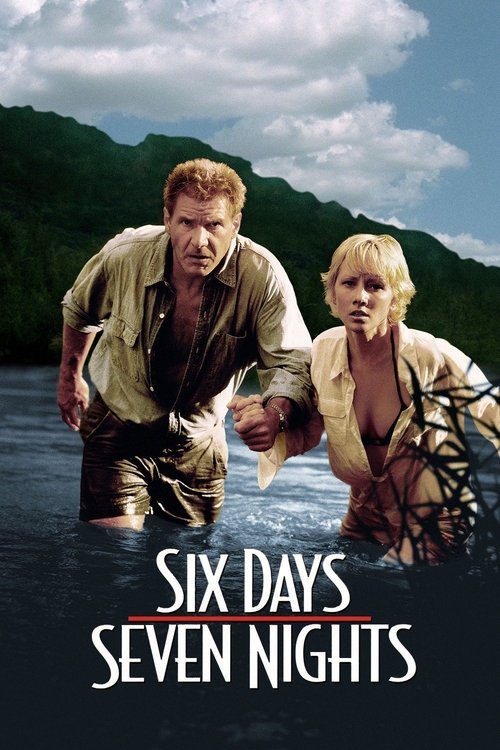
Six Days Seven Nights (1998)
Directed by Ivan Reitman
No — Six Days Seven Nights is not woke, scoring 8 out of 100 on our wokeness meter.
Six Days, Seven Nights arrives from 1998 with the confidence of a studio product that knows exactly what it is: a tropical opposites-attract comedy with a plane crash, pirates, and Harrison Ford squinting into the middle distance.
Consciousness Markers
The South Pacific setting yields a naturally diverse supporting cast (Temuera Morrison, Cliff Curtis, Danny Trejo, Jacqueline Obradors), but this is incidental regional casting rather than any deliberate representation statement.
Robin is a determined New York magazine editor with career agency who ultimately lands the plane herself, but the film remains a conventional 1998 opposites-attract romance with traditional gender dynamics.
The film contains no LGBTQ+ characters or themes whatsoever; the only related matter is the off-screen meta-controversy over Anne Heche's real-life relationship, which is not part of the film's content.
Despite its Polynesian setting and Māori cast members, the film engages in no racial commentary or consciousness of any kind.
A tropical squall serves purely as a plot device to strand the leads; there is no environmental messaging or climate crusade.
No critique of wealth, capitalism, or class structures appears anywhere in this studio romantic adventure.
No body-positivity themes or messaging are present.
No neurodivergent characters or themes are present.
The film makes no historical claims to revise; a crashed WWII floatplane is merely a plot convenience.
This is breezy Hollywood fluff with no preaching, moralizing, or didactic messaging of any kind.
Why it received this score
Six Days, Seven Nights arrives from 1998 with the confidence of a studio product that knows exactly what it is: a tropical opposites-attract comedy with a plane crash, pirates, and Harrison Ford squinting into the middle distance. The social consciousness on display is modest and mostly incidental. The South Pacific setting supplies a naturally varied supporting cast, including Temuera Morrison, Cliff Curtis, and Danny Trejo, but the film treats this as regional staffing, not a statement. No racial commentary follows the Polynesian backdrop. The climate exists only as weather machinery, a squall that strands the leads and then politely exits the narrative. There is no class critique, no body-positive messaging, no neurodivergent characterization, and no revisionist historical project. A crashed Japanese floatplane is a useful prop, not a thesis.
Robin Monroe has a magazine job and a measure of professional authority. She ultimately lands the plane herself, which gives the film a mild feminist credential. Yet the engine of the plot remains a conventional 1998 romance in which a sophisticated New York woman and a taciturn pilot bicker, survive, and fall into each other's arms. The gender dynamics are traditional, and the film has no interest in interrogating them. The off-screen casting controversy around Anne Heche belongs to Hollywood biography, not to the text. On screen there is no LGBTQ content at all.
The result is breezy, sunburned entertainment with no sermonizing impulse. It does not lecture about capital, history, or identity. It wants to put two attractive people on an island and let the mechanics of adventure do the work. That restraint is not virtue or vice. It is simply the film's operating temperature.
Analysis generated by our Consciousness Algorithm


Synopsis
In the South Pacific, in Polynesia, on the island of Makatea, Quinn Harris, a taciturn pilot, leads a quiet life, content to earn a living by transporting goods in his De Havilland Beaver. His life is exactly as he wants it to be—until he meets Robin Monroe, a sophisticated and determined woman, the assistant editor of a New York magazine, on vacation for a week with her boyfriend, Frank Martin. An urgent work assignment in Tahiti, the neighboring island, forces Robin to reluctantly hire Quinn to fly her there. But a violent storm forces them to make an emergency landing on a deserted island. This unlikely pair avoids each other at first, until they are forced to team up to escape the island... and evade the pirates who are after them. Danger and temptation are never far away...
Questions about Six Days Seven Nights
Is Six Days Seven Nights woke?
No — Six Days Seven Nights is not woke, scoring 8 out of 100 on our wokeness meter. That earns it a verdict of Ultra Based.
Does Six Days Seven Nights have any woke elements?
Very few. None of the 10 markers reaches 30, the level where a marker counts as present; the highest is Feminist Agenda at 15.
How does Six Days Seven Nights compare to other 1998 movies?
It ranks #56 of the 118 films from 1998 we've scored; their average is 12. The wokest is Show Me Love (60).
How is the Woke Score calculated?
An AI-assisted process researches the film and its reception, scores it 0–100 on ten markers, then combines those into one 0–100 Woke Score. It measures a specific set of 2020s cultural themes, not film quality.