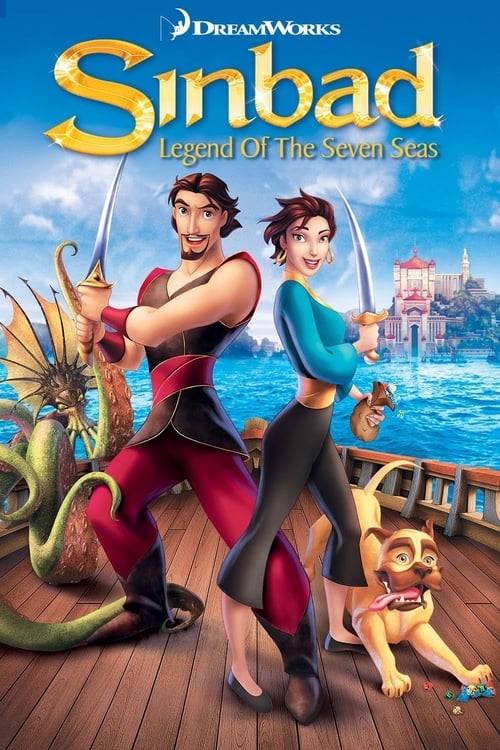
Sinbad: Legend of the Seven Seas (2003)
Directed by Tim Johnson
No — Sinbad: Legend of the Seven Seas is not woke, scoring 12 out of 100 on our wokeness meter.
Sinbad: Legend of the Seven Seas arrived in 2003 as DreamWorks Animation's last traditionally drawn feature, a detail that lends it a certain melancholy in retrospect.
Consciousness Markers
The cast is overwhelmingly white, with Brad Pitt voicing the explicitly Arab Sinbad and critics noting the film's departure from its Middle Eastern origins. Dennis Haysbert and a pair of Asian crew members provide some diversity, but the leads remain a white ensemble.
Lady Marina is a capable, headstrong ambassador who stows away, pilots the ship past the sirens, and wins the crew's respect, giving her more agency than a typical damsel. It is a conventional strong-heroine arc rather than a feminist thesis.
The film features a multiethnic pirate crew but engages in no commentary on race or racial injustice; its whitewashing of an Arab legend was itself a point of criticism rather than a theme.
The story is a straightforward romantic adventure with no overt moralizing or social messaging directed at the audience.
No LGBTQ+ characters, themes, or subtext appear anywhere in the film.
No environmental or climate themes are present in this mythological sea adventure.
Sinbad is a pirate seeking one last score, but the film carries no critique of wealth, class, or capitalism.
No body-positive messaging or diverse body representation is present.
No neurodivergent characters or themes are depicted.
The film is a fantasy drawn from legend and mythology, not a reworking of historical events.
Why it received this score
Sinbad: Legend of the Seven Seas arrived in 2003 as DreamWorks Animation's last traditionally drawn feature, a detail that lends it a certain melancholy in retrospect. The studio spent sixty million dollars and recovered eighty, a shortfall that contributed to a reported hundred and twenty-five million dollar loss and, eventually, an exclusive commitment to computers. There is a lesson in that, though not the kind the film itself cares to teach.
On the matter of cultural provenance, the record is complicated. Sinbad is identified in the production materials as an Arab sailor, and he is voiced by Brad Pitt, whose Missourian vowels were reportedly retained because the filmmakers believed they would lighten the mood. Historians of casting will study this decision for some time. The supporting ensemble includes Dennis Haysbert as the first mate and a pair of Asian crewmen who make bets with each other, gestures toward a wider world that never develop into anything. Lady Marina, an ambassador who stows away, steers the ship past the sirens while the men lie insensate, and earns the crew's grudging respect. It is a sturdy heroine arc, assembled from familiar parts, and it stops well short of argument.
Elsewhere the film is innocent. No character contends with questions of identity beyond the practical, no villain stands in for industry or empire, the sea is not melting, the bodies on display are uniformly athletic, and the mind is treated as a single uncomplicated organ. The moral instruction, such as it is, amounts to keeping a promise. A straightforward romantic adventure, then, and a costly one, which is its own kind of statement.
Analysis generated by our Consciousness Algorithm
Part of


Synopsis
The sailor of legend is framed by the goddess Eris for the theft of the Book of Peace, and must travel to her realm at the end of the world to retrieve it and save the life of his childhood friend Prince Proteus.
Questions about Sinbad: Legend of the Seven Seas
Is Sinbad: Legend of the Seven Seas woke?
No — Sinbad: Legend of the Seven Seas is not woke, scoring 12 out of 100 on our wokeness meter. That earns it a verdict of Ultra Based.
Does Sinbad: Legend of the Seven Seas have any woke elements?
2 of the 10 markers register at 30 or above, led by Feminist Agenda (30) and Representation Casting (30). On Feminist Agenda: Lady Marina is a capable, headstrong ambassador who stows away, pilots the ship past the sirens, and wins the crew's respect, giving her more agency than a typical damsel.
How does Sinbad: Legend of the Seven Seas compare to other 2003 movies?
It ranks #51 of the 150 films from 2003 we've scored; their average is 12. The wokest is Mona Lisa Smile (60).
How is the Woke Score calculated?
An AI-assisted process researches the film and its reception, scores it 0–100 on ten markers, then combines those into one 0–100 Woke Score. It measures a specific set of 2020s cultural themes, not film quality.