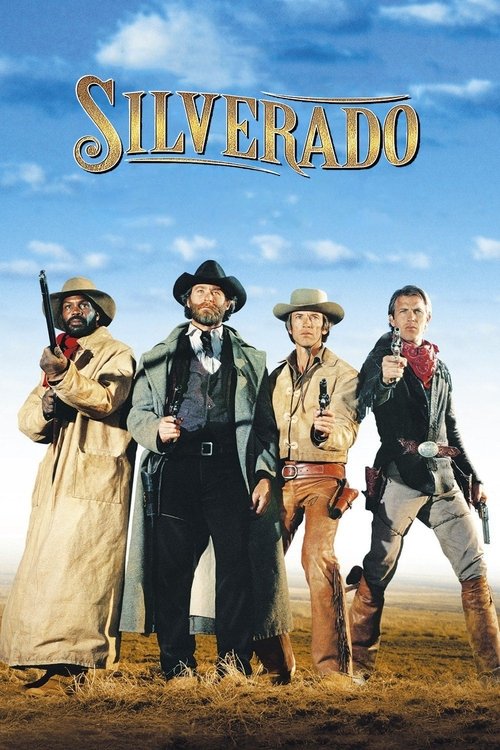
Silverado (1985)
Directed by Lawrence Kasdan
No — Silverado is not woke, scoring 15 out of 100 on our wokeness meter.
Lawrence Kasdan's Silverado arrives from 1985 with the confidence of a man who has studied the great Westerns and intends to honor every one of them.
Consciousness Markers
Danny Glover is one of the four leads as the Black cowboy Mal, and women appear in substantive supporting roles, but the film is not constructed around a modern diversity checklist.
Mal is a Black cowboy who faces explicit racism from a saloon owner, and the film acknowledges racial hostility in the Old West, though it is not a sustained racial-justice thesis.
The villains include a corrupt sheriff/saloon owner and a land-seizing rancher, giving the film a mild populist anti-power streak, but it is not an anti-capitalist parable.
No LGBTQ+ characters, themes, or subtext are present.
Women appear in the story, but the film does not advance a feminist critique or agenda.
No environmental or climate-crisis themes are present.
No body-positivity themes or messaging are present.
No neurodivergence themes or characters are present.
It is a traditional, affectionate Western rather than a revisionist historical corrective.
The film delivers genre action and camaraderie, not modern moral instruction.
Why it received this score
Lawrence Kasdan's Silverado arrives from 1985 with the confidence of a man who has studied the great Westerns and intends to honor every one of them. Four strangers converge, a corrupt sheriff runs a town, a rancher seizes land, and the whole enterprise gallops toward a shootout with the enthusiasm of a revival meeting. It is an affectionate museum piece, lovingly restored, and it makes no argument about the frontier beyond the argument that the frontier was good for a chase.
Where the film brushes against contemporary sensibilities, it does so lightly and without a manifesto. Danny Glover's Mal is a Black cowboy of real competence, and the film grants him a saloon owner's open hostility, a brief acknowledgment that the Old West contained uglier attitudes than the genre usually admitted. It is a gesture, not a thesis. Rosanna Arquette and Linda Hunt occupy meaningful space in a large ensemble, though the camera remains more interested in the men's hats. The villains are a land-grabbing rancher and a sheriff who owns the saloon, which gives the picture a faint populist rumble against concentrated power. That is the extent of the politics. Nobody lectures. Nobody converts.
Everything else is absent. There is no romantic subversion, no environmental sermon, no reclamation of the body, no neurodivergent interiority, no corrective rewriting of the historical record. The film is a traditional Western that knows it is a traditional Western and sees no reason to apologize. Kasdan stages the shootouts with genuine craft, and Bruce Broughton's score does a great deal of heavy lifting. Two Academy Award nominations, no wins. It opened seventh and never climbed higher than fifth. A pleasant, well-mounted exercise in nostalgia, and nostalgia, by its nature, does not agitate.
Analysis generated by our Consciousness Algorithm


Synopsis
Four unwitting heroes cross paths on their journey to the sleepy town of Silverado. Little do they know the town where their family and friends reside has been taken over by a corrupt sheriff and a murderous posse. It's up to the sharp-shooting foursome to save the day, but first they have to break each other out of jail, and learn who their real friends are.
Questions about Silverado
Is Silverado woke?
No — Silverado is not woke, scoring 15 out of 100 on our wokeness meter. That earns it a verdict of Ultra Based.
Does Silverado have any woke elements?
2 of the 10 markers register at 30 or above, led by Racial Consciousness (35) and Representation Casting (35). On Racial Consciousness: Mal is a Black cowboy who faces explicit racism from a saloon owner, and the film acknowledges racial hostility in the Old West, though it is not a sustained racial-justice thesis.
How does Silverado compare to other 1985 movies?
It ranks #12 of the 68 films from 1985 we've scored; their average is 8. The wokest is The Color Purple (62).
How is the Woke Score calculated?
An AI-assisted process researches the film and its reception, scores it 0–100 on ten markers, then combines those into one 0–100 Woke Score. It measures a specific set of 2020s cultural themes, not film quality.