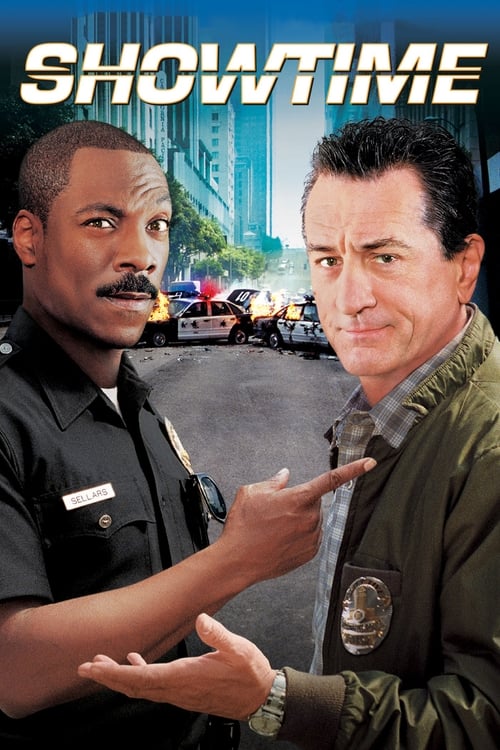
Showtime (2002)
Directed by Tom Dey
No — Showtime is not woke, scoring 16 out of 100 on our wokeness meter.
Tom Dey's Showtime arrived in 2002 carrying two of the era's largest stars, a meta premise about reality television devouring the buddy cop picture, and a budget of eighty-five million dollars.
Consciousness Markers
Eddie Murphy anchors as a Black co-lead alongside a notably multiethnic supporting cast (Mos Def, Joy Bryant, Kadeem Hardison, Nestor Serrano), but the diversity is unremarked-upon genre casting rather than a statement.
The satire targets a ratings-hungry TV network (Maxxis) that remodels a cop's life for commercial spectacle, a mild media/consumerist critique, though it never indicts capital itself.
Rene Russo's Chase Renzi is a network director with professional authority, and the closing gag hands the show to two female officers, but the film never advances a feminist argument.
A Black lead exists naturally in the story, but the film engages no racial themes, commentary, or consciousness whatsoever.
The film gestures at satirizing reality-TV policing but plays it for broad gags rather than moral instruction, keeping the preaching minimal.
No LGBTQ+ characters, themes, or subtext of any kind appear in this buddy-cop spoof.
No environmental or climate content is present.
No body-positivity themes or messaging appear.
No neurodivergent characters or themes are present.
No historical revisionism; the film is a contemporary fictional comedy.
Why it received this score
Tom Dey's Showtime arrived in 2002 carrying two of the era's largest stars, a meta premise about reality television devouring the buddy cop picture, and a budget of eighty-five million dollars. It grossed seventy-seven. The Razzies came calling. The critical consensus held that a satire of a tired genre had simply become the tired genre, which is the verdict a film earns when it spends its back half on garbage trucks and hotel floods. We approach such a specimen the way we approach a bottle left in the sun. There is still something to taste. There is not much.
The picture's representational instincts are respectable and entirely unexamined. Eddie Murphy carries half the running time as a Black lead, and the supporting bench runs from Mos Def to Joy Bryant to Kadeem Hardison to Nestor Serrano, none of whom exist in order to teach the audience anything. The film has no racial argument to make, and declines to make one. Rene Russo's network director wields real professional authority, and the closing gag hands the revived series to two female officers, a gesture toward parity the script never bothers to defend. On the culture's newer preoccupations the record is blank: no queer presence, no environmental sermon, no body politics, no neurodivergent interiority, no quarrel with the historical record. This is a comedy from a moment before the checklist.
Where the film does stir, faintly, is in its contempt for the machinery of spectacle. Maxxis Television remodels a detective's house, swaps his car, and hires William Shatner to teach him how to act, all so that commerce might harvest his life for sweeps. That is a critique of the medium, not of capital, and it is played for gags instead of lessons. The sermonizing is kept to a minimum, which is the film's one real virtue. It fails as satire and succeeds as a document of what a studio comedy looked like before anyone thought to grade it. We file it accordingly.
Analysis generated by our Consciousness Algorithm
Part of


Synopsis
A spoof of buddy cop movies where two very different cops are forced to team up on a new reality based T.V. cop show.
Questions about Showtime
Is Showtime woke?
No — Showtime is not woke, scoring 16 out of 100 on our wokeness meter. That earns it a verdict of Ultra Based.
Does Showtime have any woke elements?
1 of the 10 markers register at 30 or above, led by Representation Casting (45). On Representation Casting: Eddie Murphy anchors as a Black co-lead alongside a notably multiethnic supporting cast (Mos Def, Joy Bryant, Kadeem Hardison, Nestor Serrano), but the diversity is unremarked-upon genre casting rather than a statement.
How does Showtime compare to other 2002 movies?
It ranks #31 of the 150 films from 2002 we've scored; their average is 12. The wokest is Far from Heaven (78).
How is the Woke Score calculated?
An AI-assisted process researches the film and its reception, scores it 0–100 on ten markers, then combines those into one 0–100 Woke Score. It measures a specific set of 2020s cultural themes, not film quality.