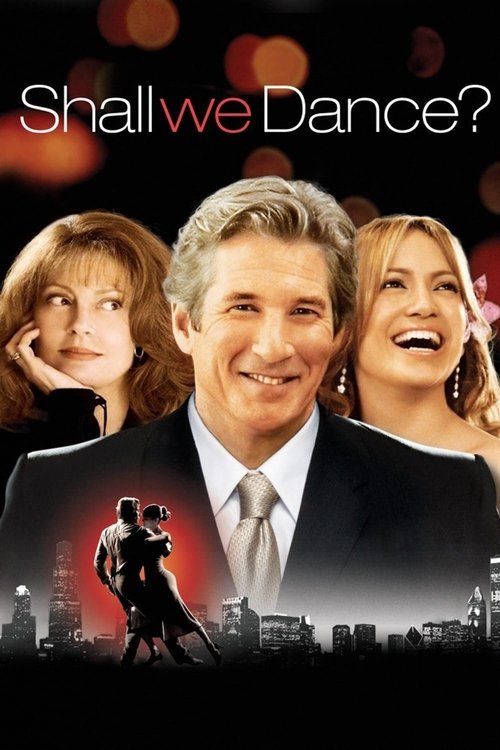
Shall We Dance? (2004)
Directed by Peter Chelsom
No — Shall We Dance? is not woke, scoring 11 out of 100 on our wokeness meter.
A bored Chicago estate lawyer rides the elevated train past a dance studio window, spies a melancholy woman, and signs up for lessons under false pretenses.
Consciousness Markers
The cast is moderately diverse for 2004 (Jennifer Lopez, Omar Benson Miller, Bobby Cannavale), but these are natural casting choices rather than identity-conscious representation. No commentary on the diversity itself.
The character Chic is revealed to be gay in the closing montage, dancing with his partner at a club. It is a brief, matter-of-fact inclusion rather than a thematic focus.
Paulina is a driven professional dancer who rediscovers her competitive passion, and Beverly is given agency in choosing not to invade her husband's privacy. These are character beats, not a feminist thesis.
The film gently celebrates that clumsy, older, and ordinary people can learn to dance, with Miss Mitzi and the awkward classmates finding joy. This is warm humanism rather than an explicit body-positivity message.
The film is set in a largely white Chicago milieu and makes no attempt to engage with racial themes or dynamics.
John's vague dissatisfaction with his comfortable lawyer life hints at suburban ennui, but the film never critiques wealth or capitalism; it ends with everyone happily partnered and prosperous.
The film is light and escapist, offering no moral instruction or social messaging to the audience.
No environmental or climate content whatsoever.
No neurodivergent characters or themes are present.
A straightforward romantic comedy with no historical revisionism of any kind.
Why it received this score
A bored Chicago estate lawyer rides the elevated train past a dance studio window, spies a melancholy woman, and signs up for lessons under false pretenses. This is the 2004 American remake of a Japanese film, and it arrives with all the cultural specificity of a hotel lobby. Peter Chelsom directs with a soft hand. Richard Gere is amiable, Susan Sarandon is underused, and the whole enterprise hums along at the pace of a well-maintained escalator.
The casting is modestly varied for its era, with Jennifer Lopez, Bobby Cannavale, and Omar Benson Miller filling roles that were not written as statements about anything. Paulina is a driven professional who rediscovers her competitive ambitions, and Beverly is granted the dignity of choosing not to rifle through her husband's private life. These are character beats. The film is not building an argument. Stanley Tucci's Chic spends the runtime as a closeted man sneaking off to dance, and the closing montage hands him a partner and a nightclub, a moment of matter-of-fact inclusion that passes without comment or fanfare. The dance studio also makes room for the elderly and the uncoordinated, suggesting that grace is available to anybody willing to look foolish for a few months. It is warm. It is not a program.
The film's politics are essentially nonexistent, which in 2004 was not yet considered a scandal. John's vague dissatisfaction with his comfortable life is the closest the screenplay comes to a critique of anything, and it resolves by having him keep the life and add a hobby. No one eats the rich. The rich simply learn the foxtrot. There is no climate anxiety, no historical revision, no sermon delivered to the audience, no diagnosis of the viewer's moral failings. What remains is a mild, pleasant film about a man who wanted to dance and was allowed to. In the current climate of cinema this registers as almost exotic. It is not important. It is not objectionable. It is a Tuesday.
Analysis generated by our Consciousness Algorithm


Synopsis
A bored estate lawyer spots a beautiful woman in the window of a ballroom dance studio. He secretly starts taking dancing lessons to be near her, and then over time discovers how much he loves dancing. His wife, meanwhile, has hired a private detective to find out why he has started coming home late smelling of perfume.
Questions about Shall We Dance?
Is Shall We Dance? woke?
No — Shall We Dance? is not woke, scoring 11 out of 100 on our wokeness meter. That earns it a verdict of Ultra Based.
Does Shall We Dance? have any woke elements?
Very few. None of the 10 markers reaches 30, the level where a marker counts as present; the highest is Representation Casting at 25.
How does Shall We Dance? compare to other 2004 movies?
It ranks #65 of the 178 films from 2004 we've scored; their average is 12. The wokest is Tropical Malady (62).
How is the Woke Score calculated?
An AI-assisted process researches the film and its reception, scores it 0–100 on ten markers, then combines those into one 0–100 Woke Score. It measures a specific set of 2020s cultural themes, not film quality.