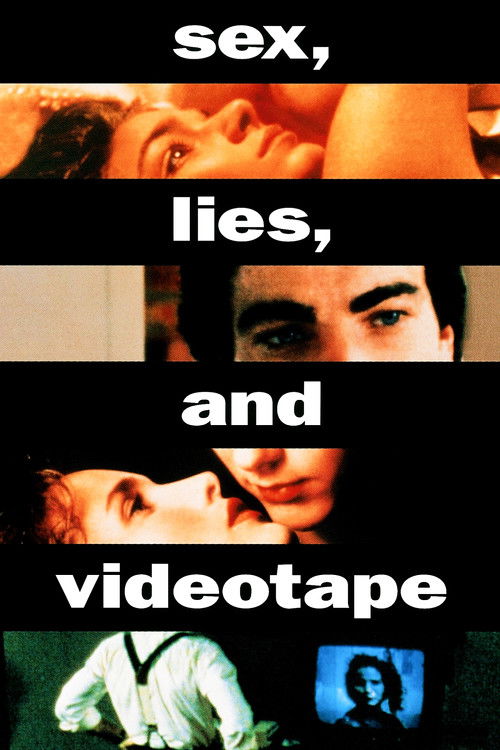
sex, lies, and videotape (1989)
Directed by Steven Soderbergh
No — sex, lies, and videotape is not woke, scoring 12 out of 100 on our wokeness meter.
Steven Soderbergh wrote this in eight days on a yellow legal pad, and the economy shows.
Consciousness Markers
The film centers female sexual experience and gives Ann and Cynthia interiority, but it does so as a humanist character study rather than a modern feminist polemic. Its treatment of women's desire is notable but not agenda-driven in the 2020s sense.
The cast is entirely white, with no effort toward diverse or inclusive casting. This is a 1989 independent drama with a conventional ensemble.
There are no LGBTQ+ characters or themes; the film concerns heterosexual marriage, infidelity, and voyeurism.
No engagement with race or racial politics whatsoever; the Baton Rouge setting and characters are uniformly white and the subject matter is purely interpersonal.
No environmental or climate themes appear in the film.
John's comfortable lawyer lifestyle is portrayed as hollow, but the film offers no systemic critique of capitalism or wealth. The discomfort is personal, not economic.
No body positivity themes; the film's treatment of sexuality is psychological rather than about body image or acceptance.
Graham's voyeurism and past pathological lying are framed as neurosis and emotional damage, not as neurodivergence in any modern diagnostic or advocacy sense.
No historical revisionism; the film is a contemporary (1989) character drama with no historical subject matter.
Soderbergh's script is a restrained, ambiguous character study that observes rather than preaches. There is no didactic messaging or moralizing.
Why it received this score
Steven Soderbergh wrote this in eight days on a yellow legal pad, and the economy shows. Four people in Baton Rouge, a camcorder, a pearl earring, and a marriage quietly decomposing inside a comfortable house. The film watches. It does not instruct. For a debut that would win the Palme d'Or and help set off the American independent film boom, it is almost defiantly uninterested in telling anyone how to live. Graham interviews women about their deepest fantasies, and the camera never once informs us how to feel about it.
The women here are granted genuine interiority. Ann's revulsion at her husband's touch, Cynthia's unapologetic appetite, the sisters' slow reconciliation at the bar where Cynthia pours drinks, all of it is treated as complex human weather and not as a position in an argument. Female desire sits at the center of the picture, which in 1989 was not nothing. But the interest is psychological and narrative. Nobody stands up to deliver a thesis about men. The movie is curious about these people, and curiosity is not a platform.
Everything else is absent by design or by era. The cast is uniformly white, and the film has no interest in that fact. There is no economic critique hiding inside John's law practice, only a hollow man in an expensive suit. Graham's voyeurism is framed as damage, not diagnosis. The whole thing is a chamber piece about lying, sex, and the difficulty of being known, and it declines to moralize about any of it. Thirty-five years on, that restraint reads as nearly exotic.
Analysis generated by our Consciousness Algorithm
Synopsis
Ann, a frustrated wife, enters into counseling due to a troubled marriage. Unbeknownst to her, her husband John has begun an affair with her sister. When John’s best friend Graham arrives, his penchant for interviewing women about their sex lives forever changes John and Ann’s rocky marriage.
Questions about sex, lies, and videotape
Is sex, lies, and videotape woke?
No — sex, lies, and videotape is not woke, scoring 12 out of 100 on our wokeness meter. That earns it a verdict of Ultra Based.
Does sex, lies, and videotape have any woke elements?
Very few. None of the 10 markers reaches 30, the level where a marker counts as present; the highest is Feminist Agenda at 20.
How does sex, lies, and videotape compare to other 1989 movies?
It ranks #18 of the 68 films from 1989 we've scored; their average is 10. The wokest is Do the Right Thing (72).
How is the Woke Score calculated?
An AI-assisted process researches the film and its reception, scores it 0–100 on ten markers, then combines those into one 0–100 Woke Score. It measures a specific set of 2020s cultural themes, not film quality.