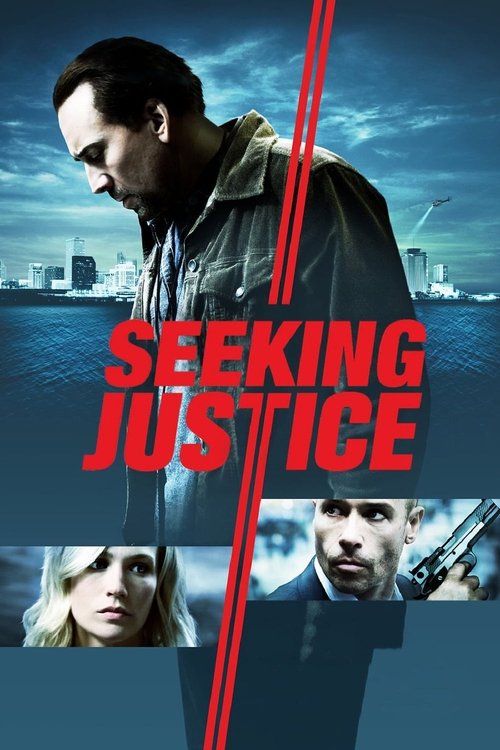
Seeking Justice (2011)
Directed by Roger Donaldson
No — Seeking Justice is not woke, scoring 3 out of 100 on our wokeness meter.
There is a moment in Roger Donaldson's Seeking Justice when a grieving husband accepts an offer from a stranger in a hospital corridor, and the machinery of the potboiler clicks into place with the quiet efficiency of a chess clock.
Consciousness Markers
The cast is predominantly white with Black actors (Harold Perrineau, IronE Singleton) in incidental supporting roles and no commentary on representation. Standard 2011 Hollywood ensemble.
The wife is a victim of assault for most of the runtime, though she does shoot the villain in the climax. No feminist thesis is advanced.
No engagement with racial politics or consciousness; the vigilante plot is colorblind in the most literal sense.
Standard potboiler plotting with no preachiness, moralizing monologues, or didactic messaging.
No LGBTQ+ characters, themes, or subtext anywhere in the film.
No environmental or climate themes whatsoever.
The vigilante organization is a shadowy justice cabal, not a critique of wealth or capitalism. No eat-the-rich sentiment.
No body-positive messaging or diverse body representation.
No neurodivergent characters or themes.
No historical revisionism; the film is a contemporary fictional thriller.
Why it received this score
There is a moment in Roger Donaldson's Seeking Justice when a grieving husband accepts an offer from a stranger in a hospital corridor, and the machinery of the potboiler clicks into place with the quiet efficiency of a chess clock. Nicolas Cage plays Will Gerard, a New Orleans high school English teacher whose cellist wife is assaulted after a concert. A man named Simon, rendered with polite menace by Guy Pearce, offers to settle the score in exchange for a favor to be named later. This is a premise borrowed wholesale from better paranoid thrillers, and the film knows it. What follows is a sequence of obligations, double crosses, and a viggo organization that dispatches wrongdoers the courts could not reach. The screenplay treats this shadowy cabal as a bureaucratic inconvenience rather than a political argument. No thesis is advanced about crime, punishment, or the privatization of vengeance. The hungry rabbit simply jumps.
The film's cultural footprint is faint. The cast is a standard 2011 Hollywood ensemble, and the two Black performers in the supporting ranks exist without comment on the arrangement. There is no engagement with racial politics, no environmental conscience, no critique of wealth, no body-positive or neurodivergent framing. January Jones spends most of the runtime as a victim before seizing a gun in the final reel, which is a gesture toward agency and not a manifesto. The villains are not capitalists but functionaries, and their scheme is procedural, not ideological. Nothing here lectures. Nothing here sermonizes. The film wants only to keep moving.
What remains is a competent, forgettable thriller that opened at number twenty-seven and vanished. It carries a Golden Raspberry nomination for its star, which feels less like a judgment than a formality. We are left with the faint melancholy of a genre exercise that aspires to nothing and achieves it. The classification is straightforward: a period piece of 2011 Hollywood, incurious about the world beyond its own chase sequences.
Analysis generated by our Consciousness Algorithm


Synopsis
After his wife is assaulted, a husband enlists the services of a vigilante group to help him settle the score.
Questions about Seeking Justice
Is Seeking Justice woke?
No — Seeking Justice is not woke, scoring 3 out of 100 on our wokeness meter. That earns it a verdict of Ultra Based.
Does Seeking Justice have any woke elements?
Very few. None of the 10 markers reaches 30, the level where a marker counts as present; the highest is Representation Casting at 10.
How does Seeking Justice compare to other 2011 movies?
It ranks #195 of the 245 films from 2011 we've scored; their average is 11. The wokest is Paul (68).
How is the Woke Score calculated?
An AI-assisted process researches the film and its reception, scores it 0–100 on ten markers, then combines those into one 0–100 Woke Score. It measures a specific set of 2020s cultural themes, not film quality.