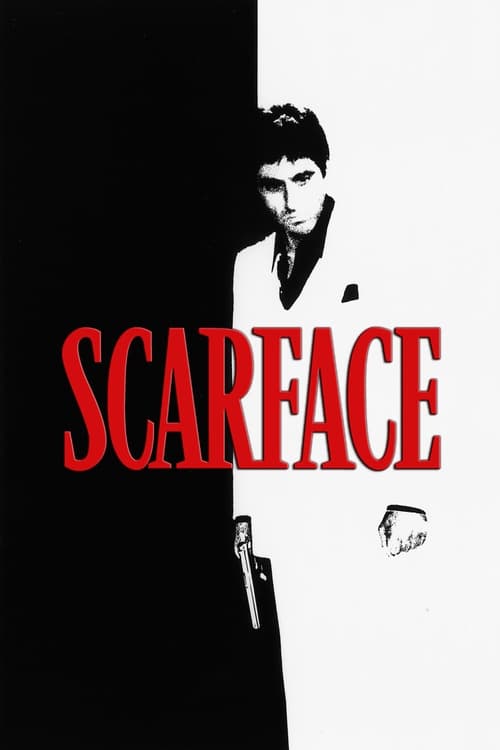
Scarface (1983)
Directed by Brian De Palma
No — Scarface is not woke, scoring 12 out of 100 on our wokeness meter.
Scarface arrives in 1983 as a remake of the 1932 Howard Hawks picture, relocated from Chicago bootlegging to the Mariel boatlift and the cocaine trade in Miami.
Consciousness Markers
The cast is predominantly Latino, reflecting the Cuban immigrant story, but many key roles were filled by non-Cuban actors (Pacino, Pfeiffer), and the film was criticized by the Cuban community for stereotyping. This is story-driven casting rather than deliberate modern representation.
The rise-and-fall arc and the 'The World Is Yours' motif critique greed and the corrupting promise of wealth, but this is classic gangster-tragedy moralizing rather than modern eat-the-rich polemic.
The film engages Cuban immigrant identity and the Mariel boatlift, but treats them as crime-drama backdrop rather than racial commentary, and was itself accused of ethnic stereotyping.
The film is aggressively macho; Elvira is a trophy wife and Gina is a possession to be guarded. Elvira's public denunciation of Tony is a character beat, not a feminist statement.
The film shows rather than tells, offering no moralizing speeches or direct audience instruction.
No LGBTQ+ characters or themes appear anywhere in the film.
No environmental or climate themes are present.
No body-positivity themes or messaging.
Tony's paranoia is drug-induced, not framed as neurodivergence.
A remake of the 1932 film, but it does not revise or reinterpret historical events.
Why it received this score
Scarface arrives in 1983 as a remake of the 1932 Howard Hawks picture, relocated from Chicago bootlegging to the Mariel boatlift and the cocaine trade in Miami. Oliver Stone wrote the script while wrestling his own addiction, and Brian De Palma shot it largely in Los Angeles after Miami's Cuban community declined to host a production they felt slandered them. The cast is heavily Latino, and Steven Bauer was the only actual Cuban among the principals. Al Pacino, a Sicilian-American from the Bronx, plays a Cuban refugee in a baroque accent that has been argued about for four decades. This is story-driven casting, not a modern representational program, and the film drew accusations of ethnic stereotyping from the very community it depicts.
The engine here is machismo, unapologetically. Elvira Hancock exists as a trophy, and Gina is guarded like inventory. The film has no interest in gender critique; it dramatizes the pathology instead of diagnosing it. The globe in the final shot reads The World Is Yours, and the arc from dishwasher to drug lord to floating corpse is a standard gangster tragedy about appetite and its invoice. That is moralizing of a very old kind, ending with a body in a pool, not a pamphlet about wealth redistribution. There is no environmental sermon, no body-positive subplot, no neurodivergent reading of Tony's cocaine paranoia, no historical revisionism, and no LGBTQ content of any kind.
The picture does not lecture. Tony's downfall is staged as spectacle, not instruction, and no character steps forward to explain the moral. The violence earned an X rating that was overturned on appeal, and De Palma released his cut anyway. Initial reviews were hostile. The reappraisal came later, largely through hip-hop's adoption of Montana as an icon of ambition, which says more about the audience than the film. As a document of 1983, this is a brutal, efficient crime picture with a magnetic performance at its center and almost no interest in telling anyone how to live. We are left with the globe, the pool, and the invoice.
Analysis generated by our Consciousness Algorithm
Part of


Synopsis
After getting a green card in exchange for assassinating a Cuban government official, Tony Montana stakes a claim on the drug trade in Miami. Viciously murdering anyone who stands in his way, Tony eventually becomes the biggest drug lord in the state, controlling nearly all the cocaine that comes through Miami. But increased pressure from the police, wars with Colombian drug cartels and his own drug-fueled paranoia serve to fuel the flames of his eventual downfall.
Questions about Scarface
Is Scarface woke?
No — Scarface is not woke, scoring 12 out of 100 on our wokeness meter. That earns it a verdict of Ultra Based.
Does Scarface have any woke elements?
1 of the 10 markers register at 30 or above, led by Representation Casting (35). On Representation Casting: The cast is predominantly Latino, reflecting the Cuban immigrant story, but many key roles were filled by non-Cuban actors (Pacino, Pfeiffer), and the film was criticized by the Cuban community for stereotyping.
How does Scarface compare to other 1983 movies?
It ranks #12 of the 38 films from 1983 we've scored; their average is 10. The wokest is Sans Soleil (68).
How is the Woke Score calculated?
An AI-assisted process researches the film and its reception, scores it 0–100 on ten markers, then combines those into one 0–100 Woke Score. It measures a specific set of 2020s cultural themes, not film quality.