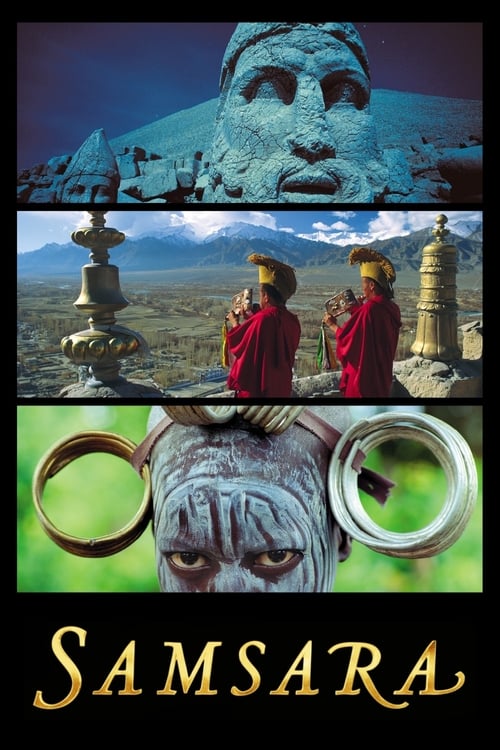
Samsara (2011)
Directed by Ron Fricke
No — Samsara is not woke, scoring 7 out of 100 on our wokeness meter.
Samsara arrives with the confidence of a film that has been to twenty-five countries and intends to let you know it.
Consciousness Markers
The film features people from 25 countries across five continents, but as a non-narrative documentary it presents global diversity as subject matter rather than deliberate inclusive casting.
Includes a brief appearance by the Ladyboys of Cascade Bar, a Thai transgender cabaret troupe, but the film does not explore LGBTQ+ themes or identity.
No feminist agenda or commentary; women appear as part of the global tableau without thematic focus.
No racial consciousness or commentary; the film avoids explicit political or social critique.
While it shows natural wonders and industrial landscapes, it does not advance a climate change message or environmental crusade.
No explicit anti-capitalist or eat-the-rich message; filmmakers deliberately avoided a particular political viewpoint.
No body positivity themes or commentary.
No neurodivergence themes or representation.
No revisionist history; the film is non-narrative and avoids historical interpretation.
Nonverbal and non-narrative, with no dialogue or direct lecturing to the audience.
Why it received this score
Samsara arrives with the confidence of a film that has been to twenty-five countries and intends to let you know it. Ron Fricke and Mark Magidson spent five years hauling seventy-millimetre cameras across five continents, and the result is a nonverbal guided meditation on birth, death, and the general impermanence of things. There is no narrator. There is no argument. There is a great deal of sand, temple, and factory, arranged with the patience of a sommelier decanting something expensive.
The cast is drawn from everywhere, which is a fact about geography more than ideology. These are not characters. They are faces in a tableau, and the film treats them as part of the scenery, which is either the point or a limitation, depending on your tolerance for this sort of thing. The Ladyboys of Cascade Bar appear briefly, a Thai cabaret troupe folded into the global collage without further comment. The film does not pursue what that appearance might mean. It simply moves on to the next astonishing image, as it always does.
And that is the curious thing about this exercise in global consciousness. It has no interest in telling us anything. No climate sermon, no indictment of capital, no feminist reading of the sacred and the industrial. Fricke and Magidson deliberately kept their politics in the middle, which in 2011 was still a defensible position. The result is beautiful, occasionally heavy-handed in its juxtapositions, and entirely free of the urge to lecture. It wants to free our minds. Whether it succeeds is another matter, but it never once tells us how to feel, and in the present climate that reads almost as a provocation.
Analysis generated by our Consciousness Algorithm


Synopsis
Filmed over nearly five years in twenty-five countries on five continents, and shot on seventy-millimetre film, Samsara transports us to the varied worlds of sacred grounds, disaster zones, industrial complexes, and natural wonders.
Questions about Samsara
Is Samsara woke?
No — Samsara is not woke, scoring 7 out of 100 on our wokeness meter. That earns it a verdict of Ultra Based.
Does Samsara have any woke elements?
Very few. None of the 10 markers reaches 30, the level where a marker counts as present; the highest is Representation Casting at 20.
How does Samsara compare to other 2011 movies?
It ranks #133 of the 245 films from 2011 we've scored; their average is 11. The wokest is Paul (68).
How is the Woke Score calculated?
An AI-assisted process researches the film and its reception, scores it 0–100 on ten markers, then combines those into one 0–100 Woke Score. It measures a specific set of 2020s cultural themes, not film quality.