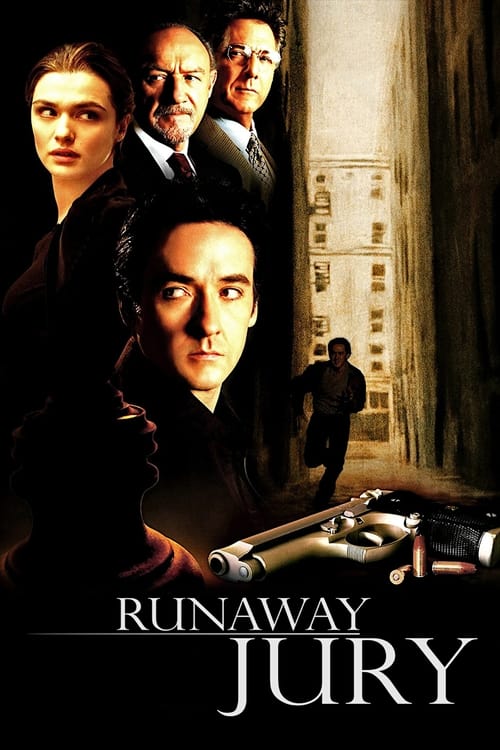
Runaway Jury (2003)
Directed by Gary Fleder
No — Runaway Jury is not woke, scoring 13 out of 100 on our wokeness meter.
Runaway Jury arrives from 2003, a year when a legal thriller could still be assembled from a Grisham paperback and four movie stars without anyone feeling obliged to explain themselves.
Consciousness Markers
The film critiques a firearms manufacturer and the corporate machinery of jury consultants and bought verdicts, but its target is legal corruption rather than capitalism as such.
The principal cast (Cusack, Hackman, Hoffman, Weisz) is overwhelmingly white; a few jurors of color appear naturally in the ensemble but the film makes no comment on their presence.
The film carries a moral about gun violence and corporate accountability, but it is delivered through thriller mechanics rather than preachy sermonizing.
Marlee (Weisz) is a capable schemer and Celeste Wood a determined widow, but the film offers no feminist thesis or gender-conscious commentary.
A Black juror (Rikki Coleman) features in the jury-tampering plot, but race is never examined as a theme; the story is colorblind in its treatment of the legal drama.
No LGBTQ+ characters, themes, or subtext of any kind appear in the film.
No environmental or climate-related content whatsoever.
No body-positivity themes or messaging present.
No neurodivergent characters or themes are depicted.
A fictional legal thriller with no historical revisionism; the tobacco-to-gun swap is a production change, not a rewriting of history.
Why it received this score
Runaway Jury arrives from 2003, a year when a legal thriller could still be assembled from a Grisham paperback and four movie stars without anyone feeling obliged to explain themselves. Gary Fleder directs the tale of a New Orleans wrongful-death suit against a firearms manufacturer, where a jury consultant named Rankin Fitch (Gene Hackman) buys jurors the way other men buy groceries, and a mysterious juror named Nicholas Easter (John Cusack) quietly outmaneuvers him. The machinery is elegant. The film's real target is not the gun industry alone but the entire apparatus of trial science: the consultants, the surveillance, the purchased verdicts. There is a grudge against corporate power here, but it is a grudge against corruption, not against capital as a system. The villains want to win a lawsuit. They do not want to privatize the water supply.
On the matter of identity, the film is a product of its moment and offers almost nothing to the modern auditor. The cast is white and the screenplay never pauses to notice. A Black juror, Rikki Coleman, is drawn into the tampering plot and even attempts suicide under pressure, yet her race is never the subject of a single line. Rachel Weisz's Marlee is a competent schemer who runs circles around the men, and Celeste Wood is a widow who refuses to fold, but the film advances no argument about gender. It simply lets them be capable. No queer characters appear. No environmental theme intrudes. Nobody discusses their body, their brain, or their wounds in the therapeutic register that later decades would demand.
The film does carry a moral. Guns kill people, the companies that make them can be held to account, and the men who fix juries are vermin. It delivers this through cross-examination and a satisfying reversal, not through a podium. Hackman's Fitch loses to a jury that votes with its heart, which is an old-fashioned idea dressed in new procedural clothing. The result is a well-made entertainment with a conscience that predates the current vocabulary of conscience. It wants to be liked, and it mostly is. A sommelier of these matters would note the vintage and set the bottle down without ceremony.
Analysis generated by our Consciousness Algorithm


Synopsis
After a workplace shooting in New Orleans, a trial against the gun manufacturer pits lawyer Wendell Rohr against shady jury consultant Rankin Fitch, who uses illegal means to stack the jury with people sympathetic to the defense. But when juror Nicholas Easter and his girlfriend Marlee reveal their ability to sway the jury into delivering any verdict they want, a high-stakes cat-and-mouse game begins.
Questions about Runaway Jury
Is Runaway Jury woke?
No — Runaway Jury is not woke, scoring 13 out of 100 on our wokeness meter. That earns it a verdict of Ultra Based.
Does Runaway Jury have any woke elements?
1 of the 10 markers register at 30 or above, led by Eat the Rich (30). On Eat the Rich: The film critiques a firearms manufacturer and the corporate machinery of jury consultants and bought verdicts, but its target is legal corruption rather than capitalism as such.
How does Runaway Jury compare to other 2003 movies?
It ranks #48 of the 150 films from 2003 we've scored; their average is 12. The wokest is Mona Lisa Smile (60).
How is the Woke Score calculated?
An AI-assisted process researches the film and its reception, scores it 0–100 on ten markers, then combines those into one 0–100 Woke Score. It measures a specific set of 2020s cultural themes, not film quality.