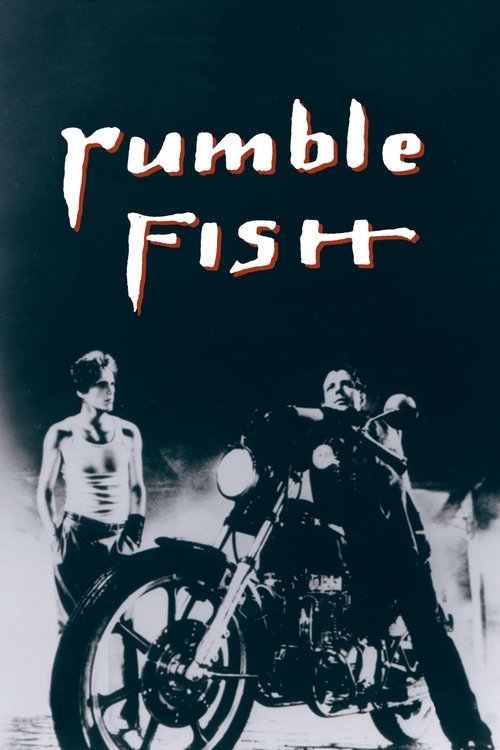
Rumble Fish (1983)
Directed by Francis Ford Coppola
No — Rumble Fish is not woke, scoring 0 out of 100 on our wokeness meter.
Francis Ford Coppola's Rumble Fish arrives from 1983 with the confidence of a film that has no interest in being useful.
Consciousness Markers
The cast is predominantly white, with Laurence Fishburne in a supporting role that is not framed as a statement on representation. No deliberate inclusive casting agenda is present.
No LGBTQ+ characters, themes, or subtext.
Female characters exist primarily in relation to male protagonists, with no feminist critique or agenda.
The film does not engage with racial identity, inequality, or consciousness.
No environmental or climate themes.
No critique of capitalism or wealth inequality; the focus is on gang life and personal decline.
No body positivity themes or diverse body representation.
The Motorcycle Boy's colorblindness and perceived instability are not framed through a modern neurodivergence lens.
Not a historical film and does not revise historical narratives.
The film is stylistically experimental and character-driven, not preachy or message-forward.
Why it received this score
Francis Ford Coppola's Rumble Fish arrives from 1983 with the confidence of a film that has no interest in being useful. It follows Rusty James and his mythic brother, the Motorcycle Boy, through a Tulsa of fog, pool halls, and dissolving gangs. The story is about hero worship, time running out, and the impossibility of living up to a legend. Coppola shoots in high-contrast black and white, borrows from German Expressionism and the French New Wave, and lets Stewart Copeland's percussive score rattle the frame. The result is a mood piece, not a lesson.
The social ledger here is blank. The cast is largely white, with Laurence Fishburne in a supporting role that carries no representative weight. Women appear as girlfriends, mothers, and objects of male anxiety, and the film offers no feminist counterargument. There is no LGBTQ content, no racial consciousness, no climate concern, no critique of capital, no body-positive framing, and no modern vocabulary for neurodivergence. The Motorcycle Boy's colorblindness and supposed instability are rendered as romantic affliction, not as a call for accommodation. History is not revised because history is not the subject. The film has no lecture energy. It is too busy staring at clocks and clouds.
What remains is an avant-garde curiosity that was booed at the New York Film Festival and then slowly became a cult item. It does not ask to be praised for its politics. It asks to be watched in a dark room while its characters drift toward unavoidable violence. By the standards of contemporary social consciousness, the film is a zero across the board. That is not an insult. It is a classification. Rumble Fish is a beautiful, alienating object from a time when a major director could spend ten million dollars on a tone poem and call it a career.
Analysis generated by our Consciousness Algorithm


Synopsis
Absent-minded street thug Rusty James struggles to live up to his legendary older brother's reputation, and longs for the days of gang warfare.
Questions about Rumble Fish
Is Rumble Fish woke?
No — Rumble Fish is not woke, scoring 0 out of 100 on our wokeness meter. That earns it a verdict of Ultra Based.
Does Rumble Fish have any woke elements?
No. All 10 markers score zero.
How does Rumble Fish compare to other 1983 movies?
It ranks #31 of the 38 films from 1983 we've scored; their average is 10. The wokest is Sans Soleil (68).
How is the Woke Score calculated?
An AI-assisted process researches the film and its reception, scores it 0–100 on ten markers, then combines those into one 0–100 Woke Score. It measures a specific set of 2020s cultural themes, not film quality.