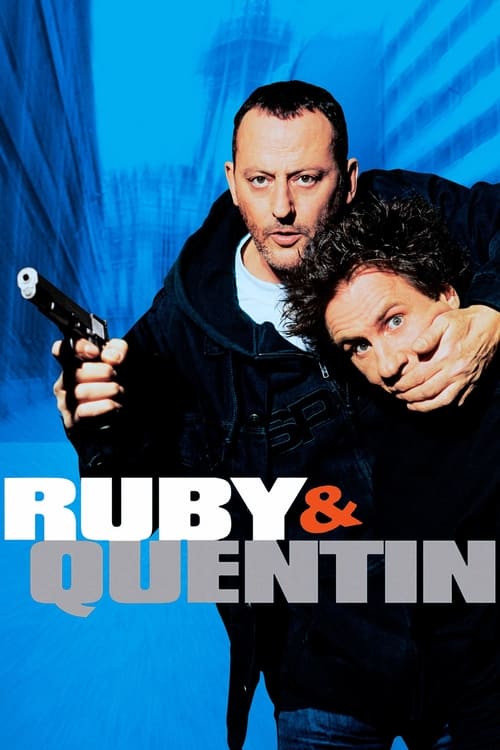
Ruby & Quentin (2003)
Directed by Francis Veber
No — Ruby & Quentin is not woke, scoring 3 out of 100 on our wokeness meter.
Ruby & Quentin arrives from 2003, a French crime comedy directed by Francis Veber and powered by the contrast between Jean Reno's silent, brooding Ruby and Gérard Depardieu's yammering Quentin.
Consciousness Markers
The cast is overwhelmingly white French actors, with no deliberate diversity casting or commentary on representation.
There are no LGBTQ+ themes or characters; a brief gag involving homophobes does not constitute LGBTQ+ representation.
Women are largely plot devices, including a murdered lover and a lookalike romantic interest, with no feminist agenda.
The film does not engage with race, racism, or racial identity in any meaningful way.
There is no environmental or climate-related theme in the story.
The crime caper focuses on personal revenge and friendship, not economic critique or anti-capitalist messaging.
The film contains no body-positivity themes or messaging about body image.
Quentin is portrayed as dim-witted for comedic effect, but the film does not frame this as neurodivergence or advocate for neurodiverse identity.
The film is a fictional crime comedy and does not revise or reinterpret historical events.
The film aims for broad comedy and entertainment rather than delivering social or political lectures.
Why it received this score
Ruby & Quentin arrives from 2003, a French crime comedy directed by Francis Veber and powered by the contrast between Jean Reno's silent, brooding Ruby and Gérard Depardieu's yammering Quentin. The plot involves prison, escape, stolen cars, cross-dressing for convenience, and a final shoot-out. It is a machine built for laughs about irritation and loyalty. The film's cultural inventory is sparse. Women appear as a murdered lover and a sudden lookalike. Quentin's dim wit is a comic engine. A cross-dressing sequence is a farce beat about stolen clothes. A homeless woman receives a charitable gesture. None of this is framed as an argument about identity, power, or history. The film wants us to laugh at two mismatched men, and that is the whole of its ambition.
This is not a failing. It is a taxonomy. The film belongs to an older tradition of French popular comedy where social observation exists as texture, not thesis. Veber's touch is light and mechanical. He sets up a gag, lets it run, then pays it off with a dislocated shoulder or a stolen police car. The screenplay has no interest in instructing the audience about how to live. It wants to watch Depardieu beam and Reno glower. That is the entire moral universe. Any attempt to read contemporary social consciousness into this material would require a projector, a notepad, and a willingness to disappoint oneself.
So we file Ruby & Quentin under zero. Not zero as an insult. Zero as a factual measurement, like finding no oak in a glass of pinot. The film is a 2003 artifact of broad commercial entertainment. It shows no markers of the modern cultural flashpoint. It has no agenda beyond friendship, revenge, and the comedic value of a man who cannot stop talking. We can respect its craft and still note its emptiness on the scorecard. It is a pleasant vintage with no ideological aftertaste. The sommelier sets down the glass and reaches for the next bottle.
Analysis generated by our Consciousness Algorithm
Synopsis
After hiding his loot and getting thrown in jail, brooding outlaw Ruby befriends Quentin, a dim-witted and garrulous giant. After Quentin botches a solo escape attempt, they make a break together. Unable to shake the clumsy Quentin, Ruby is forced to take him along as he pursues his former partners in crime to avenge the death of the woman he loved and get to the money.
Questions about Ruby & Quentin
Is Ruby & Quentin woke?
No — Ruby & Quentin is not woke, scoring 3 out of 100 on our wokeness meter. That earns it a verdict of Ultra Based.
Does Ruby & Quentin have any woke elements?
No. All 10 markers score zero.
How does Ruby & Quentin compare to other 2003 movies?
It ranks #122 of the 150 films from 2003 we've scored; their average is 12. The wokest is Mona Lisa Smile (60).
How is the Woke Score calculated?
An AI-assisted process researches the film and its reception, scores it 0–100 on ten markers, then combines those into one 0–100 Woke Score. It measures a specific set of 2020s cultural themes, not film quality.