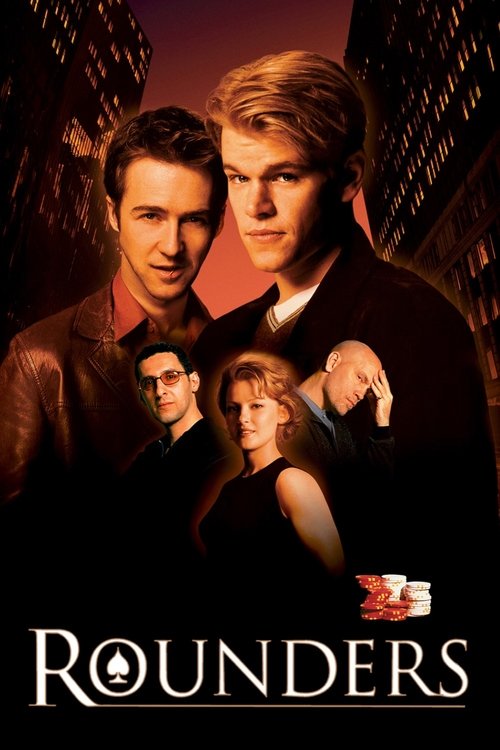
Rounders (1998)
Directed by John Dahl
No — Rounders is not woke, scoring 0 out of 100 on our wokeness meter.
John Dahl's Rounders arrives from 1998, a vintage that predates nearly every marker the modern classifier has been trained to detect.
Consciousness Markers
The cast is predominantly white and the film makes no deliberate effort at inclusive or representative casting.
There are no LGBTQ+ characters, themes, or subtext in the film.
Female characters function as girlfriend and call-girl figures without any feminist critique or agenda.
The film does not engage with racial consciousness, systemic racism, or racial identity.
There are no environmental or climate-related themes.
Gambling debts and loan sharks appear as plot mechanics, not as a critique of capitalism or wealth inequality.
The film contains no body-positivity themes or messaging.
Gambling compulsion is portrayed as a personal flaw, not through a neurodivergence or neurodiversity framework.
The film is not concerned with historical revisionism or reinterpreting past events.
The film does not deliver preachy social-justice lecturing; its moral concerns are personal and poker-specific.
Why it received this score
John Dahl's Rounders arrives from 1998, a vintage that predates nearly every marker the modern classifier has been trained to detect. The film concerns Mike McDermott, a law student who loses thirty thousand dollars in a single hand to a Russian mobster and then spends the rest of the runtime trying to win it back. The cast is white, the concerns are personal, and the moral universe is entirely contractual. There is a debt, and there is a man who must pay it. The cinema of grievance has not yet reached the poker table.
The women here serve as friction and ornament. Gretchen Mol's Jo exists to be disappointed and then to leave. Famke Janssen's Petra dispenses information from behind a bar in a manner suggesting the filmmakers had seen a noir once and liked it. Nobody in the film pauses to interrogate these arrangements, and nobody is asked to. The screenplay is not interested in structures larger than the felt. Loan sharks are not metaphors for the lending system. They are men with guns who would like their money.
What remains is a picture about competence. McDermott wins because he reads a tell and keeps his nerve, which is the least fashionable thesis available to a modern production. Nobody explains the moral of the story to the audience. Nobody apologizes for the pleasure of watching a man win. The result is a modest, atmospheric crime film that asks nothing of its viewers except attention, and receives exactly that. It is a relic from a simpler dispensation, and it knows nothing of the conversations that would follow it.
Analysis generated by our Consciousness Algorithm


Synopsis
Poker addict Mike McDermott knows the game inside out, but loses his money one night in a game to Russian-American gangster Teddy KGB. Promising his partner Jo he'll give up, he meets up with best friend Lester 'Worm' Murphy, just out of prison and owing lots of money to the wrong kind of people. McDermott becomes his co-guarantor and now there's only one way to raise the money, the pair have to get back into the game.
Questions about Rounders
Is Rounders woke?
No — Rounders is not woke, scoring 0 out of 100 on our wokeness meter. That earns it a verdict of Ultra Based.
Does Rounders have any woke elements?
No. All 10 markers score zero.
How does Rounders compare to other 1998 movies?
It ranks #110 of the 118 films from 1998 we've scored; their average is 12. The wokest is Show Me Love (60).
How is the Woke Score calculated?
An AI-assisted process researches the film and its reception, scores it 0–100 on ten markers, then combines those into one 0–100 Woke Score. It measures a specific set of 2020s cultural themes, not film quality.