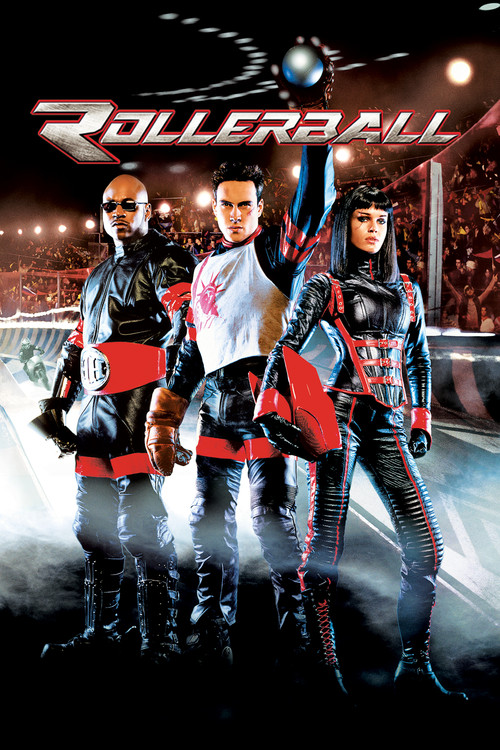
Rollerball (2002)
Directed by John McTiernan
No — Rollerball is not especially woke, scoring 26 out of 100 on our wokeness meter.
The 2002 remake of Rollerball arrives as a curious artifact, a film that gestures toward social commentary while tripping over its own roller skates.
Consciousness Markers
The plot centers on a corporate promoter who stages violent accidents to boost ratings and treats players as disposable commodities, culminating in a revolt against his control.
The cast includes LL Cool J, Naveen Andrews, and Rebecca Romijn in prominent roles, giving the film a moderately diverse ensemble for a 2002 action film, though the diversity is not framed as a social statement.
The film gestures at media manipulation and corporate exploitation but delivers its commentary through action rather than preachy dialogue.
No LGBTQ+ characters, themes, or subtext appear in the film.
Rebecca Romijn's Aurora is a capable athlete but functions primarily as a romantic interest and damsel in distress; the film offers no feminist critique or agenda.
The film features non-white actors but never engages with race, racism, or racial identity as a theme.
No environmental or climate-related themes are present.
No body-positivity themes or messaging.
No neurodivergent characters or themes.
The film is a fictional sci-fi sports story and does not revise or reinterpret historical events.
Why it received this score
The 2002 remake of Rollerball arrives as a curious artifact, a film that gestures toward social commentary while tripping over its own roller skates. Its ensemble includes LL Cool J, Naveen Andrews, and Rebecca Romijn in prominent roles, a modestly diverse lineup for a February action release. The film never frames this casting as a statement, and it never engages race as a theme. Rebecca Romijn's Aurora is a competent athlete, but the script consigns her to romantic interest and hostage, offering no feminist critique. The film has no interest in LGBTQ lives, environmental crisis, body positivity, neurodivergence, or revising history. It is a fictional future sport, and it stays there.
Where the film does show a pulse is in its contempt for corporate power. The promoter Alexi Petrovich orchestrates bloody accidents to boost ratings, treats players as disposable assets, and engineers a revolt when his stars try to quit. This is an eat-the-rich narrative, blunt and unsubtle, but present. The commentary on media manipulation and corporate exploitation is delivered through chases and crashes, not speeches, so the sermonizing remains at a low simmer. It plays as action-first satire, though the action is often incoherent. The film wants us to feel the exploitation, and it succeeds only in making us feel the runtime.
As a cultural document, Rollerball is a minor curiosity. It was a critical punching bag and a box office disaster, and its director later faced prison for wiretapping the producer. It removes the social critique of the 1975 original and replaces it with WWE-style spectacle. The result is a film with a faint anti-corporate streak and a mildly diverse cast, but no meaningful engagement with the progressive markers that define modern cultural consciousness. It is a vintage best left on the shelf, dusty and slightly embarrassing.
Analysis generated by our Consciousness Algorithm


Synopsis
In this fast action-packed thriller, Jonathan, Marcus, and Aurora compete in a dangerous, fierce sport called Rollerball. Although, Johnathan and Marcus try to quit, cruel and vindictive promoter Alexi Petrovich encourages them to still participate.
Questions about Rollerball
Is Rollerball woke?
No — Rollerball is not especially woke, scoring 26 out of 100 on our wokeness meter. That earns it a verdict of Based.
Does Rollerball have any woke elements?
2 of the 10 markers register at 30 or above, led by Eat the Rich (50) and Representation Casting (30). On Eat the Rich: The plot centers on a corporate promoter who stages violent accidents to boost ratings and treats players as disposable commodities, culminating in a revolt against his control.
How does Rollerball compare to other 2002 movies?
It ranks #18 of the 150 films from 2002 we've scored; their average is 12. The wokest is Far from Heaven (78).
How is the Woke Score calculated?
An AI-assisted process researches the film and its reception, scores it 0–100 on ten markers, then combines those into one 0–100 Woke Score. It measures a specific set of 2020s cultural themes, not film quality.