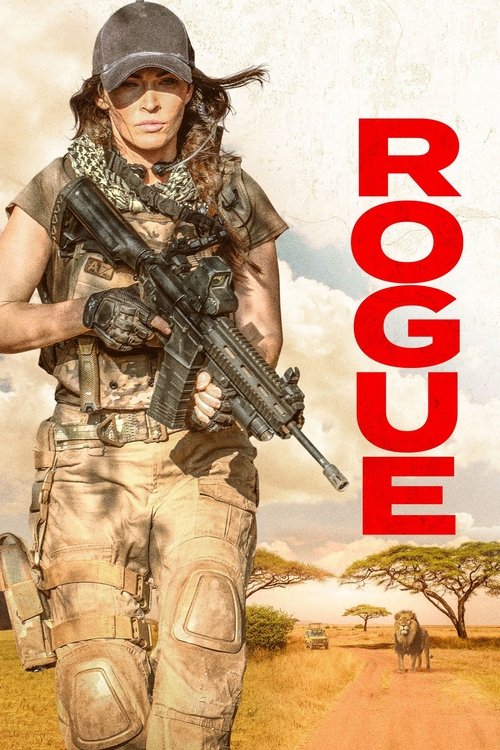
Rogue (2020)
Directed by MJ Bassett
No — Rogue is not woke, scoring 16 out of 100 on our wokeness meter.
Rogue arrives as a lean action exercise in which Megan Fox, playing the battle-hardened Samantha O'Hara, leads a multinational mercenary crew into the grasslands of East Africa to retrieve an abducted governor's daughter.
Consciousness Markers
The film features a female lead heading a multinational mercenary team, including Black African characters and a Masaai former jihadist. However, the diversity is largely functional to the action-ensemble setup rather than a self-conscious representational statement.
Megan Fox plays a battle-hardened female mercenary who leads the mission, and a teenage girl eventually fights back against her captor. The film is woman-directed and co-written with the director's daughter, but it does not advance an explicit feminist argument.
A postscript states the film is fictional and calls for an end to illegal lion farms in South Africa, giving the ending a mild moralizing aftertaste. Otherwise, the film prioritizes action over preaching.
The story is set in East Africa with Black characters and a former jihadist backstory, but it does not engage with racial injustice, systemic racism, or racial identity as a theme.
There are no LGBTQ+ characters, themes, or subtext in the film.
Although the film includes illegal lion farming and wildlife trafficking, it does not address climate change, environmental collapse, or ecological activism as a primary concern.
The villains are poachers and terrorists, and the postscript condemns illegal lion farms, but the film does not critique capitalism, wealth inequality, or class power in any meaningful way.
There is no body-positivity theme, fat acceptance message, or subversion of conventional beauty standards.
No characters are depicted with neurodivergence, and the film does not explore neurodiversity as a theme.
The film is explicitly fictional and does not attempt to revise or reinterpret historical events or figures.
Why it received this score
Rogue arrives as a lean action exercise in which Megan Fox, playing the battle-hardened Samantha O'Hara, leads a multinational mercenary crew into the grasslands of East Africa to retrieve an abducted governor's daughter. The ensemble is assembled with a certain globalist tidiness: Black African operators, a Masaai former jihadist, a Chinese-accented comrade. The picture does not pause to celebrate its own inclusiveness. These are bodies in a squad, positioned for gunfire and crocodile attacks, and the arrangement reads as casting convenience instead of a statement of values.
The film was directed by M. J. Bassett and co-written with her daughter, and its lead is a woman who outranks and outshoots everyone around her. A teenage captive eventually finds the nerve to kill one of her captors. None of this is argued for. The screenplay simply places these figures in the frame and lets the bullets do the talking. The African setting supplies a former al-Shabaab operative with a revenge arc and a backstory of slaughtered children, yet the film treats racial identity as scenery, not subject. There is no queer presence, no meditation on the body, no interest in neurodivergence, and no attempt to rewrite any historical record.
Where a lesser effort might have sermonized about poaching, Rogue saves its conscience for a closing card. That postscript announces the story is fiction and demands an end to South Africa's illegal lion farms. It lands as a mild scold after ninety minutes of mauling, and we can respect the gesture while noting how briefly it lingers. The villains are traffickers and terrorists, which leaves the class question untouched. The lioness, incidentally, is the most principled character on screen. She kills to protect her cubs and spares the heroine out of maternal courtesy. That is the film's entire moral architecture, and it is enough.
Analysis generated by our Consciousness Algorithm
Part of


Synopsis
Battle-hardened O’Hara leads a lively mercenary team of soldiers on a daring mission: rescue hostages from their captors in remote Africa. But as the mission goes awry and the team is stranded, O’Hara’s squad must face a bloody, brutal encounter with a gang of rebels.
Questions about Rogue
Is Rogue woke?
No — Rogue is not woke, scoring 16 out of 100 on our wokeness meter. That earns it a verdict of Ultra Based.
Does Rogue have any woke elements?
2 of the 10 markers register at 30 or above, led by Representation Casting (40) and Feminist Agenda (30). On Representation Casting: The film features a female lead heading a multinational mercenary team, including Black African characters and a Masaai former jihadist.
How does Rogue compare to other 2020 movies?
It ranks #100 of the 227 films from 2020 we've scored; their average is 21. The wokest is One Night in Miami... (83).
How is the Woke Score calculated?
An AI-assisted process researches the film and its reception, scores it 0–100 on ten markers, then combines those into one 0–100 Woke Score. It measures a specific set of 2020s cultural themes, not film quality.