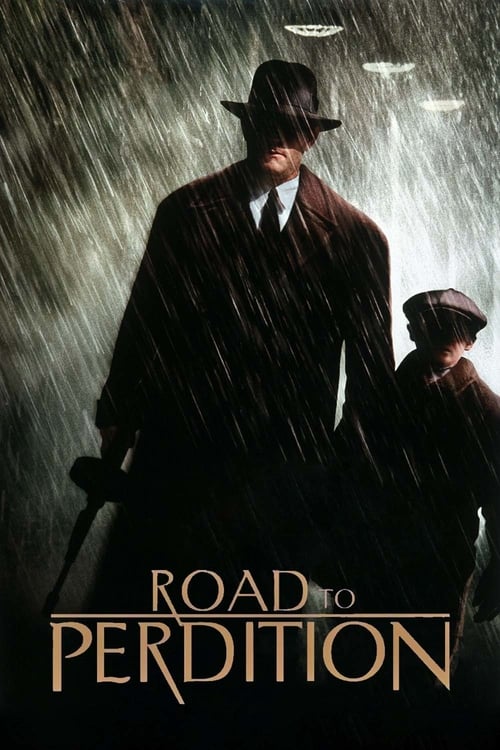
Road to Perdition (2002)
Directed by Sam Mendes
No — Road to Perdition is not woke, scoring 0 out of 100 on our wokeness meter.
Sam Mendes's Road to Perdition arrives from 2002, a Depression-era gangster elegy adapted from a DC graphic novel.
Consciousness Markers
The cast is almost entirely white and the story is set within Irish and Italian-American mob communities; there is no deliberate inclusive or color-conscious casting.
No LGBTQ+ characters, relationships, or themes appear.
Female characters are peripheral, chiefly the murdered wife and aunt; the film is a father-son crime drama with no feminist critique.
Race is not a thematic concern; the narrative focuses on ethnic mob rivalries and revenge.
No environmental or climate themes are present.
The Depression-era bank robberies are plot mechanics for revenge, not a critique of capitalism or wealth inequality.
No body-positivity themes or diverse body representation are present.
No neurodivergent characters or themes are present.
It is a fictionalized graphic-novel adaptation using period gangster figures, not a revisionist historical corrective.
The film is deliberately minimalist and elegiac, with no preachy or didactic messaging.
Why it received this score
Sam Mendes's Road to Perdition arrives from 2002, a Depression-era gangster elegy adapted from a DC graphic novel. Tom Hanks plays Michael Sullivan, a hit man with a conscience that operates mostly as silence. The film is beautiful in a cold, Hopper-ish way, all rain, dark suits, and Conrad Hall's shadows. It concerns fathers and sons, loyalty as a trap, and the cost of violence passed down. The plot is revenge, plain and simple, though the telling is patient and mournful.
For those of us who audit cinema for contemporary social instruction, this is a barren field. The cast is white, the mob is Irish and Italian, and the women are killed early or kept offscreen. Race is not a thesis, sexuality is not a subject, and the environment is weather, not a cause. The Depression exists as texture for bank robberies, not as an indictment of capital. No character pauses to educate the audience on body image, neurodivergence, or the correct way to feel. The film has no sermon in its pocket. It wants to be a tragedy, and it succeeds on those narrow terms.
Craft remains. Mendes strips dialogue down to near silence, lets faces and rooms carry the weight, and refuses to moralize. The result is a film that trusts viewers to sit with ambiguity. It is not socially progressive in the modern sense, and it does not pretend to be. It is a father-son story with guns, guilt, and a beach house at the end of the world. We can respect it for that. We can also note, with professional disappointment, that it offers no checklist for our times. It simply endures as a somber, well-made thing.
Analysis generated by our Consciousness Algorithm


Synopsis
Mike Sullivan works as a hit man for crime boss John Rooney. Sullivan views Rooney as a father figure, however after his son is witness to a killing, Mike Sullivan finds himself on the run in attempt to save the life of his son and at the same time looking for revenge on those who wronged him.
Questions about Road to Perdition
Is Road to Perdition woke?
No — Road to Perdition is not woke, scoring 0 out of 100 on our wokeness meter. That earns it a verdict of Ultra Based.
Does Road to Perdition have any woke elements?
No. All 10 markers score zero.
How does Road to Perdition compare to other 2002 movies?
It ranks #129 of the 150 films from 2002 we've scored; their average is 12. The wokest is Far from Heaven (78).
How is the Woke Score calculated?
An AI-assisted process researches the film and its reception, scores it 0–100 on ten markers, then combines those into one 0–100 Woke Score. It measures a specific set of 2020s cultural themes, not film quality.