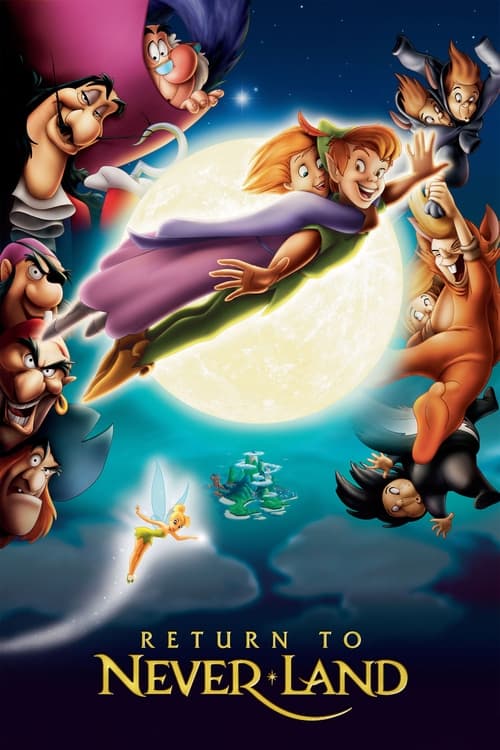
Return to Never Land (2002)
Directed by Robin Budd
No — Return to Never Land is not woke, scoring 8 out of 100 on our wokeness meter.
Return to Never Land arrives as a 2002 Disney sequel, a theatrical afterthought to a 1953 classic.
Consciousness Markers
Jane is a headstrong girl who becomes the first 'Lost Girl,' giving the film a modest girl-empowerment thread, but it is framed around belief and family rather than any explicit feminist argument.
The film carries a gentle 'believe in fairies/imagination' moral delivered through song and Jane's arc, but it is soft and child-directed rather than preachy.
A 2002 Disney animated sequel with a predominantly white British-coded voice cast; the only mild note is a female protagonist, but there is no deliberate diverse or inclusive casting.
The production quietly removed the Native American characters from the original film to avoid its racist caricatures, but the sequel itself contains no racial themes or commentary.
No LGBTQ+ characters, themes, or subtext of any kind appear in the film.
No environmental or climate themes are present in this Neverland adventure.
No critique of capitalism, wealth, or class appears; the pirates are simply villains.
The mermaids were given brassieres to reduce sexualization, but this is a modesty edit, not a body-positivity message.
No neurodivergent characters or themes are depicted.
The film is a straightforward sequel to a fantasy classic, not a reworking of historical events.
Why it received this score
Return to Never Land arrives as a 2002 Disney sequel, a theatrical afterthought to a 1953 classic. Its social consciousness is modest at best. Jane, Wendy's daughter, becomes the first Lost Girl, a girl-empowerment thread that registers as a gentle tug rather than a manifesto. The production quietly excised the Native American characters from the original, a preemptive edit that avoids caricature without offering commentary. This is omission as caution, not racial consciousness.
The film checks almost none of the modern boxes. No LGBTQ characters or themes. No climate crusade. No anti-capitalist sentiment (the pirates are simply villains). No body positivity, despite the mermaids being given brassieres to reduce sexualization, a modesty edit that says nothing about self-acceptance. No neurodivergence. No revisionist history. The lecture energy is low: a soft moral about believing in fairies, delivered through song and Jane's arc, aimed squarely at children. It preaches only in the way a bedtime story preaches.
What we have is a harmless retread, competently animated and utterly forgettable. It avoids offense by subtraction, not by adding progressive signifiers. The result is a film that scores near zero on the cultural barometer, a relic of a gentler era of children's entertainment. We note this without judgment, only the fatigue of a critic who has seen the checklist and found it empty.
Analysis generated by our Consciousness Algorithm
Part of


Synopsis
In 1940, the world is besieged by World War II. Wendy, all grown up, has two children; including Jane, who does not believe Wendy's stories about Peter Pan.
Questions about Return to Never Land
Is Return to Never Land woke?
No — Return to Never Land is not woke, scoring 8 out of 100 on our wokeness meter. That earns it a verdict of Ultra Based.
Does Return to Never Land have any woke elements?
Very few. None of the 10 markers reaches 30, the level where a marker counts as present; the highest is Feminist Agenda at 20.
How does Return to Never Land compare to other 2002 movies?
It ranks #75 of the 150 films from 2002 we've scored; their average is 12. The wokest is Far from Heaven (78).
How is the Woke Score calculated?
An AI-assisted process researches the film and its reception, scores it 0–100 on ten markers, then combines those into one 0–100 Woke Score. It measures a specific set of 2020s cultural themes, not film quality.