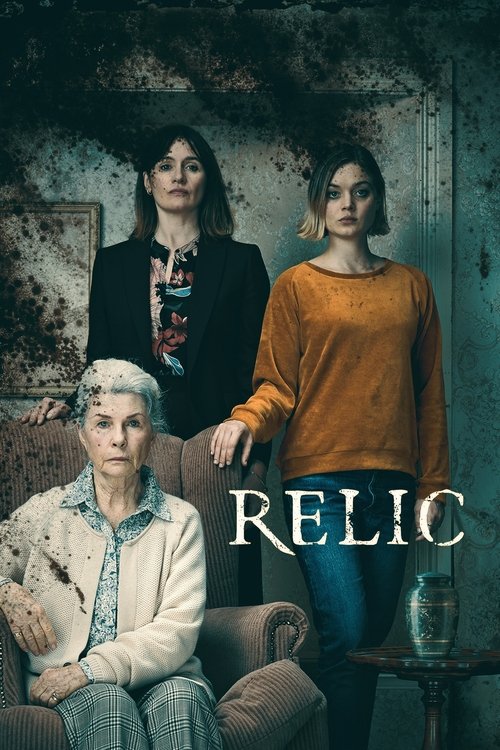
Relic (2020)
Directed by Natalie Erika James
No — Relic is not especially woke, scoring 23 out of 100 on our wokeness meter.
Relic arrives with a premise that could have been assembled in a laboratory for the current cultural moment: a woman director, three generations of women, and dementia as the central subject, treated with empathy and from the sufferer's own disoriented vantage.
Consciousness Markers
Directed by a woman (Natalie Erika James) and centered on three generations of women — grandmother, mother, and granddaughter — whose relationships and experiences drive the entire narrative.
The cast is largely white, but the film notably casts Chris Bunton, an actor with Down syndrome, as Jamie, providing genuine disability representation in a supporting role.
The film's central subject is dementia/Alzheimer's, a neurological condition portrayed with empathy and from the sufferer's disorienting perspective, though it is a degenerative disease rather than developmental neurodivergence.
The film is an atmospheric, dread-driven horror piece that shows rather than tells, with no preachy or didactic messaging.
There are no LGBTQ+ characters, relationships, or themes anywhere in the film.
The film has no engagement with race or racial themes; the story is a domestic horror about a white family.
No environmental or climate themes are present.
No economic or class-based critique; the film is a psychological horror about illness and family.
The film depicts bodily decay and aging as horror rather than promoting body acceptance; it is body horror, not body positivity.
No historical revisionism; the film is a contemporary fictional horror story.
Why it received this score
Relic arrives with a premise that could have been assembled in a laboratory for the current cultural moment: a woman director, three generations of women, and dementia as the central subject, treated with empathy and from the sufferer's own disoriented vantage. The film, however, declines to announce its virtues. Natalie Erika James builds dread from ordinary conversation, a creaking wall, a post-it note reading I AM LOVED, and lets the audience do the moral arithmetic unassisted. Robyn Nevin's Edna is not a symbol of anything. She is a woman losing her house, her memories, and eventually her face, and the camera regards her with patience instead of pity.
The casting of Chris Bunton, an actor with Down syndrome, as the neighbor Jamie is the sort of choice a lesser production would have underlined with a speech. Here it passes without comment, which is either admirable restraint or a missed opportunity, depending on the viewer's appetite for commentary. The film's attention to a woman's bodily decay is body horror, not body acceptance. The mould creeping through the walls is not a metaphor for self-love.
Instead of a message, the film offers craft. The corridors loop, the ceilings descend, and we crawl along with Sam into the dark. There is no sermon here, no moment when a character turns to the camera to explain the theme. It is a horror film about watching a parent disappear, and it trusts that this is horror enough. The restraint is almost old-fashioned. In the present climate that reads as either confidence or cowardice, and the film is too well made to settle the question.
Analysis generated by our Consciousness Algorithm


Synopsis
When elderly mother Edna inexplicably vanishes, her daughter rushes to the family's decaying home, finding clues of her increasing dementia scattered around the house in her absence.
Questions about Relic
Is Relic woke?
No — Relic is not especially woke, scoring 23 out of 100 on our wokeness meter. That earns it a verdict of Based.
Does Relic have any woke elements?
3 of the 10 markers register at 30 or above, led by Feminist Agenda (40), Representation Casting (35) and Neurodivergence (30). On Feminist Agenda: Directed by a woman (Natalie Erika James) and centered on three generations of women — grandmother, mother, and granddaughter — whose relationships and experiences drive the entire narrative.
How does Relic compare to other 2020 movies?
It ranks #71 of the 227 films from 2020 we've scored; their average is 21. The wokest is One Night in Miami... (83).
How is the Woke Score calculated?
An AI-assisted process researches the film and its reception, scores it 0–100 on ten markers, then combines those into one 0–100 Woke Score. It measures a specific set of 2020s cultural themes, not film quality.