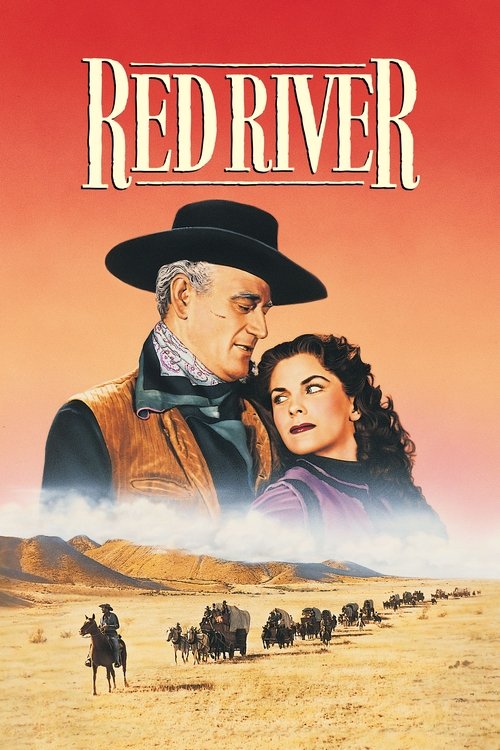
Red River (1948)
Directed by Howard Hawks
No — Red River is not woke, scoring 5 out of 100 on our wokeness meter.
Red River arrives from 1948 with the confidence of a picture that knows exactly what it is: a cattle drive, a stubborn patriarch, and a surrogate son who learns to say no.
Consciousness Markers
Joanne Dru's Tess Millay is given unusual agency for 1948 — she negotiates with Dunson, demands to accompany him, and ultimately halts the climactic brawl at gunpoint. A proto-feminist flourish, but framed entirely within a male-driven Western.
The cast is almost entirely white, with Native American actors (e.g., Chief Yowlachie) relegated to uncredited, stereotypical 'Comanche raider' antagonist roles. No meaningful representation casting.
No LGBTQ+ characters, subtext, or themes of any kind.
Native Americans appear only as anonymous attacking 'Indians' to be fought off; no racial consciousness or critique of the era's racial order.
No environmental or climate themes whatsoever; the land is a resource to be driven across.
The plot is a straightforward capitalist enterprise — driving cattle to market for the best price. No critique of wealth or class.
No body positivity themes present.
No neurodivergence themes present.
A fictionalized account of the first Chisholm Trail drive, but it makes no revisionist historical argument in the modern sense.
The film tells its story through action and character conflict rather than moral instruction; no preaching or messaging.
Why it received this score
Red River arrives from 1948 with the confidence of a picture that knows exactly what it is: a cattle drive, a stubborn patriarch, and a surrogate son who learns to say no. Howard Hawks keeps the camera on the herd and the men who move it, and the film earns its standing through dust, hunger, and the slow corrosion of authority. For our purposes it is a clean specimen, a Western that predates nearly every cultural marker we now track and shows little interest in acquiring them retroactively.
The cast is white to a man, with Native American performers such as Chief Yowlachie consigned to uncredited roles as anonymous Comanche raiders who exist to be shot. That is representation in name only, a rounding error more than a statement. Joanne Dru's Tess Millay fares slightly better. She bargains with Dunson, demands a place on his pursuit, and finally halts a fistfight by aiming a gun at two grown men. It is a genuine flicker of agency inside a story built entirely around male grievance, though it flickers briefly and within strict bounds.
The remaining dials sit at zero, and they sit there honestly. The land is a resource, the drive is a business, and the goal is the best price at the railhead, which leaves no room for ecological anxiety or class critique. There is no body positivity, no neurodivergence, no reckoning with the racial order of 1851, and no revisionist argument about the West. Most tellingly, the film never lectures. It argues through stampedes and gunfire. A viewer may leave unimproved, but at least un-sermonized.
{"thematic_tags": []}}
Analysis generated by our Consciousness Algorithm


Synopsis
Following the Civil War, headstrong rancher Thomas Dunson decides to lead a perilous cattle drive from Texas to Missouri. During the exhausting journey, his persistence becomes tyrannical in the eyes of Matthew Garth, his adopted son and protégé.
Questions about Red River
Is Red River woke?
No — Red River is not woke, scoring 5 out of 100 on our wokeness meter. That earns it a verdict of Ultra Based.
Does Red River have any woke elements?
Very few. None of the 10 markers reaches 30, the level where a marker counts as present; the highest is Feminist Agenda at 15.
How does Red River compare to other 1948 movies?
It ranks #2 of the 10 films from 1948 we've scored; their average is 4. The wokest is Key Largo (7).
How is the Woke Score calculated?
An AI-assisted process researches the film and its reception, scores it 0–100 on ten markers, then combines those into one 0–100 Woke Score. It measures a specific set of 2020s cultural themes, not film quality.