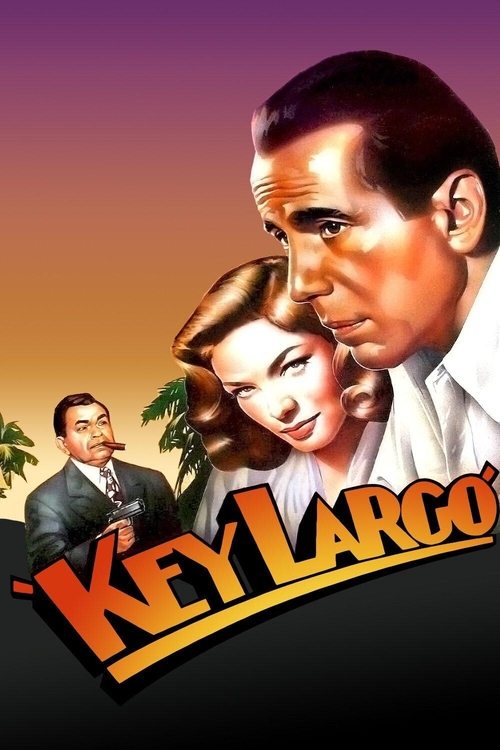
Key Largo (1948)
Directed by John Huston
No — Key Largo is not woke, scoring 7 out of 100 on our wokeness meter.
John Huston's Key Largo arrives from 1948, a year when a hurricane could still be simply a hurricane.
Consciousness Markers
Frank McCloud delivers moralizing speeches about heroism versus self-preservation, and reviewers flagged the film's 'overtones of soapboxing on a better world,' though the sermonizing stays subordinate to the thriller plot.
The Seminole characters and the Osceola brothers are framed and killed for a murder they did not commit, which carries an implicit note of racial injustice, but it functions as plot machinery rather than conscious racial commentary.
Huston intended the gangsters to embody the rot of post-war America, and critics noted 'soapboxing on a better world,' but the target is moral decay and corruption rather than capitalism or class.
The cast is overwhelmingly white, though the Osceola brothers are played by actual Native American actors Jay Silverheels and Rodd Redwing in uncredited roles — natural period casting rather than any modern representational intent.
Nora Temple is a standard widowed love interest and Gaye Dawn is a victimized, humiliated moll; the women exist to be protected or pitied, with no feminist agency or critique.
No LGBTQ+ characters, themes, or subtext of any kind appear in this 1948 noir.
The hurricane is atmospheric pressure for the hostage drama, not an environmental statement of any kind.
No body-positivity themes; the film's treatment of Gaye's alcoholism is one of degradation, not acceptance.
No neurodivergent characters or themes are present.
Adapted from a stage play, not from history, and it makes no revisionist historical claims.
Why it received this score
John Huston's Key Largo arrives from 1948, a year when a hurricane could still be simply a hurricane. The Hotel Largo fills with humidity, hostage tension, and Edward G. Robinson's Johnny Rocco, and the picture settles into a chamber piece about men deciding whether courage is worth the cost. Claire Trevor took home a supporting actress Oscar for a single a cappella number, which remains one of the more efficient awards campaigns on record. The film is adapted from Maxwell Anderson's stage play, and it carries the talkiness of its source.
The cast is a wall of white faces, with Jay Silverheels and Rodd Redwing appearing uncredited as the Osceola brothers, Seminole men framed for a murder they did not commit and shot by a sheriff before the third act resolves. The injustice sits there, unexamined, serving the plot the way the storm serves the set dressing. Nora Temple exists to be protected and then to marry the hero's memory. Gaye Dawn exists to be degraded for our entertainment and then to hand over a gun. The film has no interest in either woman beyond their utility. The hurricane is barometric, not ecological.
Frank McCloud does climb a soapbox. He lectures the room on self-preservation, insists that one Rocco more or less is not worth dying for, and then spends the climax proving the opposite. Variety called it soapboxing on a better world, and the sermon is real, though it never displaces the gunplay. Huston aimed his gangsters at the rot of post-war America, which is a moral target, not an economic one. The result is a taut, well-made thriller with a faint pulpit smell. Measured against modern social consciousness, it registers as a period piece, and a quiet one.
Analysis generated by our Consciousness Algorithm
Part of


Synopsis
A hurricane swells outside, but it's nothing compared to the storm within the hotel at Key Largo. There, sadistic mobster Johnny Rocco holes up - and holds at gunpoint hotel owner James Temple, his widowed daughter-in-law Nora, and ex-GI Frank McCloud.
Questions about Key Largo
Is Key Largo woke?
No — Key Largo is not woke, scoring 7 out of 100 on our wokeness meter. That earns it a verdict of Ultra Based.
Does Key Largo have any woke elements?
Very few. None of the 10 markers reaches 30, the level where a marker counts as present; the highest is Lecture Energy at 18.
How does Key Largo compare to other 1948 movies?
It is the wokest of the 10 films from 1948 we've scored; their average is 4.
How is the Woke Score calculated?
An AI-assisted process researches the film and its reception, scores it 0–100 on ten markers, then combines those into one 0–100 Woke Score. It measures a specific set of 2020s cultural themes, not film quality.